
Bitcoin Whale Dynamics and Price Action: A Signal of Distribution or Accumulation?
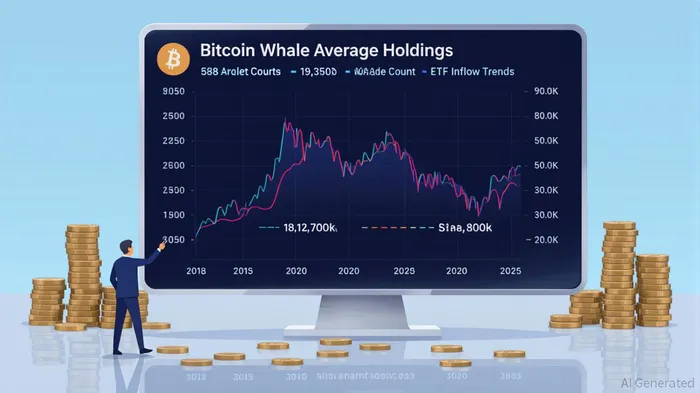
Bitcoin’s on-chain dynamics in Q3 2025 reveal a paradox: while average whale holdings have plummeted to 488 BTC—the lowest since December 2018—this decline coincides with a record 19,130 whale addresses, suggesting a nuanced shift in market behavior. This divergence raises critical questions: Is this a bearish distribution phase, or does it reflect healthier supply dispersion and growing institutional confidence?
The Whale Conundrum: Smaller Holdings, More Addresses
According to data from Mitrade and Coinstats, the average BitcoinBTC-- whale holding size has dropped to 488 BTC as of September 2025 [1][3]. This decline contrasts with the 10,000+ BTC “ultra-whale” addresses, which have seen reduced activity, while smaller whale addresses (1,000–10,000 BTC) have proliferated. This fragmentation could indicate profit-taking after Bitcoin’s 2024–2025 rally to $124,000, with whales breaking up large holdings to diversify risk or capitalize on liquidity [3].
However, the record 19,130 whale addresses suggest a broader narrative of accumulation. More addresses holding significant BTC implies a decentralization of ownership, reducing the market’s reliance on a few large players. This aligns with historical patterns where whale address growth precedes bullish cycles, as seen in 2019 and 2021 [4].
Exchange Inflows and Wallet Distribution: A Mixed Bag
Bitcoin’s exchange inflows have cooled sharply. The 14-day average of net inflows into U.S. spot Bitcoin ETFs fell to 540 BTC/day in September 2025, down from peaks above 3,000 BTC/day in April [1]. This slowdown mirrors broader weakening demand as Bitcoin consolidates between $104k–$116k. Glassnode’s UTXO Realized Price Distribution data shows accumulation in this range, but it’s offset by widespread distribution across all wallet cohorts, including large holders (>10,000 BTC) and small wallets (<1 BTC) [1].
The Accumulation Trend Score (ATS) dropped to 0.26 in late August, remaining below the 0.5 threshold for days—a clear signal of distribution [1]. This aligns with typical post-ATH behavior, where investors take profits after a rally. Yet, the persistence of 19,130 whale addresses suggests that while some whales are selling, others are accumulating smaller positions, potentially building for a long-term bullish thesis.
Derivatives Positioning: Institutional Caution vs. Altcoin Migration
Bitcoin’s derivatives market tells a story of institutional caution. Open interest in BTC derivatives reached $41.19 billion on September 3, 2025, but this growth didn’t translate to higher prices [2]. Positive funding rates (1.73% daily) indicate longs paying fees to hold positions in a weak environment, while net taker flow turned negative (-$9.81 billion in a month), signaling bearish conviction [2].
Meanwhile, institutional capital is shifting toward EthereumETH--. Ethereum’s derivatives open interest hit $10 billion in Q3 2025, outpacing Bitcoin’s stagnant $12 billion [6]. This migration is driven by Ethereum’s 4.5–5.2% staking yields, regulatory clarity, and upgrades like Dencun and Pectra, which enhance scalability and infrastructure appeal [1]. Bitcoin ETFs faced $751 million in outflows in August 2025, while Ethereum ETFs attracted $3.69 billion in the same period [6].
Bearish Distribution or Healthier Dispersion?
The data points to a hybrid scenario. On one hand, the ATSATS-- below 0.5, negative net taker flow, and ETF outflows suggest bearish distribution. On the other, the record number of whale addresses and Ethereum’s institutional gains indicate a healthier, more decentralized supply chain.
Historically, September has been a weak month for Bitcoin, averaging a 4.6% loss since 2011 [3]. However, the Federal Reserve’s 90% chance of a rate cut in September 2025 could counteract this seasonal weakness, fostering risk-on sentiment [5]. If Bitcoin stabilizes above $100,000, the current consolidation could set up a rebound. Below this level, however, further selling pressure is likely.
Investment Implications
For investors, the key takeaway is to balance caution with opportunity. Short-term volatility is probable, given the mixed derivatives signals and seasonal headwinds. However, the long-term fundamentals—Bitcoin’s role as a macro hedge and Ethereum’s yield-driven appeal—remain intact.
- Bearish Play: Short Bitcoin futures if the $100k support breaks, leveraging the negative net taker flow and ETF outflows.
- Bullish Play: Accumulate Bitcoin in the $104k–$116k range, where UTXO Realized Price Distribution suggests buying interest.
- Altcoin Rotation: Allocate capital to Ethereum-based products, capitalizing on its derivatives surge and staking yields.
In conclusion, Bitcoin’s whale dynamics and derivatives positioning reflect a market in transition. While distribution is evident, the broader shift toward decentralization and Ethereum’s institutional adoption could signal a healthier, more resilient ecosystem. Investors must navigate this duality with a mix of technical analysis and macroeconomic awareness.
Source:
[1] Accumulating in the GapGAP-- [https://insights.glassnode.com/the-week-onchain-week-35-2025/]
[2] Something unusual is building in $9.81 billion of Bitcoin futures flows and it could break either way [https://cryptorank.io/news/feed/aeb68-something-unusual-is-building-in-9-81-billion-of-bitcoin-futures-flows-and-it-could-break-either-way]
[3] September Weakness Could Drag BTC Below $100K [https://www.mexc.com/news/september-weakness-could-drag-btc-below-100k/84681]
[4] Bitcoin Surpasses 110000 USDT as Whale Confidence ... [https://thecurrencyanalytics.com/bitcoin/bitcoin-crosses-110000-usdt-as-market-shows-signs-of-stability-194194]
[5] Bitcoin Price Forecast: BTC recovers as 90% chance of Fed rate cut boosts risk-on sentiment [https://www.mitrade.com/insights/news/live-news/article-3-1091924-20250903]
[6] Ethereum's Derivatives Surge: A New Institutional Bull [https://www.bitget.com/news/detail/12560604937298]







Comentarios
Aún no hay comentarios