
Bitcoin's Whale-Driven Volatility: A Double-Edged Sword for Short Positions?
Bitcoin's market dynamics in 2025 have been a rollercoaster, with whale activity serving as both a catalyst for chaos and a signal of long-term conviction. The interplay between large-scale sell-offs, accumulation trends, and institutional behavior has created a volatile environment where short positions are increasingly at risk.
The October 2025 Whale Transaction: A Volatility Catalyst
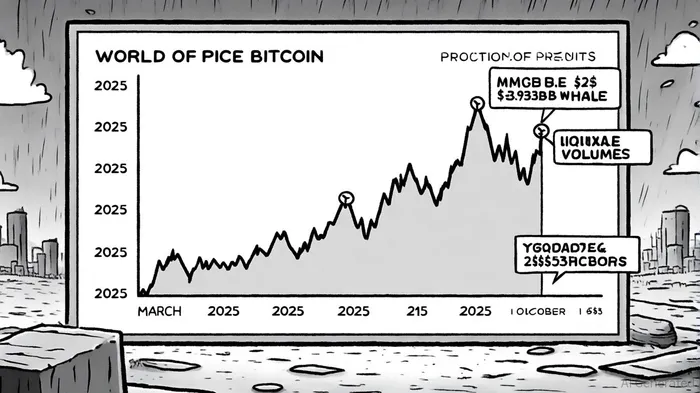
In October 2025, a single BitcoinBTC-- whale transaction-32,322 BTC, valued at $3.93 billion-triggered a 4% price drop, sending Bitcoin's value from $126,192 to $120,000, according to a FinancialContent report. This abrupt sell-off led to $620 million in liquidations, primarily targeting leveraged long positions. The event exemplifies the "leverage flush" phenomenon, where large whale movements create cascading liquidation effects, amplifying short-term volatility. According to a FinancialContent report, the transaction originated from long-dormant wallets, suggesting a strategic profit-taking move by institutional actors.
Accumulation Trends: A Bullish Undercurrent
Contrast this with the broader trend of whale accumulation. Since late March 2025, large holders have added over 53,600 BTC to their portfolios, controlling approximately 67.77% of Bitcoin's total supply, according to an OnTheNode analysis. Daily additions of over 1,000 BTC underscored confidence in Bitcoin's long-term value proposition. This accumulation, despite market corrections, signals a shift toward "HODL" behavior among whales, who appear to view volatility as an opportunity to accumulate at lower prices.
Institutional Behavior and ETF Inflows: Mixed Signals
While whale activity has been mixed, institutional sentiment has also diverged. A decline in institutional purchasing activity and increased whale deposits to exchanges in October 2025 raised concerns about bearish sentiment, as noted in a OneSafe post. However, U.S. Bitcoin ETFs like BlackRock's IBIT recorded substantial inflows, indicating ongoing institutional interest despite market corrections, according to a Crowdfund Insider analysis. This duality-retail and institutional actors responding differently to volatility-highlights the complexity of interpreting whale-driven market signals.
Implications for Short Positions
The October 2025 sell-off underscores the risks of short positions in a market dominated by whale activity. When large holders move significant BTC to exchanges-such as the 26.74 BTC transfer in October 2025 reported by OneSafe-it often triggers panic selling and margin calls. For traders, this means short-term volatility is not just a function of macroeconomic factors but also of opaque whale behavior. The "leverage flush" effect, as seen in October, can erase months of gains in hours, particularly for leveraged positions.
Conclusion: Navigating the Whale Factor
Bitcoin's 2025 volatility is a double-edged sword. While whale accumulation suggests long-term bullishness, sudden large-scale sell-offs expose the fragility of leveraged positions. Investors must balance these signals, recognizing that whale activity is both a risk and an opportunity. For short sellers, the lesson is clear: in a market where 67.77% of Bitcoin is controlled by whales, liquidity can evaporate overnight.






Comentarios
Aún no hay comentarios