
Bitcoin Whale Activity and Market Direction: What Easing Selling Pressure Means for BTC's Next Move
Bitcoin's price action in 2025 has been a rollercoaster, driven by a tug-of-war between institutional accumulation and whale-driven volatility. Recent on-chain analytics reveal a critical shift: whale selling pressure is easing, a development that could signal a turning point for Bitcoin's short- to medium-term trajectory. Let's break down what this means for investors.
Whale Activity: From Panic to Prudence
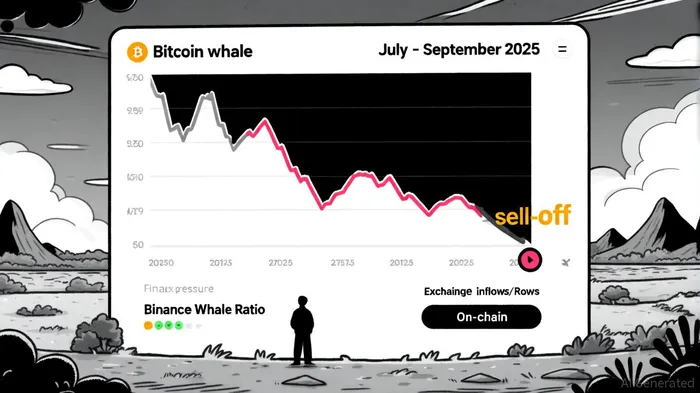
Bitcoin whales—wallets holding 1,000+ BTC—have historically acted as both market stabilizers and disruptors. In September 2025, a massive 115,000 BTC ($12.7 billion) was offloaded in a single month, marking the largest distribution since July 2022 [1]. This triggered a sharp pullback, pushing BTC below $108,000 in late August. However, recent data shows a moderation in whale behavior. By September 6, weekly outflows had dropped to 38,000 BTC, and the Binance Whale Ratio—a metric tracking large investor inflows—plummeted from 0.55 to 0.28 in just two days, signaling reduced bearish momentum [2].
This easing of selling pressure coincides with BitcoinBTC-- trading in a narrow range between $111,700 and $112,000. While some analysts warn of a potential breakdown below $112,000 support [3], others argue that institutional-grade strategies are tempering panic. For instance, corporate treasuries now hold 951,000 BTC ($100 billion), with BlackRock's IBITIBIT-- ETF surpassing MicroStrategy in holdings [4]. These long-term holders are less sensitive to short-term volatility, creating a floor for price declines.
On-Chain Metrics: A Healthy Correction, Not a Cycle Top
Bitcoin's on-chain fundamentals tell a nuanced story. The Network Value to Transactions (NVT) ratio remains below 50, indicating undervaluation relative to network activity [5]. Meanwhile, the Market Value to Realized Value (MVRV) ratio has not approached the 3.6 threshold typically seen at market peaks [5]. These metrics suggest the market is in a healthy correction rather than a euphoric overbought phase.
Miner behavior further supports this view. Unlike past cycle tops, miner reserves have remained stable at 1.805 million BTC, with minimal outflows [5]. Additionally, the Adjusted Spent Output Profit Ratio (aSOPR)—a gauge of realized profits—has not spiked, signaling that long-term holders are not aggressively cashing out [5].
Macro Factors: Fed Policy and Institutional Tailwinds
While on-chain data is encouraging, macroeconomic forces remain pivotal. The Federal Reserve's September 17 rate decision could inject liquidity into risk assets if a 50-basis-point cut materializes [2]. Historically, Bitcoin has rallied on Fed dovishness, and this cycle is no different. Pseudonymous analyst Mr. Wall Street predicts a FOMO-driven rebound to $140,000–$145,000 in the short term, with a potential $200,000 target by Q4 2025 if the Fed pivots aggressively [5].
Institutional adoption also provides a tailwind. ETF inflows, particularly in the U.S., have stabilized despite retail caution [2]. BlackRock's IBIT and other ETFs continue to accumulate BTC, reinforcing demand even as whales rotate capital into altcoins like EthereumETH-- [5]. This structural demand contrasts with the speculative retail-driven flows that amplify short-term volatility [4].
Technical Outlook: Key Levels to Watch
Bitcoin's price action is now hinged on critical support and resistance levels. The $112,000 support has held strong, with buyers stepping in to absorb downward pressure [5]. A sustained break above $113,000 could reignite bullish momentum, targeting $120,000—a level endorsed by JPMorganJPM-- and others [5]. Conversely, a breakdown below $112,000 risks a retest of $108,000, with further downside to $100,000 if macro sentiment deteriorates [2].
Conclusion: A Window of Opportunity
The easing of whale selling pressure, combined with resilient on-chain metrics and institutional demand, suggests Bitcoin is navigating a correction rather than a bear market. While short-term volatility remains a risk—particularly with September historically averaging a 4.68% loss since 2010 [2]—the long-term fundamentals are intact. Investors should monitor the Fed's policy pivot, ETF inflows, and key support levels to position for potential upside.
For now, the market appears to be in a “wait-and-see” phase. But history shows that Bitcoin's cycles are defined by volatility, not panic. As the saying goes: “The trend is your friend.”





Comentarios
Aún no hay comentarios