
Bitcoin's Weak Recovery and Its Implications for Altcoins in 2025
Bitcoin's Bearish Market Structure: A Tale of Failed Rallies and Dwindling Volume
Bitcoin's October 2025 correction-a 15% drop to $108,982 after hitting $126,272-exposed deep structural weaknesses in its market. The collapse was driven by aggressive deleveraging and the unwinding of leveraged positions, wiping out $19 billion in liquidated capital and affecting 1.6 million traders, according to a Coinotag analysis. Despite stabilizing in the low-$110K range, BitcoinBTC-- has shown little conviction. Key support levels at $108,000–$110,000 have held, but attempts to reclaim $115,000–$116,000 have fizzled, with volume failing to confirm bullish momentum, as noted in a Phemex report.
On-chain data paints a grim picture. Large holders (whales) have been net sellers, offloading BTCBTC-- to exchanges at an accelerated pace. For example, the Winklevoss twins alone have sold over 9,000 BTC ($900 million) since early 2025, according to a Bitzo analysis. Meanwhile, institutional ETFs like Fidelity's FBTC saw $256 million in outflows on November 7, signaling a shift in investor sentiment, according to the Bitzo analysis. Technical indicators like RSI and MACD suggest a potential bottom is forming, but without a surge in volume at the edges of Bitcoin's trading range, a breakout remains unlikely, as noted in the Phemex report.
The bearish narrative is further reinforced by Bitcoin's inability to sustain rallies. A brief push to $114,000 in mid-November was quickly reversed, with price now trading near $101,966, according to the Bitzo analysis. Analysts warn that without a clear break above $115,000, Bitcoin risks a prolonged consolidation phase-or worse, a breakdown below $100,000, according to the Phemex report.

Altcoins: The Casualties of Bitcoin's Weakness
Altcoins have fared even worse. During Bitcoin's October–November corrections, EthereumETH-- (ETH) fell 27%, SolanaSOL-- (SOL) 32%, XRPXRP-- 26%, and DogecoinDOGE-- (DOGE) 36%, according to an Amberdata report. Smaller tokens saw losses exceeding 20%, with trading volumes spiking during the sell-off-a classic sign of panic-driven liquidations, according to the Amberdata report. This underperformance highlights a critical trend: investors are fleeing altcoins for Bitcoin during downturns, treating BTC as a relative "safe haven" within crypto.
The October 10 crash-a $19.13 billion liquidation event-exacerbated this flight to quality. Long positions were disproportionately hit, with a 5:1 long-to-short liquidation ratio, according to the Amberdata report. Altcoins, already more leveraged and speculative, bore the brunt of this systemic risk. For instance, Solana's U.S. spot ETFs, which had attracted $2.1 billion in inflows over nine weeks, saw outflows during the crash as investors rotated to cash, according to an Investor Empires piece.
Regulatory uncertainty has compounded the bearish pressure. The U.S. Senate's crypto market structure bill, while aiming to clarify Bitcoin's commodity status, has introduced compliance burdens for altcoin projects. Smaller exchanges like OKX TR have responded by delisting low-volume altcoins (e.g., BAL, PERP) to preserve liquidity, according to an OKX TR announcement. This "pruning" of the altcoin ecosystem suggests a long-term shift toward institutional-grade assets, leaving speculative tokens vulnerable to further underperformance.
The Path Forward: What Bitcoin's Weakness Means for Altcoins
Bitcoin's weak recovery has created a paradox: altcoins are both beneficiaries and victims of BTC's struggles. On one hand, Bitcoin's stabilization in the $108K–$110K range has allowed some altcoins to recover, with Solana and XRP attracting institutional inflows via ETFs, according to the Investor Empires piece. On the other hand, Bitcoin's inability to break higher has limited the broader market's upside potential.
For altcoins, the key challenge lies in capitalizing on Bitcoin's consolidation. If BTC remains range-bound, altcoins may see modest gains as investors rotate into higher-yield opportunities. However, this scenario hinges on Bitcoin's dominance dropping further (currently at 59%) and macroeconomic conditions improving, according to the Investor Empires piece. Conversely, a breakdown below $100,000 could trigger a cascading selloff across the board, with altcoins facing even steeper declines.
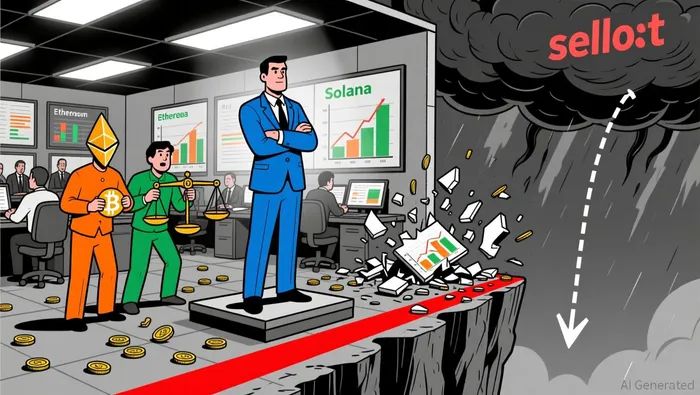
Conclusion: A Market in Transition
Bitcoin's weak recovery in 2025 is not just a technical issue-it's a symptom of deeper structural shifts. Regulatory clarity, institutional adoption, and macroeconomic headwinds are reshaping the crypto landscape, with altcoins caught in the crossfire. For investors, the lesson is clear: Bitcoin's market structure and volume trends are inextricably linked to altcoin performance. Until BTC can break out of its range with sustained volume, altcoins will remain at the mercy of a bearish undercurrent.






Comentarios
Aún no hay comentarios