
Bitcoin's Vulnerability to Macro Shocks Below $100,000: A Deep Dive into Systemic Risks and Investor Behavior
Bitcoin, often dubbed “digital gold,” has long been marketed as a hedge against macroeconomic instability. Yet its price history tells a different story: a volatile asset deeply entangled with traditional financial systems. As Bitcoin's price has repeatedly dipped below $100,000 in 2025, the interplay between macroeconomic shocks and investor behavior has become a critical lens for understanding its systemic risks. This analysis unpacks how inflation, interest rates, geopolitical tensions, and market psychology converge to shape Bitcoin's trajectory—and what this means for investors.
Historical Precedents: When BitcoinBTC-- Crashed Below $100,000
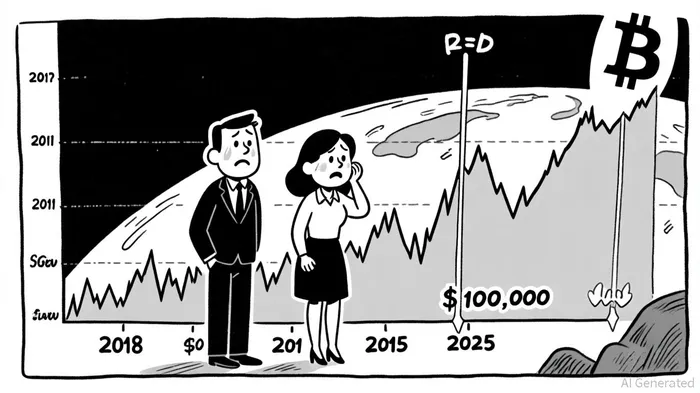
Bitcoin's price has historically been a barometer for macroeconomic stress. The 2018 “crypto winter,” triggered by the Mt. Gox exchange collapse, saw Bitcoin plummet from $20,000 to $3,200—a 80% drop—amid regulatory crackdowns and loss of institutional trust [1]. Fast-forward to 2025, and the narrative has shifted. The approval of Bitcoin ETFs in 2024 briefly pushed prices to $109,000, but the subsequent retreat below $100,000 in early 2025 was driven by a cocktail of factors: Trump's 25% tariffs on Canadian and Mexican imports, the rise of low-cost AI apps like DeepSeek, and a Fed policy pivot that spooked risk-on markets [2].
These events underscore a key insight: Bitcoin's price is not immune to macroeconomic forces. While its fixed supply model theoretically insulates it from inflation, in practice, it behaves like a risk asset. For example, during the 2022 Fed rate hikes, Bitcoin fell from $60,000 to $30,000 as investors flocked to higher-yielding bonds [3]. Similarly, in 2025, the fear of a Trump-era regulatory crackdown and inflationary pressures triggered a 25% plunge in Bitcoin's price [4].
Macroeconomic Levers: Inflation, Rates, and Geopolitical Tensions
Bitcoin's price sensitivity to macroeconomic variables is now well-documented. Inflation, for instance, has a dual effect. On one hand, Bitcoin's scarcity makes it a natural hedge against fiat devaluation. On the other, high inflation often coincides with rising interest rates, which dampen demand for speculative assets. The 2022 bear market exemplifies this: as the Fed raised rates to combat inflation, Bitcoin's price fell in lockstep with equities [5].
Interest rates, meanwhile, act as a liquidity valve. When the Fed signals rate cuts, Bitcoin often rallies. In 2025, anticipation of rate easing briefly buoyed prices, but the market quickly soured as inflation data outpaced expectations [6]. Geopolitical risks further complicate the equation. The 2025 sell-off, for instance, was exacerbated by fears of a Middle East conflict and Trump's protectionist policies, which triggered a “risk-off” flight to cash [7].
Investor Behavior: Panic, Leverage, and On-Chain Signals
Bitcoin's price swings are not just about macroeconomic fundamentals—they're also a reflection of investor psychology. In 2025, the Fear and Greed Index dipped into the “Fear” zone as Bitcoin stalled below $100,000, with retail traders dumping positions amid geopolitical jitters [8]. This panic was amplified by leveraged trading: on September 21, 2025, $1.5 billion in long positions were liquidated, accelerating the sell-off [9].
On-chain metrics reveal deeper patterns. The Adjusted Spent Output Profit Ratio (SOPR) and Miner Position Index (MPI) indicated that miners were holding Bitcoin rather than selling, suggesting long-term confidence despite short-term volatility [10]. Meanwhile, the SOPR's decline below 1.0—a signal of net losses—highlighted the pain of retail investors, who were forced to sell at a discount [11].
Systemic Risks: Contagion and Regulatory Gaps
Bitcoin's integration into traditional finance has also introduced systemic risks. The 2022 collapse of TerraUSD (UST) and FTX demonstrated how crypto-specific failures can ripple across markets. When FTX imploded, Bitcoin fell 20% in a single day, dragging down equities of crypto-linked firms like MicroStrategy and Coinbase [12]. Similarly, in 2025, a Trump-era regulatory crackdown triggered a 60% probability of Bitcoin falling below $100,000 by year-end, according to market models [13].
These events expose a critical vulnerability: Bitcoin's ecosystem is now too interconnected to be considered a standalone asset. As one study notes, Bitcoin and EthereumETH-- are major contributors to systemic risk, while altcoins like SolanaSOL-- are more vulnerable to contagion [14].
Implications for Investors
For investors, Bitcoin's macroeconomic sensitivity demands a nuanced approach. Here are three key takeaways:
1. Diversify Exposure: Given Bitcoin's correlation with equities and interest rates, pairing it with inflation-linked assets (e.g., TIPS) or safe-haven currencies can mitigate risk. Historical backtests show that while support-level bounces (e.g., 73% success rate in 1-day pops) can offer short-term opportunities, these advantages fade within weeks, reinforcing the need for diversification [15].
2. Monitor On-Chain Metrics: Tools like SOPR and MPI offer early warnings of capitulation or accumulation. For instance, SOPR below 1.0 signals widespread retail losses, often preceding further declines.
3. Hedge Against Policy Shifts: With regulatory uncertainty looming, options strategies (e.g., protective puts) can guard against sudden shocks.
Conclusion
Bitcoin's price below $100,000 in 2025 is not an anomaly—it's a symptom of a broader macroeconomic and behavioral ecosystem. While its decentralized nature remains a draw, its susceptibility to inflation, interest rates, and geopolitical risks underscores the need for caution. For investors, the lesson is clear: Bitcoin is not a standalone hedge but a volatile asset that thrives in a world of interconnected risks.






Comentarios
Aún no hay comentarios