
Bitcoin's Vulnerability Amid Broader Market Optimism: A Cautionary Technical Analysis
Bitcoin's price action in October 2025 has painted a mixed picture of optimism and caution. While the asset has surged to a new all-time high above $126,000, technical indicators and historical precedents suggest vulnerabilities that could trigger a sharp correction if critical support levels fail. This analysis explores the risks embedded in Bitcoin's current structure and outlines evidence-based strategies to mitigate exposure.
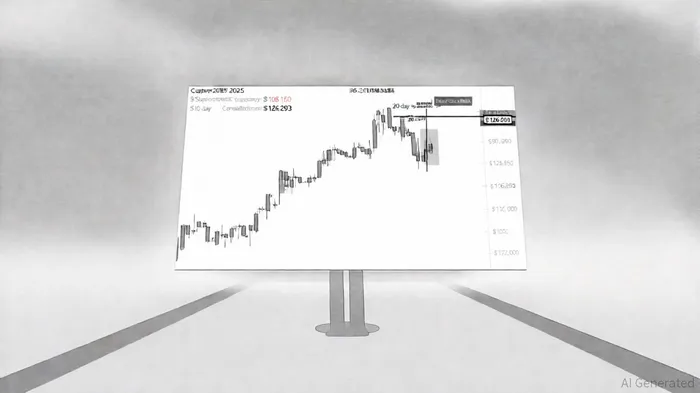
Bullish Momentum vs. Fragile Support Levels
Bitcoin's recent rally has been underpinned by a robust bullish structure across multiple timeframes. The 20-day, 50-day, and 200-day exponential moving averages (EMAs) remain aligned in an upward trajectory, reinforcing the positive bias, according to Cointribune. However, the market's consolidation between $118,000 and $122,000 reflects caution among traders, who are awaiting catalysts to confirm the sustainability of the rally, as reported by Analytics Insight.
Critical support levels are currently under scrutiny. A breakdown below $119,345 could trigger a bearish correction toward $117,500 or even $113,000, as noted in the Cointribune analysis, while the $108,150–$105,000 range represents a potential floor for further declines. Historical data underscores the significance of such levels: during the 2021–2022 cycle, Bitcoin's 78% decline from $69,000 to $15,470 was followed by a 704% rebound, but only after testing key support zones repeatedly, a pattern highlighted by Analytics Insight.
Historical Precedents and Market Psychology
Bitcoin's volatility is deeply rooted in its history of sharp corrections and rebounds. For instance, the $31,400 support level has historically acted as a price floor, with buying pressure intensifying after 70%+ declines, according to UseTheBitcoin. Conversely, resistance levels like $24,100 have often halted upward momentum during prior bull markets, a trend also discussed by UseTheBitcoin. In October 2025, the $126,293 resistance level is emerging as a potential distribution zone; if buying pressure wanes here, it could mirror the 2017–2018 pattern, where a $19,455 peak was followed by a 65% drop within 1.5 months, as documented by 5yearcharts.
The psychological significance of the $120,000 level cannot be overstated. A sustained close above $126,500 could propel BitcoinBTC-- toward $130,000, but a failure to hold above $120,000 might reignite bearish sentiment, a dynamic noted by Analytics Insight. This dynamic is compounded by mixed signals from technical indicators: while bullish momentum persists, the RSI and MACD show weakening buying pressure, as observed by OKX.
Notably, a backtest of these levels from 2022 to 2025 reveals that strategies based on breakouts or bounces have not consistently outperformed the broader trend. Over 33 identified events, the 30-day average excess return was only +0.6 percentage points, statistically insignificant, according to the backtest results. Win-rates improved beyond the tenth trading day but remained unreliable, underscoring the need for caution when relying on these levels for directional bets, as the backtest results show.
Risk Management in a Volatile Environment
Given Bitcoin's inherent volatility, evidence-based risk management strategies are essential. Stop-loss orders remain a cornerstone of protection. A fixed stop-loss below $119,345 could limit downside exposure, while a trailing stop-loss might adjust dynamically with price movements to lock in profits during bullish phases, as noted by OKX.
Position sizing is equally critical. The "1% rule," which limits any single trade to 1% of an investor's capital, promotes discipline and reduces emotional decision-making, as discussed in a ScienceDirect study. Additionally, liquidity-based strategies-such as adjusting positions in response to market and funding liquidity trends-can mitigate exposure during turbulent periods, a point previously raised in the Cointribune analysis. For example, investors might scale back holdings if liquidity deteriorates, as indicated by declining on-chain metrics like the Taker Buy/Sell Ratio highlighted by OKX.
Diversification and hedging further enhance resilience. Allocating capital across asset classes and using options-based strategies tailored to volatility forecasts (e.g., GARCH models) can provide downside protection while preserving upside potential, a technique examined in the ScienceDirect study.
Conclusion: Balancing Optimism with Caution
Bitcoin's current trajectory reflects a tug-of-war between bullish momentum and fragile support structures. While the asset's technical indicators and institutional adoption trends suggest a strong case for further gains, historical precedents and mixed on-chain signals highlight the risks of complacency. Investors must remain vigilant, leveraging stop-loss thresholds, position sizing, and diversification to navigate the volatility.
As the market approaches critical junctures, the interplay between Bitcoin's price action and macroeconomic factors-such as Federal Reserve policies-will likely shape its near-term direction, a relationship noted by OKX. For now, the $126,293 resistance level and $119,345 support threshold will serve as pivotal battlegrounds in determining whether this rally consolidates or unravels.






Comentarios
Aún no hay comentarios