
Bitcoin's Volatility and Whale Behavior as Indicators of a Market Inflection Point
In Q3 2025, Bitcoin's market dynamics have entered a critical phase, marked by stabilizing volatility, strategic whale activity, and shifting investor sentiment. These factors collectively signal a potential inflection point in the crypto cycle, offering insights into capital reallocation strategies for both institutional and retail participants.
Volatility as a Barometer of Market Stability
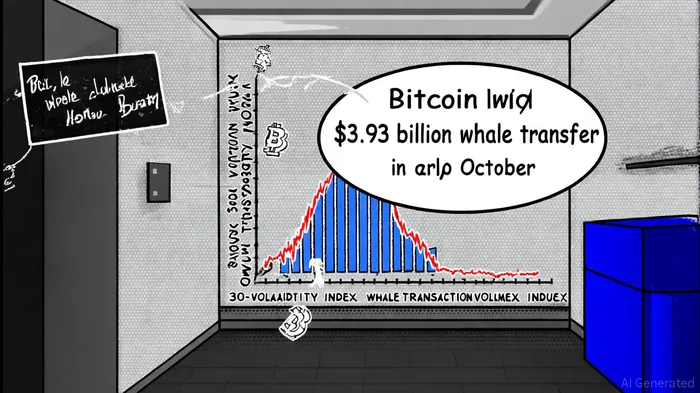
Bitcoin's 30-day volatility index has shown signs of stabilization after a sharp correction from all-time highs above $124,000 to a consolidation range of $110,000–$116,000, according to an On The Node analysis. This decline in volatility, measured as an annualized rate, reflects a market transitioning from speculative fervor to cautious accumulation. On-chain metrics like the MVRV Z-Score and Value Days Destroyed (VDD) further reinforce this narrative, indicating that long-term holders are capitalizing on lower prices to add to their positions, per a CryptoRank analysis.
However, volatility remains a double-edged sword. A massive $3.93 billion BitcoinBTC-- transfer from dormant wallets in early October triggered $620 million in liquidations, sending Bitcoin's price tumbling from $126,192 to $120,000, as reported in a FinancialContent report. Such events underscore the influence of macroeconomic factors-like the U.S. Federal Reserve's dovish pivot-and the unpredictable nature of whale-driven market shocks.
Whale Behavior: Accumulation, Profit-Taking, and Strategic Rebalancing
Whale activity in Q3 2025 reveals a nuanced picture. Large holders, controlling ~67.77% of Bitcoin's supply, have continued to accumulate during dips, adding over 250,000 BTC to their portfolios since early 2025, according to an On The Node breakdown. This contrasts with short-term profit-taking observed in October, where average dormancy rates hit monthly highs and metrics like Coin Days Destroyed (CDD) spiked, as detailed in a Yahoo Finance report.
Notably, whales are diversifying their strategies. A 32,322 BTC transfer ($3.93 billion) and a 100 BTC move from a 12-year-old wallet ($12.5 million) highlight both long-term confidence and tactical selling (reported by Yahoo Finance). Meanwhile, projects like DeXe ProtocolDEXE-- ($DEXE), EthereumETH--, and SolanaSOL-- have attracted whale capital, signaling a broader reallocation toward altcoins and DeFi ecosystems, according to a The Merkle article. This trend aligns with Ethereum's $1.295 billion institutional ETF inflows and Solana's $124.37 billion DEX trading volume, suggesting whales are hedging against Bitcoin's volatility by leveraging innovation in layer-2 solutions and governance tokens (coverage in The Merkle).
Investor Sentiment: Fear, Greed, and the Psychology of Capital Reallocation
Investor sentiment in Q3 2025 remains a mixed bag. The Bitcoin Fear and Greed Index hit a six-month low of 28 in October, driven by regulatory uncertainties and technical breakdowns like Bitcoin's close below the 200-day moving average, per a BTCC analysis. Yet, this fear coexists with bullish optimism: 66% of global investors plan to increase crypto exposure, with emerging markets (Nigeria, China, India) leading the charge, according to a FinanceFeeds report.
This duality reflects a maturing market. While retail investors exhibit caution, institutions are doubling down. The approval of U.S. spot Bitcoin ETFs and the Trump administration's August 2025 executive order permitting Bitcoin in 401(k) accounts have normalized crypto as a wealth management tool, noted in a Bitget note. As a result, capital reallocation strategies are shifting from speculative trading to long-term diversification, with 43% of investors prioritizing savings and portfolio stability (FinanceFeeds). Ethereum and Solana, in particular, are gaining traction for staking and yield generation, capturing 67% and 55% of investor interest, respectively (FinanceFeeds).
Macro-Driven Inflection Points and Strategic Implications
The interplay of volatility, whale behavior, and sentiment points to a market at a crossroads. Bitcoin's price action near $110,000-a key resistance level-will likely determine whether the consolidation phase leads to a sustained uptrend or a deeper correction, as noted by On The Node. Meanwhile, whales' dual focus on Bitcoin accumulation and altcoin diversification suggests a broader crypto cycle shift, akin to the 2020–2021 bull run where institutional adoption and DeFi innovation drove capital flows (analysis in The Merkle).
For investors, the priority is balancing risk and reward. Strategies should include:
1. Hedging Bitcoin Exposure: Allocating 30–40% of portfolios to Ethereum or Solana to capitalize on yield opportunities (Bitget).
2. Monitoring Whale Signals: Tracking large wallet movements and CDD metrics to anticipate liquidity shifts (Yahoo Finance).
3. Leveraging ETFs: Utilizing spot Bitcoin ETFs for regulated, institutional-grade exposure while avoiding overleveraged positions (FinancialContent).
Conclusion
Bitcoin's volatility and whale activity in Q3 2025 are not mere noise-they are signals of a maturing market grappling with macroeconomic tailwinds and structural innovation. As investor sentiment oscillates between fear and greed, the path forward hinges on institutional confidence, regulatory clarity, and the ability of altcoins to deliver on their utility promises. For those attuned to these dynamics, the current inflection point offers a rare opportunity to reallocate capital with both caution and conviction.






Comentarios
Aún no hay comentarios