
Bitcoin's Volatility and the Timing of a Black Swan Event: Navigating Risk in a Fractured Market
Bitcoin's price history is a rollercoaster of extremes, marked by both the rhythmic predictability of halving events and the chaotic disruptions of Black Swan occurrences. While the former offers a framework for understanding long-term trends, the latter introduces an element of unpredictability that tests even the most seasoned investors. This article explores how Bitcoin's volatility intersects with the timing of Black Swan events, focusing on risk assessment and the psychological undercurrents shaping crypto markets.
The Maturing Market: Halvings and Stabilization
Bitcoin's volatility has shown signs of structural maturation over the past decade. Studies analyzing cumulative abnormal returns (CARs) and volatility around halving events reveal a declining trend in both daily returns and volatility. For instance, the 2024 halving saw a 30-day volatility increase of 2.72%, compared to 3.92% in 2020 and 3.24% in 2012, according to a 2024 MDPI study. This stabilization is attributed to regulatory clarity, institutional adoption, and improved market infrastructure. However, these predictable cycles coexist with the ever-present threat of Black Swan events-unforeseen shocks that can erase years of progress in days.
Black Swan Events: The Unpredictable Wild Card
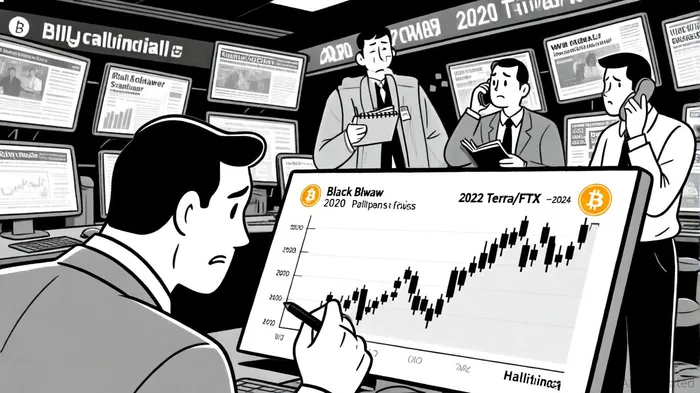
Black Swan events in crypto are defined by their rarity, massive impact, and post-hoc rationalization. The 2020 pandemic crash, the 2022 TerraUSD implosion, and the FTX collapse exemplify this. During the March 2020 crash, BitcoinBTC-- plummeted nearly 50% in two days amid global liquidity freezes, as documented in a volatility forecasting analysis. Similarly, the FTX collapse in 2022 triggered a domino effect, wiping $40 billion in value and exposing systemic risks in centralized exchanges, as noted by Kraken. These events are not merely price corrections; they are psychological ruptures that erode trust and force a reevaluation of risk paradigms.
Market psychology plays a pivotal role in amplifying these shocks. During crises, herd behavior and panic selling dominate, as seen in the 2020 crash (reported in the MDPI study). Investors, driven by fear rather than fundamentals, exacerbate volatility. This dynamic is further compounded by the interconnectedness of crypto protocols and platforms, where a single failure can cascade across the ecosystem, as explored in The Coinomist analysis.
Timing the Unpredictable: Can Risk Be Quantified?
While Black Swan events are, by definition, unpredictable, certain patterns emerge in their aftermath. Academic models like TARCH (1,2,0) highlight how negative returns disproportionately increase volatility, creating a feedback loop of fear and selling, as shown in the volatility forecasting analysis. High-frequency data analysis during crises also reveals nonlinear dynamics, such as the Hurst exponent, which measures long-term memory in price movements, a point noted in The Coinomist analysis. These tools offer partial insights but cannot fully anticipate the timing or magnitude of a Black Swan.
Investors must instead focus on risk mitigation. Diversification, self-custody of assets, and liquidity buffers are critical strategies (as explained by Kraken). For example, the 2022 TerraLUNA-- collapse underscored the dangers of algorithmic stablecoins, prompting a shift toward overcollateralized models and conservative reserve ratios, a lesson covered by Kraken. Similarly, the 2024 crash, triggered by geopolitical tensions and macroeconomic shifts, reinforced the need for macroeconomic hedging in crypto portfolios, as discussed in The Coinomist analysis.
The Path Forward: Balancing Structure and Chaos
Bitcoin's market is evolving, but its susceptibility to Black Swan events remains. The key to navigating this duality lies in understanding both structural trends (e.g., halving cycles) and psychological triggers (e.g., panic selling). As institutional participation grows, so too does the potential for systemic resilience-but also for larger, more complex shocks.
Conclusion
Bitcoin's volatility is a double-edged sword: it reflects both the maturation of a nascent asset class and the inherent fragility of a market still grappling with its own risks. While halving events provide a roadmap for long-term value, Black Swan events serve as stark reminders of the unpredictable forces at play. For investors, the challenge lies in balancing optimism with caution-leveraging data-driven strategies while remaining vigilant to the psychological tides that shape crypto markets.






Comentarios
Aún no hay comentarios