
Bitcoin's Volatility, Systemic Risks, and Strategic Opportunities in a Manipulated Market
Bitcoin's volatility in late 2025 has reached a boiling point, driven by a toxic mix of technical fragility, macroeconomic headwinds, and allegations of coordinated manipulation by major players like Binance and Wintermute. The October 2025 crash, which erased $19–20 billion in liquidations within hours, exposed systemic vulnerabilities in crypto infrastructure and raised urgent questions about market integrity. For investors, the challenge lies in navigating a landscape where price action is increasingly influenced by both algorithmic chaos and opaque human behavior.
The Perfect Storm: Technical and Macroeconomic Factors
Bitcoin's volatility is no longer just a function of speculative trading. Technological flaws in centralized exchanges and oracleADA-- systems have amplified price swings. During the October crash, Binance's Unified Account margin system and oracle failures caused stablecoins like USDeUSDe-- to depeg to $0.65, triggering cascading liquidations. Meanwhile, macroeconomic factors like the Federal Reserve's tightening cycle and Trump's 100% tariffs on Chinese goods created a perfect storm of risk-off sentiment.
On-chain data reveals Bitcoin's price is now tightly correlated with traditional assets. The S&P 500 and NASDAQ 100 have become critical barometers for crypto, while Bitcoin's inverse relationship with gold and inflation data suggests it's increasingly behaving as a risk-on asset. AI-driven trading models, meanwhile, have accelerated sell-offs, turning minor corrections into flash crashes.
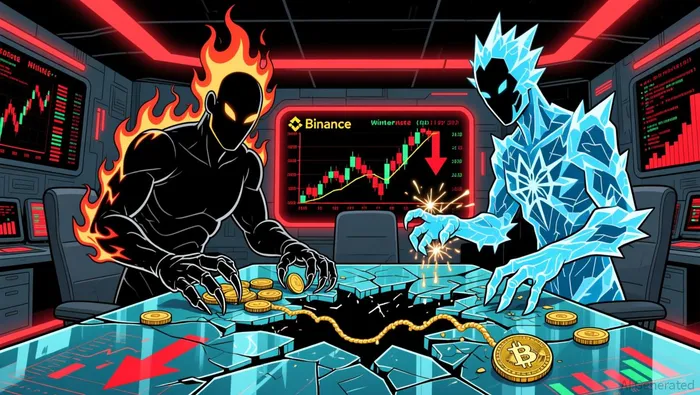
The Shadow of Manipulation: Binance, Wintermute, and Sell Walls
Allegations of coordinated price manipulation have intensified, with Binance and Wintermute at the center. According to on-chain analyst Butcher, Binance allegedly transferred $700 million in BitcoinBTC-- and EthereumETH-- to Wintermute's wallets hours before major price drops, enabling Wintermute to create "sell walls" that triggered $19 billion in liquidations. These actions, critics argue, exploit leveraged positions and oracle vulnerabilities to profit from market chaos.
While Binance and Wintermute deny manipulation, the opacity of their transactions raises red flags. For example, Wintermute's $700 million deposit into Binance's hot wallet ahead of the October crash coincided with aggressive sell walls and a 10–12% Bitcoin drop. Market makers like Wintermute often rebalance portfolios during volatility, but the timing and scale of these trades suggest more than routine liquidity management.
Systemic Risks: A House of Cards?
The October crash highlighted how centralized infrastructure failures can trigger global contagion. Binance's oracle system, which failed during a critical price update transition, allowed manipulated data to propagate across exchanges, causing false liquidations. This fragility is compounded by the concentration of power in a few exchanges: Binance's dominance means its technical issues can rapidly destabilize the entire market.
Regulators are beginning to take notice. The U.S. Digital Asset Stockpile and the SEC's "Project Crypto" initiative aim to address these risks, but enforcement remains fragmented. For now, the lack of circuit breakers or cross-exchange coordination leaves the market vulnerable to repeat crashes.
Strategic Positioning: Navigating the Chaos
For investors, the key is to balance risk mitigation with opportunistic positioning. Here's how:
Technical Levels as Guardrails: Bitcoin is currently range-bound between $81,300 (True Market Mean) and $93,000 (hidden supply wall)that creates a ceiling no rally can break. Breakouts above $93,000 could signal institutional buying, while a drop below $81,300 risks reigniting panic selling. Options expiries in late December 2025 are likely to reinforce this range, with dealers incentivized to sell rallies and buy dips.
Macroeconomic Hedges: With liquidity tightening and interest rates elevated, Bitcoin's appeal as a non-yielding asset is waning. Investors should hedge against dollar strength by allocating to Bitcoin ETFs and crypto infrastructure stocks, which offer exposure without full price exposure.
Avoiding Leverage Traps: The October crash wiped out $19 billion in leveraged longs, underscoring the dangers of overexposure. Retail investors should prioritize unleveraged positions, while institutions might explore short-term options strategies to capitalize on volatility without directional bets.
Regulatory Tailwinds: The approval of Bitcoin ETFs and the GENIUS Act for stablecoins provides a floor for long-term demand. However, investors must stay vigilant as regulatory clarity lags market innovation.
Conclusion: The New Normal
Bitcoin's volatility in 2025 reflects a market in transition. While manipulation allegations and systemic risks remain unresolved, the interplay of technical, macroeconomic, and geopolitical factors creates both hazards and opportunities. For those willing to navigate the chaos, strategic positioning around key technical levels and macroeconomic signals offers a path to resilience-and potentially outsized returns-in a market that's far from boring.






Comentarios
Aún no hay comentarios