
Bitcoin's Volatility Surge and the Implications of the FOMC Rate Cut: Strategic Entry Points Amid Macro-Driven Tailwinds
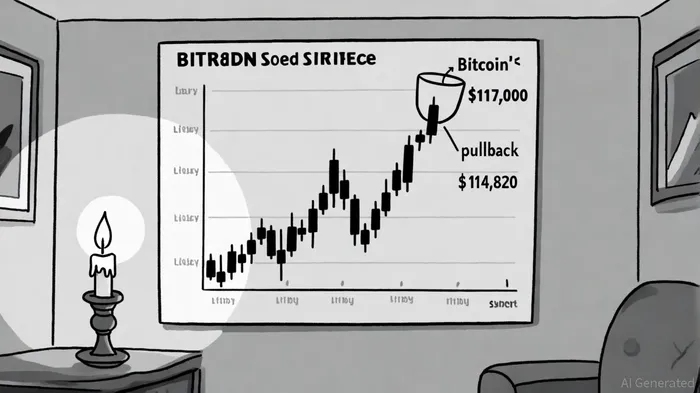
The U.S. Federal Reserve's 25-basis-point rate cut on September 17, 2025, sent shockwaves through the cryptocurrency market, triggering a volatile but ultimately mixed response from BitcoinBTC-- (BTC). While the move marked the first easing in months and reduced the federal funds rate to 4%–4.25%, the market's reaction underscored the delicate balance between macroeconomic optimism and lingering caution. Bitcoin surged intraday to $116,318 before retreating to $114,820, a classic “sell the news” scenario that highlighted the asset's hypersensitivity to monetary policy shifts [1]. This volatility, amplified by rapid liquidation clusters in the $115,000–$114,000 range, signals fragile positioning and a market still grappling with uncertainty [2].
The FOMC's Macro Tailwinds and Bitcoin's Structural Resilience
The Fed's decision to ease rates, while largely priced in by traders (96% probability via CME, 91% on Polymarket), injected liquidity into risk assets and weakened the U.S. dollar—a historically bullish catalyst for Bitcoin [3]. Institutional buying further reinforced this narrative, with a single wallet acquiring $680 million in BTCBTC-- just days before the announcement, signaling confidence in the asset's long-term trajectory [4]. On-chain data corroborates this optimism: Bitcoin's 30-day volatility index spiked, while the RSI (60.7) and inflows into spot ETFs pointed to strengthening momentum without overbought conditions [5].
However, Bitcoin's inability to sustain gains above $117,000—despite a dovish Fed and a weakening dollar—reveals short-term headwinds. The price's consolidation around $115,000 suggests a critical inflection point, where technical and macroeconomic forces will determine whether BTC resumes its bullish trend or faces a deeper correction [6].
Strategic Entry Points: Technical and Historical Insights
For investors seeking to capitalize on post-FOMC volatility, technical analysis offers a roadmap. Bitcoin's price action has formed a cup-and-handle pattern, with resistance near $117,000 and a potential target of $126,700 if the pattern completes [7]. Key support levels at $113,500 and $111,100 provide defensive entry points, while the 200-day EMA (~$105,300) acts as a critical psychological floor [8].
Historical precedents also offer guidance. During the 2020 pandemic rate cuts, Bitcoin surged from $7,000 to $28,000 as liquidity flooded risk assets [9]. Similarly, the 2019 easing cycle saw BTC rise from $3,700 to $7,000. Yet, these rallies were not linear; March 2020's emergency cuts coincided with a 40% selloff, underscoring the importance of broader economic context [10]. For 2025, the interplay between rate cuts and Bitcoin's on-chain strength—evidenced by reduced exchange outflows and rising ETF inflows—suggests a more resilient environment [11].
Risk Management and Positioning in a Volatile Regime
While macro tailwinds favor Bitcoin, volatility remains a double-edged sword. Traders should prioritize risk management by:
1. Leveraging Breakouts: Place entries just above $117,500 (resistance) or below $113,500 (support) with tight stop-loss orders to mitigate sudden reversals [12]. However, historical backtesting of this approach from 2022 to 2025 reveals mixed results: a total return of -2.93% (annualized -0.46%) and a maximum drawdown of 8.09% during holding periods. Most positions closed with small losses, as Bitcoin spent limited time beyond these thresholds .
2. Diversifying Exposure: Allocate capital across Bitcoin and EthereumETH-- while avoiding over-leveraged altcoin bets, which remain prone to liquidity shocks [13].
3. Monitoring Fed Guidance: Post-meeting statements from Chair Jerome Powell will shape near-term sentiment. A dovish tone emphasizing further easing could catalyze a retest of $120,000, while hawkish revisions may delay the rally [14].
The Path Forward: Uptober 2.0 or Correction?
Bitcoin now faces a pivotal test. A breakout above $117,500 could reignite the “Uptober” narrative—a historically bullish seasonal pattern—while a breakdown below $111,100 may trigger a retest of the 200-day EMA. Institutional adoption and the 2025 halving event provide a structural floor, but short-term volatility will persist as traders parse Fed signals and global macroeconomic data [15].
For strategic investors, the September 2025 FOMC decision represents both a cautionary tale and an opportunity. By combining macroeconomic tailwinds with disciplined technical execution, positioners can navigate Bitcoin's volatility to secure entry points in a market poised for transformation.






Comentarios
Aún no hay comentarios