
Bitcoin's Volatility and Structural Weaknesses: A Cautionary Tale for Long-Term Investors
Bitcoin's journey in 2025 has been a rollercoaster of extremes, punctuated by sharp price swings, systemic fragility, and growing evidence of market manipulation. While proponents tout its role as a "digital gold," the reality is far more complex. For long-term investors, the asset's structural vulnerabilities-thin liquidity, fragmented order books, and susceptibility to manipulation-pose existential risks that demand scrutiny.
The Volatility Paradox
Bitcoin's volatility is not a bug but a feature of its design. With no intrinsic valuation anchors and a fixed supply of 21 million coins, its price is driven by speculative demand rather than fundamentals. From 2020 to 2025, Bitcoin has experienced repeated drawdowns of over 70%, a pattern exacerbated by macroeconomic shocks like U.S. Federal Reserve policies and geopolitical tensions. The asset's pseudonymous, permissionless nature further amplifies speculative behavior, creating a feedback loop where investor sentiment-rather than economic utility-dictates value.
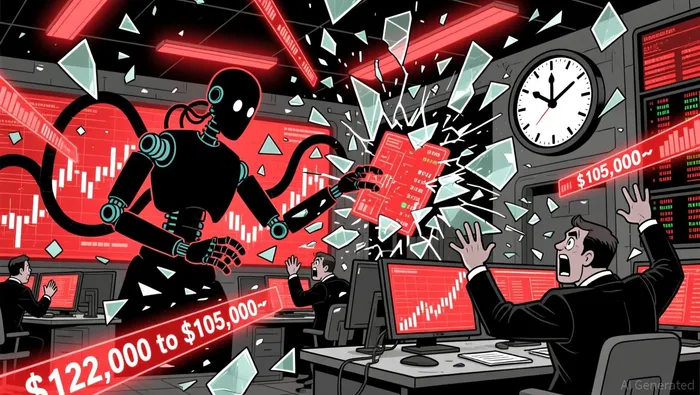
This volatility was starkly exposed in October 2025, when a surprise U.S. tariff announcement on Chinese software imports triggered a $19 billion liquidation event in just 24 hours. Bitcoin's price plummeted from $122,000 to $105,000 within hours, revealing a market structure ill-equipped to handle sudden sell pressure. Thin order books and fragmented liquidity left the market one-sided, with liquidity providers withdrawing or hitting risk limits during the crisis.
Structural Weaknesses: A House of Cards
Bitcoin's proof-of-work consensus mechanism, while secure, is economically costly and limits scalability, creating bottlenecks in transaction throughput. These technical constraints are compounded by the asset's lack of traditional monetary functions. Economists have long questioned Bitcoin's viability as a stable store of value or medium of exchange, given its price instability and energy-intensive infrastructure.
The October 2025 crash further highlighted systemic fragility. During the sell-off, order books became nearly blank on the bid side, enabling large players to exploit liquidity vacuums through tactics like "liquidity sweeps"-short-term price manipulations that trigger smaller orders during illiquid periods. Analysts have pointed to recurring price declines coinciding with U.S. market opens, suggesting the involvement of high-frequency trading firms like Jane Street, which allegedly dumped BitcoinBTC-- to trigger leveraged liquidations before buying back at lower prices.
Market Manipulation: From Bots to Black Swans
Bitcoin's market structure has become a playground for manipulative actors. In 2025, the Department of Justice charged 17 individuals in Massachusetts for using bots to inflate trading volumes of altcoins and memeMEME-- coins. Similarly, the SEC's enforcement actions emphasized crackdowns on insider trading and wash trading, with Chainalysis estimating $704 million in suspected wash trading on decentralized exchanges (DEXs) alone.
The Terraform Labs collapse in 2025 serves as a cautionary tale. The $40 billion fraud, involving algorithmic stablecoins and deceptive governance structures, exposed how manipulative practices-such as using Genesis Stablecoins to fund trading bots-can destabilize entire ecosystems. Meanwhile, the depegging of stablecoins like USDe during the October crash further amplified volatility, triggering cascading margin calls and eroding trust in crypto's foundational infrastructure.
Regulatory Gaps and the Path Forward
While 2025 saw regulatory progress-such as the U.S. passing the GENIUS Act and the EU advancing MiCA-gaps persist. The Bybit hack, where attackers exploited unregulated infrastructure to launder stolen funds, underscores the need for stricter oversight. Yet, even with these measures, Bitcoin's market remains prone to manipulation. For instance, precision oracle attacks have become a major risk, contributing to repeated stablecoin depegging events.
Implications for Long-Term Investors
For investors, Bitcoin's volatility and structural weaknesses present a paradox. While the asset has seen periods of explosive growth, its susceptibility to manipulation and systemic shocks makes it a high-risk proposition. The October 2025 crash, for example, erased $1 billion in leveraged positions within hours, demonstrating how quickly gains can evaporate. Moreover, the shift of capital toward equities and precious metals-where Bitcoin underperformed the S&P 500 by 30% in late 2025-signals waning confidence in its long-term utility.
Regulatory clarity and institutional adoption may mitigate some risks, but they cannot eliminate Bitcoin's inherent fragility. As one financial strategist noted, dismissing bullish price predictions as "nonsense" highlights the market's fragility and its disconnect from macroeconomic realities. For long-term investors, the lesson is clear: Bitcoin's volatility and manipulation risks demand a cautious, diversified approach.
Conclusion
Bitcoin's allure as a speculative asset remains strong, but its structural weaknesses-thin liquidity, fragmented order books, and susceptibility to manipulation-pose systemic risks that cannot be ignored. The October 2025 crash and subsequent regulatory actions underscore the need for robust safeguards, including improved circuit breakers and transparent liquidation protocols. For investors, the takeaway is simple: while Bitcoin may offer upside potential, its volatility and market structure vulnerabilities make it a precarious bet for long-term wealth preservation.






Comentarios
Aún no hay comentarios