
Bitcoin's Volatility and Structural Shifts: A Macro and Psychological Perspective
Bitcoin's journey through 2023–2025 has been defined by a confluence of macroeconomic tailwinds, institutional adoption, and evolving investor sentiment. As the cryptocurrency navigates a maturing market landscape, its volatility and structural shifts reflect a complex interplay of traditional financial dynamics and digital asset innovation. This analysis unpacks the forces shaping Bitcoin's trajectory, emphasizing how macroeconomic catalysts and psychological drivers are redefining its role in global portfolios.
Macroeconomic Catalysts: Dovish Policy and Institutional Liquidity
Bitcoin's recent rally to an all-time high of $109,000 in September 2025, according to a Redlands Daily Facts report, underscores the profound impact of U.S. Federal Reserve policy. The Fed's dovish stance, marked by rate cuts and a weakening dollar, has reduced the opportunity cost of holding non-yielding assets like BitcoinBTC--. As inflationary pressures persist and fiat currencies face devaluation risks, Bitcoin's appeal as a hedge has intensified, as the Redlands Daily Facts report observes. This dynamic is further amplified by the approval of spot Bitcoin ETFs in 2024, which injected $54.4 billion in net inflows by August 2025, the article notes. These ETFs, led by BlackRock's IBIT, now hold over 1.29 million BTC-approximately 6% of the total supply-signaling a structural shift toward institutional-grade adoption.
The U.S. dollar's weakening trajectory has also bolstered Bitcoin's demand. With global liquidity expanding and M2 money supply rising, investors are increasingly allocating capital to assets perceived as inflation-resistant. Bitcoin's correlation with the S&P 500 has surged to 0.86 in 2025, reflecting its growing alignment with traditional markets. However, this correlation has fluctuated historically, dropping to near zero in mid-2024, as noted in a Medium analysis, as Bitcoin's independence as an asset class solidified.
Investor Psychology: From Retail Hype to Institutional Confidence
Investor psychology has played a dual role in Bitcoin's volatility. On one hand, social media sentiment on platforms like X and Reddit has fueled bullish narratives, framing Bitcoin as both an inflation hedge and a risk-on asset, a theme highlighted in the Redlands Daily Facts report. On the other, short-term uncertainties-such as the U.S. government shutdown in early October 2025-have introduced mixed signals. Delays in SEC decisions on crypto ETPs and economic data releases created temporary volatility, with some investors treating Bitcoin as a safe haven while others adopted cautious stances, according to the same report.
The psychological shift from retail-driven speculation to institutional confidence is equally significant. Publicly listed companies now hold over 1,001,953 BTC as corporate treasuries, the report states, reflecting a broader acceptance of Bitcoin as a strategic asset. This transition has narrowed Bitcoin's price swings compared to past cycles, as institutional participation stabilizes liquidity and reduces retail-driven extremes.
Structural Shifts: Market Dominance and Historical Patterns
Bitcoin's structural dominance has surged to 62.2% of the total crypto market in 2025, its highest level since 2021, according to a BeInCrypto outlook. This shift is driven by macroeconomic uncertainties and regulatory clarity, which have redirected capital away from speculative altcoins toward Bitcoin as a benchmark asset. The 2024 halving event further reinforced this trend, aligning with historical patterns of supply scarcity and investor anticipation, as described in the HyroTrader guide.
However, historical seasonality remains a cautionary factor. Q3 has traditionally been Bitcoin's weakest quarter, averaging 6.03% returns, a pattern BeInCrypto highlights. While optimism around Fed rate cuts and rising liquidity fuels bullish expectations, analysts like Benjamin Cowen warn of potential mid-June weakness as Q3 patterns emerge. Meanwhile, geopolitical risks-such as trade wars-could reintroduce volatility, echoing past market turbulence.
The Road Ahead: Uptober and Beyond
Analysts anticipate a "bullish Uptober," with Bitcoin poised to rebound from September's volatility, the Redlands Daily Facts report suggests. Implied volatility compression, similar to patterns observed in 2023, suggests the market may be underpricing future turbulence, potentially setting the stage for a sharp October move; the Medium analysis discussed similar dynamics. The approval of crypto ETPs and continued ETF inflows are expected to further stabilize Bitcoin's price action, while a dovish Fed and weak dollar create favorable conditions for a potential $130K–$140K price target, according to BeInCrypto.
Conclusion
Bitcoin's volatility and structural shifts in 2023–2025 reflect a maturing market increasingly influenced by macroeconomic forces and institutional adoption. While short-term uncertainties persist, the interplay of dovish policy, ETF-driven liquidity, and evolving investor psychology positions Bitcoin as a critical asset in diversified portfolios. As the market approaches October 2025, investors must balance optimism with caution, recognizing both the tailwinds and the historical patterns that could shape Bitcoin's next chapter.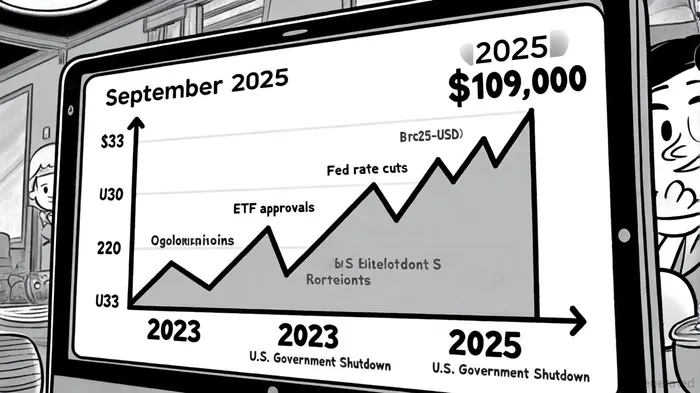





Comentarios
Aún no hay comentarios