
Bitcoin's Volatility and Short-Term Momentum in Late 2025: Tactical Entry Points Amid Seasonal Trends and Volume Patterns
Bitcoin's late 2025 performance has been a masterclass in volatility, with sharp corrections and institutional shifts reshaping the landscape for investors. As the year closed, BitcoinBTC-- traded near $87,964, down 6.83% year-to-date, amid a confluence of bearish on-chain signals and macroeconomic headwinds. Yet, beneath the surface, structural trends-such as rising institutional adoption and maturing market infrastructure-suggest tactical opportunities for those navigating the chaos. This analysis dissects Bitcoin's volatility, seasonal dynamics, and volume patterns to identify actionable entry points in Q4 2025.
Volatility and Momentum: A Tale of Two Cycles
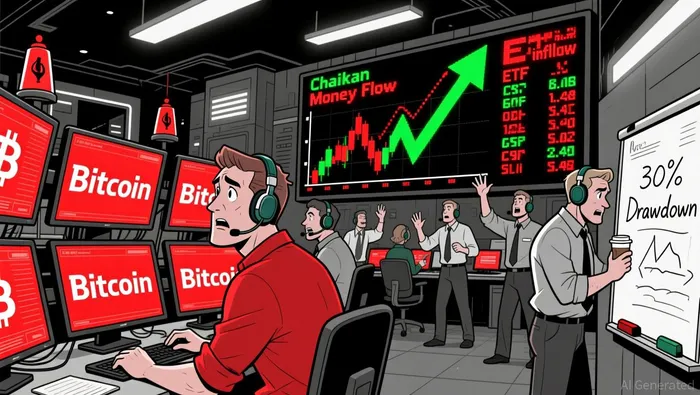
Bitcoin's Q4 2025 price action was defined by a dramatic 30% drawdown from its October peak of $126,000 to sub-$86,000 levels by late November, driven by forced selling and deleveraging in leveraged positions. This volatility, while painful, aligns with historical patterns in bull markets, where 12–18 months post-halving (April 2024) often precede bearish pullbacks. However, the broader context reveals a nuanced picture: spot trading volumes surged to $8B–$22B daily, and long-term volatility normalized to 43.0% from 84.4%, signaling a maturing market structure.
On-chain data further complicates the narrative. Large "shark" wallets (100–1,000 BTC) shifted from accumulation to distribution, while the Chaikin Money Flow (CMF) dipped below zero, reinforcing bearish momentum. Yet, institutional investors continued to accumulate, with ETF inflows nearing $60 billion and Digital Asset Treasuries (DATs) purchasing 42,000 BTC in December-a sign of corporate confidence amid retail-driven selloffs.
Seasonal Trends: History vs. Reality
Historically, Q4 has been Bitcoin's most bullish quarter, averaging 85% returns since 2013, with November alone delivering 46% gains on average according to historical data. However, Q4 2025 defied this pattern, closing down 24%-its worst quarterly performance since the 2018 bear market. The divergence stems from a premature cycle peak in October, where Bitcoin's all-time high pulled forward gains typically reserved for Q4. This created a "buy the dip" vacuum, as short-term holders faced unrealized losses and institutional ETFs reversed their Q4 2024 accumulation into distribution according to on-chain analysis.
Despite this, the 50-week simple moving average (SMA) at $98,900 remains a critical psychological level. Historically, Bitcoin's ability to hold above this threshold has signaled continued bullish momentum, even amid short-term bearishness. The current price action suggests a shallow bear cycle, with potential support near $70,000 and a long-term bottom near $56,000 according to market analysis.
Volume Patterns and On-Chain Signals: A Contrarian Playbook
Volume dynamics in Q4 2025 revealed a tug-of-war between bearish exhaustion and institutional resilience. Daily trading volumes rose to $86B, up from $67B in Q4 2024, while stablecoin market capitalization expanded to $166B. However, on-chain metrics like declining new address creation and stagnant transaction fees hinted at demand exhaustion.
A key contrarian signal emerged in December: the 4% drop in Bitcoin's hashrate, a historical precursor to positive 90–180-day returns. This decline, coupled with ETF inflows and corporate treasury accumulation, suggests a potential inflection point. Meanwhile, the shift in institutional behavior-from spot ETFs to tokenized real-world assets (RWAs)-highlights a broader trend toward utility-driven adoption, with tokenized RWA value rising to $24B.
Tactical Entry Points: Navigating the Volatility
For investors seeking tactical entry points, three levels stand out:
1. $98,900 (50-Week SMA): A critical support level that, if held, could reignite bullish momentum.
2. $84,020 (Descending Triangle Support): A short-term floor where technical buyers may step in.
3. $70,000 (Long-Term Support): A potential capitulation level, historically followed by sharp rebounds.
Positioning should prioritize dollar-cost averaging into these levels, with a focus on institutional-grade instruments like ETFs and tokenized RWAs to mitigate retail-driven volatility. Additionally, macroeconomic catalysts-such as the Federal Reserve's rate policy and stablecoin legislation-will shape risk appetite in the coming months.
Conclusion
Bitcoin's Q4 2025 volatility reflects a maturing market grappling with cyclical corrections and structural shifts. While the immediate outlook remains bearish, the interplay of seasonal trends, institutional resilience, and on-chain signals points to a shallow bear cycle. For tactical investors, the key lies in leveraging these dynamics to capitalize on dislocated pricing, with a disciplined focus on liquidity, volume patterns, and macroeconomic tailwinds.






Comentarios
Aún no hay comentarios