
Bitcoin's Volatility and the Risks of Whale-Driven Leverage in a Downturning Market
The cryptocurrency market in late 2025 is a study in paradoxes. While long-term holders still cling to historical unrealized profits, the specter of $350 billion in aggregate unrealized losses-$85 billion of which is tied to Bitcoin-has begun to erode confidence. This tension is most acutely felt among leveraged whale positions, where a single $114 million BitcoinBTC-- trade in October 2025 crystallized a staggering loss. These developments underscore a market teetering between resilience and fragility, with leveraged whale activity acting as both a barometer and a catalyst for systemic risk.
The Systemic Fragility of Whale-Driven Leverage
Crypto whales, particularly in EthereumETH--, have increasingly adopted leveraged long positions with perilously thin liquidation margins. As of late 2025, leverage ratios on major platforms have reached 0.58-a level where even minor price corrections can trigger cascading liquidations. A recent case in point: an Ethereum whale unwound a 7x leveraged long position, suffering a $3.34 million loss. This incident highlights how leverage amplifies not just gains but also the velocity of capital destruction during downturns.
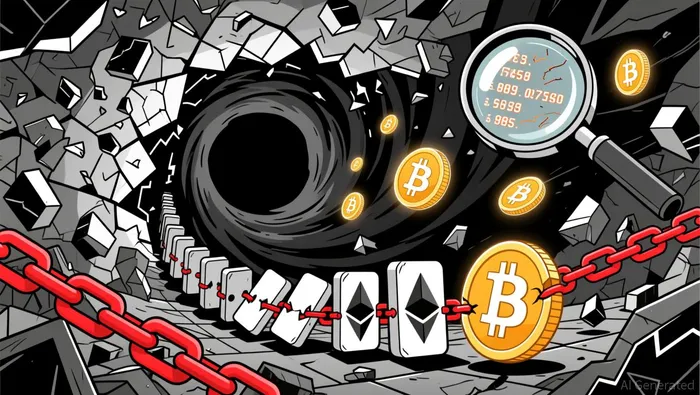
The fragility is compounded by a liquidity crisis. Stablecoin inflows into exchanges have halved since mid-2025, dropping from $158 billion to $78 billion. Spot trading activity has also slowed, reducing the market's ability to absorb sell-side pressure. When leveraged whale positions face liquidation, the resulting sell orders can spiral into self-fulfilling price collapses. For instance, the October 2025 Bitcoin crash exposed structural flaws such as opaque pricing and pseudonymous trading, which allowed volatility to metastasize. These dynamics create a feedback loop: falling prices trigger more liquidations, which further depress prices.
Implications for Retail Investors
Retail investors, often positioned as long-term holders, are not immune to these risks. While their positions may lack the leverage of whale portfolios, they face indirect threats from cascading liquidations. A sharp sell-off triggered by whale-driven leverage can force retail investors into panic selling, eroding their unrealized gains. For example, the broader bearish technical backdrop-marked by weakening on-chain metrics and declining institutional inflows-has already pushed Bitcoin into a consolidation phase. If leveraged whale positions destabilize further, this could accelerate a shift into a bear market.
Moreover, the macroeconomic context exacerbates vulnerabilities. Strengthening correlations between crypto and traditional markets mean that Federal Reserve rate cuts or tightening cycles now have a more direct impact on crypto liquidity. Retail investors who entered the market during the 2024 bull run, buying near cycle highs, are particularly exposed. Their unrealized losses, while smaller in aggregate than whale positions, could trigger a wave of capitulation if confidence erodes further.
The Perfect Storm: Leverage, Liquidity, and Macroeconomics
The convergence of high leverage, thin liquidity, and macroeconomic uncertainty has created a "perfect storm" for systemic risk. Leverage ratios in Ethereum and Bitcoin have reached levels where even a 5% price drop can liquidate a significant portion of whale positions. This is compounded by the fact that many whale portfolios are concentrated in a handful of large accounts, increasing the likelihood of correlated failures.
Macro trends further amplify these risks. Regulatory shifts in Asia and the U.S. have introduced uncertainty, while global rate cuts have yet to provide the liquidity tailwinds seen in previous cycles. The result is a market where whale-driven leverage acts as a double-edged sword: it can supercharge rallies but also accelerate collapses. The October 2025 crash revealed how pseudonymous whale activity and fragmented market data can be exploited for manipulation, deepening volatility.
Strategic Risk Management for Leveraged Longs
For investors holding leveraged long positions, the lessons from 2025 are clear. First, liquidity risk must be prioritized. With stablecoin inflows and spot trading volumes at multi-year lows, even moderately leveraged positions face heightened liquidation risks. Second, diversification across asset classes and leverage ratios is critical. Whale portfolios with 7x or higher leverage, as seen in the Ethereum case, are particularly vulnerable to margin calls. Third, macroeconomic signals-such as Fed policy shifts and regulatory developments-should be monitored closely, as they now have a direct bearing on crypto liquidity.
Retail investors, meanwhile, should avoid overexposure to leveraged products and consider hedging strategies like short-term options or stablecoin-backed loans. The current bearish technical environment, combined with whale-driven instability, suggests that caution-not aggression-should dominate portfolio construction.
Conclusion
Bitcoin's volatility in 2025 is no longer a function of retail speculation alone. Whale-driven leverage, coupled with a fragile liquidity backdrop, has transformed the market into a high-stakes game of margin calls and cascading liquidations. While the $3.34 million Ethereum loss and the $114 million Bitcoin position are isolated cases, they are symptomatic of a broader systemic risk. For both institutional and retail investors, the path forward demands a recalibration of risk management frameworks-one that accounts for the interconnectedness of leverage, liquidity, and macroeconomic forces. In a market where a single whale's margin call can trigger a chain reaction, prudence is no longer optional.







Comentarios
Aún no hay comentarios