
Bitcoin's Volatility and the Resurgence of Macro Shorts: A Behavioral Finance Deep Dive
Bitcoin's 2025 volatility has become a masterclass in behavioral finance, with macro shorts leveraging psychological biases and sentiment shifts to amplify gains-and risks. The resurgence of aggressive shorting strategies, particularly on platforms like Hyperliquid, underscores how fear, greed, and institutional positioning are reshaping the crypto landscape.
The Psychology of Panic and Profit
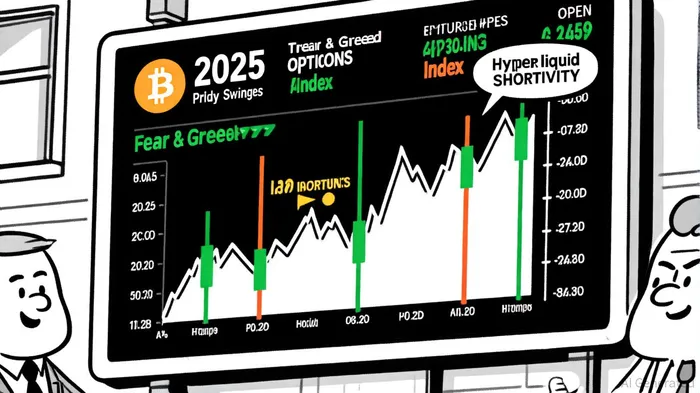
Bitcoin's price action in 2025 has been a rollercoaster, swinging between all-time highs of $121,000 and corrections to $84,000. This volatility is not just technical but deeply psychological. The Bitcoin Fear and Greed Index, a barometer of retail sentiment, hit an extreme fear level below 10 in April 2025, driven by regulatory uncertainty and geopolitical tensions. By May, the Crypto Fear & Greed Index surged to "Extreme Greed" (above 75), reflecting overconfidence and speculative fervor. Such swings highlight the market's susceptibility to herd behavior, where fear of missing out (FOMO) and loss aversion drive irrational decisions.
High-profile traders have weaponized these dynamics. The enigmatic wallet address 0xb317 on Hyperliquid, for instance, capitalized on panic by shorting BitcoinBTC-- for a $192 million profit during the March 2025 crash, as detailed in a Coindesk profile. Their latest $333 million short at $84,040.80-using 40x leverage-was timed just 30 minutes before former President Trump's 100% tariff announcement, triggering a $19 billion selloff, according to a CryptoTimes report. This raises questions about whether such timing reflects insider knowledge or a mastery of sentiment-driven volatility.
Market Positioning: Institutions vs. Retail
Bitcoin's derivatives markets have become a battleground for positioning. Open interest in Bitcoin options now rivals futures, hitting $80 billion in October 2025, according to an options market report. This surge reflects institutional strategies: Deribit attracts crypto-native traders with short-dated, event-driven bets, while BlackRock's IBIT options cater to long-term, structured products, as noted in the same report. Meanwhile, retail traders on platforms like Robinhood continue to amplify volatility through attention-driven trading, as highlighted by a ScienceDirect study linking their activity to Bitcoin's discontinuous price jumps.
The long/short ratio of 1.15 in Q3 2025 suggests cautious optimism, but this metric must be contextualized. Institutional investors, now dominant over retail, have reduced Bitcoin's average daily volatility to 1.8% post-ETF adoption, per the Uptober Outlook. Yet, leveraged retail positions remain a wildcard. A Hyperliquid trader turned a $10 million profit into a $2.5 million loss in a single day as Bitcoin fell, documented in a Coindesk report.
Macro Shorts and the New Normal
The resurgence of macro shorts is not just technical-it's macroeconomic. The Federal Reserve's easing cycle and a weaker dollar have positioned Bitcoin as a high-beta asset, but geopolitical risks (e.g., Trump's tariffs) create fertile ground for shorting. The trader 0xb317's actions exemplify how macro events are weaponized: their $333 million short was executed at a margin usage of 111%, a precarious position that could trigger liquidation if Bitcoin rallies, as reported by CryptoTimes.
Behavioral biases further complicate this. Confirmation bias leads traders to ignore contradictory signals, while overconfidence in leverage amplifies losses. The VIX spike to 60 in April 2025, interpreted by some as a market bottom signal, contrasts with bearish analyses like Tony Severino's Bitcoin/VIX ratio sell signal in a Cointelegraph piece. This divergence reflects the chaos of sentiment-driven markets, where even experts clash.
Strategic Implications for 2025
For investors, the lesson is clear: discipline and diversification are non-negotiable. The Bitcoin Fear and Greed Index's contrarian nature suggests that extreme fear (April 2025) may signal buying opportunities, while extreme greed (May 2025) warns of overvaluation, as shown by the Gate analysis. Institutions are adopting a contrarian approach, accumulating during fear-driven dips, while retail traders must guard against emotional overreactions.
The rise of AI-driven sentiment analysis-using tools like attention-augmented CNN-LSTM models-offers a glimpse into the future. These models parse TikTok and Twitter sentiment to predict short-term volatility, giving sophisticated traders an edge, according to an arXiv paper. However, no algorithm can fully account for black swan events like Trump's tariffs or sudden regulatory shifts.
Conclusion
Bitcoin's 2025 volatility is a collision of behavioral finance and macroeconomic forces. The resurgence of macro shorts, epitomized by traders like 0xb317, reveals how sentiment and leverage can turn markets upside down. For investors, the path forward requires balancing technical analysis with psychological discipline-and a healthy respect for the unpredictable.






Comentarios
Aún no hay comentarios