
Bitcoin's Volatility and Reserve Dynamics: Strategic Entry Points Amid Macroeconomic Shifts
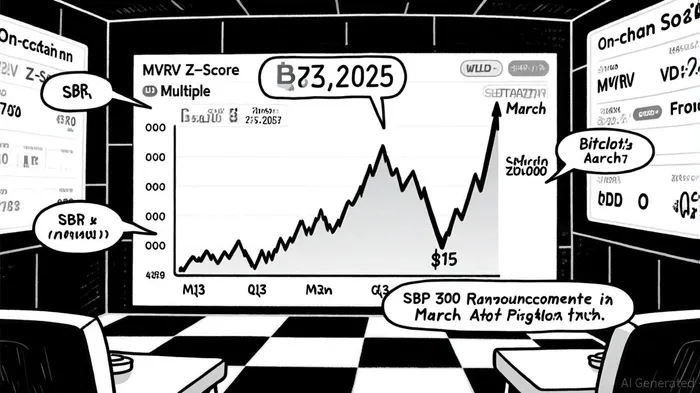
Bitcoin's 2025 journey has been a rollercoaster of volatility, driven by macroeconomic turbulence, geopolitical tensions, and institutional innovation. From a peak of $109,588 in early 2025 to a trough of $76,606 by March, the asset's price swings reflect its evolving role as both a speculative vehicle and a strategic reserve asset. For investors, navigating this volatility requires a nuanced understanding of on-chain signals, macroeconomic tailwinds, and the transformative impact of institutional adoption—particularly the U.S. Strategic BitcoinBTC-- Reserve (SBR).
Volatility Drivers: Macroeconomics and Geopolitical Uncertainty
Bitcoin's first-quarter 2025 volatility was fueled by a perfect storm of macroeconomic and geopolitical factors. The Trump administration's announcement of new tariffs on Canada, Mexico, and China exacerbated global trade uncertainties, while the Federal Reserve's interest rate policies created a tug-of-war between inflationary pressures and liquidity constraints [1]. Compounding these issues, a $1.4 billion EthereumETH-- theft from Bybit in Q1 accelerated Bitcoin's decline, exposing the fragility of exchange infrastructure [1].
Yet, Bitcoin's volatility isn't purely reactive. On-chain data reveals deeper structural shifts. The MVRV (Market Value to Realized Value) ratio dropped from 2.29 to 1.99, while the SOPR (Spent Output Profit Ratio) metric fell to 1.00, signaling breakeven selling activity as investors trimmed positions during the downturn [1]. Meanwhile, the Fear and Greed Index swung wildly—from 84 post-Trump's inauguration to 10 by March—highlighting the emotional extremes driving market sentiment [1].
On-Chain Indicators: A Bull Market in Disguise?
Despite the Q1 selloff, on-chain metrics suggest Bitcoin's bull market remains intact. The MVRV Z-Score, a normalized measure of market overextension, fell to 1.43 in March 2025—a level historically associated with local bottoms rather than tops [2]. This drop aligns with patterns from prior bull cycles (e.g., 2017, 2021), indicating accumulation by long-term holders rather than capitulation [2].
The Value Days Destroyed (VDD) Multiple further reinforces this narrative. By entering the “green zone” in Q3 2025, the metric signals a shift from profit-taking to accumulation, with macro-savvy investors buying dips [2]. Similarly, Bitcoin Cycle Capital Flows show the 1–2 year cohort—often seen as sophisticated investors—increasing holdings, mirroring behaviors from the 2020–2021 bull run [2]. These patterns suggest we're in the early-to-mid stages of a bull cycle, with potential for renewed upward momentum.
Reserve Dynamics: The SBR and Institutional Adoption
The most transformative development of 2025 has been the establishment of the U.S. Strategic Bitcoin Reserve (SBR) in March. By treating seized Bitcoin as a sovereign asset rather than liquidating it, the Trump administration has removed selling pressure from the market, potentially stabilizing prices and legitimizing Bitcoin as a reserve asset [3]. Over 30% of the circulating supply is now held by centralized entities like exchanges, ETFs, and public companies, reflecting a shift toward institutional custody [3].
The SBR's impact extends beyond price dynamics. By positioning Bitcoin as a hedge against inflation and currency devaluation—similar to gold—it has reshaped its role in global finance [3]. For example, BlackRock's iShares Bitcoin Trust (IBIT) attracted $1.3 billion in inflows within two days in July 2025, underscoring institutional demand [4]. This trend is further amplified by the approval of spot Bitcoin ETFs in 2024, which have democratized access for traditional investors [4].
Strategic Entry Points: Balancing Volatility and Opportunity
For investors seeking entry points, the interplay between on-chain signals and macroeconomic factors offers a roadmap. The MVRV Z-Score's rebound from 1.43 to levels seen in prior bull markets (e.g., 2.5–3.0) suggests a potential inflection point [2]. Meanwhile, the SBR's accumulation of 198,000 BTC by August 2025 has reduced circulating supply, creating scarcity-driven tailwinds [5].
However, Bitcoin's strong correlation with the S&P 500 (0.88 in Q3 2025) means traditional market dynamics will continue to influence its trajectory [6]. A recession or equity market selloff could cap Bitcoin's rally, while dovish Fed policies or inflationary pressures might drive institutional inflows. Investors should also monitor the Pi Cycle Oscillator and Bitcoin Cycle Master Chart, which indicate sustained bullish momentum and a potential peak of $140,000–$210,000 by Q4 2025 [2].
Conclusion: A New Era for Bitcoin
Bitcoin's 2025 volatility is not a bug but a feature of its transition from speculative asset to strategic reserve. While macroeconomic risks persist, on-chain accumulation and institutional adoption—led by the SBR—provide a robust foundation for long-term growth. For investors, the key lies in leveraging on-chain indicators to time entry points while hedging against macroeconomic headwinds. As the bull cycle progresses, Bitcoin's role as a macro-financial instrument—and its potential to outperform traditional assets—will only become clearer.






Comentarios
Aún no hay comentarios