
Bitcoin's Volatility and Value Reassessment: Is a $100K Floor a Buying Opportunity?
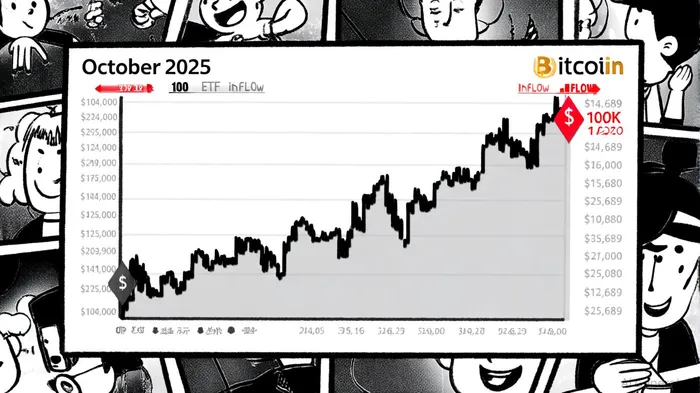
Bitcoin's price action in October 2025 has been a masterclass in volatility, oscillating between a record high of $125,689 and a pullback to $104,782 amid shifting macroeconomic narratives and institutional dynamics. For investors, the question is no longer whether BitcoinBTC-- belongs in a diversified portfolio but how to position for its next leg higher. With the $100K level now a psychological floor rather than a ceiling, the market is at a crossroads: Is this a contrarian buying opportunity, or a warning sign of deeper corrections?
The New Normal: Stabilized Volatility Amid Institutional Dominance
Bitcoin's volatility has historically been its Achilles' heel, but 2025 has seen a paradigm shift. By mid-2025, realized volatility had dropped by 75% from peak levels, driven by institutional-grade liquidity and the "strong hands" effect, according to a Pinnacle Digest analysis. This stabilization is not accidental-it's structural. Spot Bitcoin ETFs, led by BlackRock's iShares Bitcoin Trust (IBIT), have injected $65 billion in assets under management (AUM) by April 2025, with IBITIBIT-- alone capturing 48.5% of the market, per a PowerDrill report. These institutions are not day traders; they're long-term holders, reducing panic-driven sell-offs and creating a more predictable price environment.
Yet, volatility persists. In October 2025, Bitcoin's price dropped to $104,782 after ETF outflows of $530.9 million and U.S.-China trade tensions, as detailed in an Analytics Insight article. This short-term pain, however, may be a buying opportunity for those who understand the broader narrative: Bitcoin's volatility is now a function of macroeconomic cycles, not retail speculation.
Contrarian Positioning: Buying the Dip, Not the Noise
The $100K level has become a battleground for sentiment. While some analysts warn of a potential pullback to $90K, according to Coinpedia's price prediction, others argue this is a temporary correction in a multi-year bull market. Consider the data:
- ETF inflows in early October totaled $5.95 billion, with $3.55 billion directly allocated to Bitcoin, the Pinnacle Digest analysis shows.
- Despite mid-month outflows, Bitcoin's 10-day average volume remained 30% higher than pre-ETF levels, the PowerDrill report finds.
- Historical patterns show Bitcoin gains an average of +27% in October over the past 15 years, per Coinpedia's price prediction.
For contrarian investors, the key is to distinguish between noise and signal. ETF outflows in October 2025 were driven by short-term macro fears (e.g., Trump-era tariff speculation), not a collapse in fundamentals. Institutional buyers, including corporate treasuries like MicroStrategy and Marathon Digital, continue to accumulate BTC at a rate 7x higher than mining supply, according to a Bitcoin Magazine analysis. This imbalance between demand and supply suggests the $100K floor is more likely a springboard than a trap.
Risk Rebalance: Bitcoin as a Macro Hedge
Bitcoin's role in a diversified portfolio has evolved from speculative outlier to strategic asset. With global central banks printing money and inflationary pressures persisting, Bitcoin's store-of-value properties are increasingly attractive. Corporate treasuries now hold over 3.8 million BTC, valued at $435 billion, the Bitcoin Magazine analysis estimates, while pension funds and insurers allocate Bitcoin to hedge against currency debasement, the Pinnacle Digest analysis notes.
The risk-rebalance argument hinges on Bitcoin's low correlation with traditional assets. In October 2025, while equities and bonds faced volatility, Bitcoin's 30-day correlation with the S&P 500 dropped to 0.15 from 0.6 in early 2024, as reported by the PowerDrill report. This decoupling makes Bitcoin a powerful tool for portfolio diversification, especially in a world of unpredictable macro shocks.
The Floor Is Not the End-It's the Foundation
Critics will point to Bitcoin's October 2025 pullback as a sign of weakness. But history shows that Bitcoin's bear markets are often brief intermissions in a longer bull cycle. With institutional adoption accelerating, regulatory clarity improving, and supply shocks (e.g., post-halving scarcity) on the horizon, the $100K level is best viewed as a strategic entry point for long-term investors.
That said, caution is warranted. Short-term risks-geopolitical tensions, regulatory shifts, or a Fed pivot-could test the $100K support. But for those with a 12–18 month horizon, the data suggests Bitcoin's next move is upward. As one analyst put it: "The floor is $100K, but the ceiling is $200K." the Pinnacle Digest analysis concluded.





Comentarios
Aún no hay comentarios