
Bitcoin's Volatility and Institutional Exposure: Navigating Divergent Predictions
The crypto market in 2025 is a study in contrasts. BitcoinBTC--, once a pariah in institutional portfolios, now commands a $1.2 trillion market cap, yet its volatility remains a double-edged sword. As macroeconomic forces and regulatory clarity reshape the landscape, investors face a critical question: How to balance Bitcoin's high-risk, high-reward profile with the need for strategic positioning in a fragmented market?
Volatility Recalibrated: A New Equilibrium
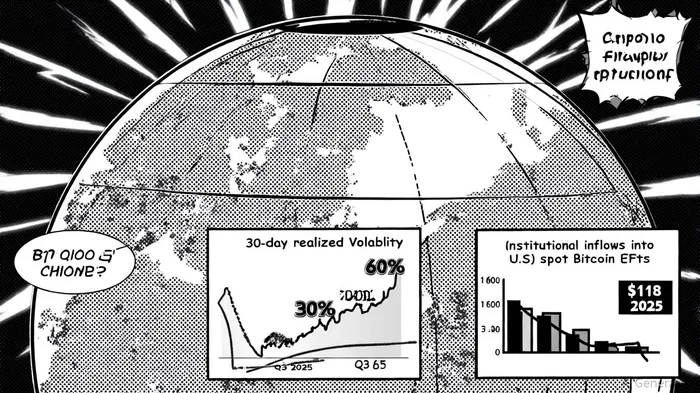
Bitcoin's volatility has entered a new phase. According to a report by Blockscholes, the asset's 30-day realized volatility rarely exceeded 60% in 2025, a marked improvement from pre-2023 levels. This maturation is partly attributed to the Federal Reserve's dovish pivot, which reduced macroeconomic uncertainty. In August 2025, Bitcoin's short-term implied volatility dropped to a 2025 low of 26%, coinciding with Chair Jerome Powell's Jackson Hole speech signaling potential rate cuts.
However, volatility remains a defining feature. Institutional investors have adopted nuanced risk management strategies, including diversified crypto portfolios: 50% in large-cap assets like Bitcoin and EthereumETH--, 20% in mid-cap altcoins, and 20% in stablecoins. Over 95% of institutional Bitcoin holdings are now stored in hardware wallets, with multi-tiered storage and stop-loss orders further mitigating downside risks.
Institutional Adoption: A Tipping Point
The surge in institutional exposure has been nothing short of transformative. U.S. spot Bitcoin ETFs attracted $118 billion in institutional inflows during Q3 2025, with BlackRock's IBIT alone amassing $86 billion in assets. This capital influx coincided with Bitcoin hitting an all-time high of $124,000 in mid-August. Corporate treasuries now hold 847,000 BTC (6% of total supply), with firms like CEA IndustriesBNC-- and Bit DigitalBTBT-- allocating up to 10% of their portfolios to Bitcoin.
Regulatory clarity has been a key enabler. The U.S. CLARITY Act and the EU's MiCAR framework have reduced legal uncertainty, while the inclusion of Bitcoin in retirement portfolios has normalized its role as a diversifier. Yet, challenges persist. A $1.2 billion outflow in Q3 2025, driven by Fed rate uncertainty, revealed lingering fragility. Structural factors—such as long-term holder dominance (68% of holdings) and corporate accumulation (18% supply locked)—helped stabilize prices, but volatility remains a wildcard.
Fragmented Markets: Strategic Allocation in a Divided World
The crypto market's fragmentation has created divergent opportunities. While the U.S. and EU embrace regulatory frameworks like MiCAR, regions such as Brazil, the UAE, and Singapore have emerged as crypto-friendly hubs. In contrast, India's restrictive policies and China's outright bans have pushed capital to more permissive jurisdictions.
Institutions are leveraging this fragmentation to optimize returns. For example, Brevan Howard and Harvard's increased stakes in BlackRock's IBIT reflect a strategic shift toward viewing Bitcoin as a core asset alongside gold and equities. Meanwhile, Ethereum's deflationary supply model and staking yields have attracted $151 million in ETF inflows in Q3 2025, outpacing Bitcoin's growth.
Risk Rebalance: The Path Forward
For investors, the key lies in balancing Bitcoin's potential with its risks. Modest allocations (5–10%) in traditional portfolios can enhance returns without significantly increasing volatility, according to Kaiko's analysis. Dollar-cost averaging (DCA) remains a recommended strategy for retail investors, while institutions rely on tactical entry points during oversold conditions.
The coming months will test this equilibrium. With the Fed expected to cut rates in Q4 2025 and Bitcoin ETFs gaining traction, the asset's role as an inflation hedge and portfolio diversifier is likely to expand. However, market fragmentation and regulatory shifts will require continuous recalibration.
Conclusion
Bitcoin's journey in 2025 underscores a maturing market. Volatility, once a barrier to adoption, now coexists with sophisticated risk management tools. Institutional exposure has reached critical mass, yet strategic positioning demands vigilance in a fragmented landscape. As the crypto ecosystem evolves, investors must navigate both the promise and perils of this new asset class with discipline and foresight.





Comentarios
Aún no hay comentarios