
Bitcoin's Volatility Amid Geopolitical Conflicts: A Strategic Analysis of Portfolio Resilience and Risk Management
In an era marked by escalating geopolitical tensions-from the Russia-Ukraine War to the Middle East conflicts-investors are increasingly scrutinizing Bitcoin's role as a hedge against uncertainty. While the cryptocurrency has shown flashes of safe-haven potential, its volatility and evolving market dynamics present a complex picture for portfolio resilience. This analysis examines Bitcoin's performance during key geopolitical events from 2022 to 2025, evaluates its diversification benefits, and explores its limitations as a reliable risk management tool.
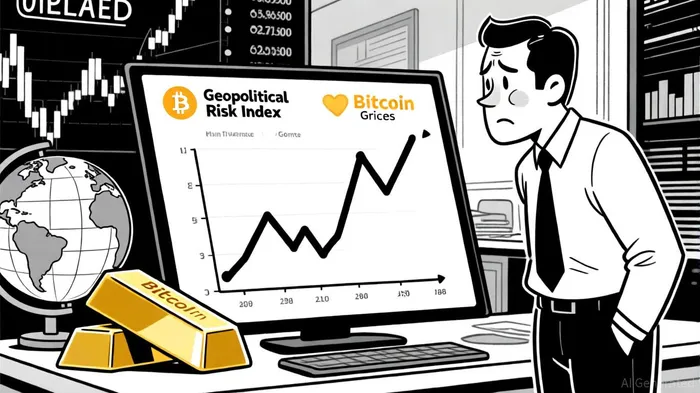
Bitcoin's Mixed Performance During Geopolitical Shocks
Bitcoin's response to geopolitical conflicts has been far from uniform. During the early stages of the Russia-Ukraine War in 2022, the cryptocurrency surged over 18% as investors sought decentralized alternatives amid frozen assets and currency instability, according to a CoinGecko report. However, broader market uncertainties later that year caused BitcoinBTC-- to plummet by 65%, as detailed in a CoinLive analysis. By mid-2023, it had recovered to pre-war levels, aided by growing institutional adoption.
In contrast, the October 2023 Israel-Gaza conflict saw Bitcoin remain relatively stable, rebounding to pre-crisis levels within 50 days, according to a ScienceDirect article. This resilience contrasted with the June 2025 Israel-Iran tensions, when Bitcoin dropped 4% in a single day amid fears of U.S. military escalation, a CoinLive analysis reported. The divergent outcomes highlight Bitcoin's dual nature: a speculative asset influenced by market psychology and a digital innovation gaining traction as a hedge in localized crises, as suggested by CoinLive.
The Geopolitical Risk (GPR) Index further contextualizes these dynamics. During the 2024 Iran-Israel conflict, Bitcoin's volatility remained within ±3% on the day of a missile attack, a marked improvement from the 2022 Russia-Ukraine war, the CoinGecko report observed. This suggests growing institutionalization and reduced reactivity to geopolitical shocks. Yet, as seen in October 2025, Bitcoin remains vulnerable to systemic risks, such as trade tensions and liquidity crises, which triggered an 18% crash amid U.S.-China trade hostilities, according to a FAF article.
Portfolio Resilience: Bitcoin vs. Traditional Safe-Haven Assets
Bitcoin's role in portfolio diversification has been a focal point for academics and investors. Studies indicate that Bitcoin enhances risk-adjusted returns during high economic policy uncertainty (EPU) periods but offers limited value in low EPU environments, as the CoinGecko report found. For instance, during the Russia-Ukraine conflict, Bitcoin demonstrated hedging potential against blue economy and green finance assets, as noted by the FAF article. However, its volatility often undermines its effectiveness compared to gold, which surged to record highs above $4,000 per ounce in October 2025 while Bitcoin faltered, according to the FAF article.
Comparative analyses reveal Bitcoin's unique risk-return profile. While it shows weak short-term correlations with traditional assets, its long-term linkages strengthen during extreme market shocks, the ScienceDirect article shows. For example, Bitcoin's negative correlation with the U.S. dollar positions it as a potential diversifier in portfolios, though its positive correlation with equities and commodities complicates its safe-haven narrative. A 2025 CoinGecko report noted Bitcoin's zero correlation with the S&P 500 in Q3 2025, alongside a near-historical high correlation with gold. This duality underscores its maturing role as an independent asset class but also highlights structural vulnerabilities.
Challenges and Limitations
Bitcoin's safe-haven potential is tempered by regulatory headwinds and market psychology. Regulatory actions, such as China's 2021 cryptocurrency ban and U.S. SEC enforcement, have historically increased Bitcoin's correlation with traditional markets, reducing its diversification benefits, as the FAF article argued. Similarly, social media sentiment and news cycles-such as hacking incidents or geopolitical escalations-exacerbate volatility, a CoinLive analysis noted.
The October 2025 crash exemplifies these challenges. Amid U.S. government shutdowns and trade tensions, Bitcoin faced a liquidity crisis, with $19 billion in leveraged positions liquidated within 24 hours, the FAF article reported. Institutional outflows from U.S. spot Bitcoin ETFs further signaled a reassessment of its risk profile, according to the FAF article. While Bitcoin eventually stabilized, the event exposed its susceptibility to systemic shocks, particularly when leveraged positions amplify selling pressure, as observed in the FAF coverage.
Strategic Implications for Investors
For investors navigating geopolitical uncertainty, Bitcoin offers both opportunities and risks. Its performance during localized conflicts-such as the Russia-Ukraine War-suggests utility as a tool for asset preservation and cross-border value transfer, as the CoinGecko report highlighted. However, its underperformance relative to gold during systemic crises highlights the need for caution.
A balanced approach might involve allocating Bitcoin to portfolios as a complementary diversifier rather than a primary safe-haven asset. Academic studies recommend limiting exposure to Bitcoin in risk-averse portfolios due to its volatility, as shown in a ResearchGate paper. Conversely, institutional adoption and ETF inflows-such as those seen in July 2025-signal growing confidence in its long-term resilience, a trend documented by CoinLive.
Conclusion
Bitcoin's volatility in response to geopolitical conflicts reflects its evolving identity as both a speculative asset and a digital innovation. While it has demonstrated resilience in localized crises and diversification benefits during high EPU periods, its susceptibility to regulatory shifts and systemic shocks limits its safe-haven status. For investors, the key lies in strategic allocation, leveraging Bitcoin's unique properties while mitigating its inherent risks through hedging against traditional assets like gold. As the cryptocurrency market matures, its role in portfolio resilience will depend on institutional adoption, regulatory clarity, and the global economic landscape.






Comentarios
Aún no hay comentarios