
Bitcoin's Volatility Amid Fed Uncertainty: Tactical Positioning in a Potential Rate-Cut Cycle
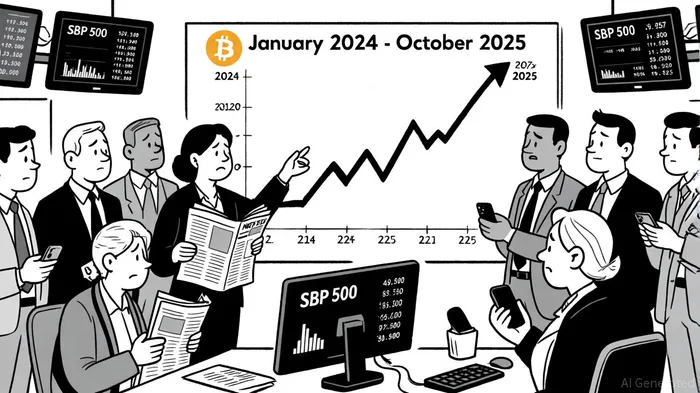
The Federal Reserve's October 2025 policy deliberations have created a fog of uncertainty, with divided officials struggling to balance inflation risks against economic growth. This ambiguity has sent ripples through financial markets, particularly into Bitcoin's price dynamics. As the Fed edges toward a potential rate-cut cycle, investors must navigate a landscape where historical correlations, institutional adoption, and macroeconomic signals converge to shape Bitcoin's volatility.
The Fed's Policy Dilemma: Dovish Signals and Internal Fractures
The Federal Reserve's September 2025 rate cut-lowering the federal funds rate by 25 basis points to 4.00%-4.25%-marked its first easing since December 2024, according to CBS News. However, the central bank's internal divisions, as revealed in meeting minutes, underscore a lack of consensus. While a majority of the FOMC supported further cuts, "around half" of participants favored two additional reductions by December, contrasting with a 10-9 split in the "dot plot" projections, per MarketMinute. Officials like Dallas Fed President Lorie Logan emphasized a "higher for longer" rate path to combat inflation, while dissenting Governor Stephen Miran argued for a more aggressive 50-basis-point cut, citing structural fiscal improvements, as noted in Forbes.
This policy tug-of-war has left markets in limbo. Polymarket bettors price in a 91% chance of a 25-basis-point cut at the October 28-29 meeting, according to CoinDesk, but conflicting signals from Fed officials-dovish vs. hawkish-have amplified uncertainty. Such ambiguity often drives volatility, as investors grapple with divergent expectations.
Bitcoin's Historical Response to Rate Cuts: A Mixed Playbook
Bitcoin's price has historically shown a positive correlation with Fed rate cuts, though the relationship is far from linear. A 2025 white paper estimates that a 1% reduction in the federal funds rate could drive Bitcoin's price up by 13.25%-30%, depending on broader economic conditions, according to a Cognac white paper. This dynamic played out in September 2025, when BitcoinBTC-- surged past $125,700 following the rate cut, echoing its 2020 rally amid pandemic-era easing, as reported in a CCN analysis.
Yet, past cycles reveal nuances. In 2019, Bitcoin initially surged 270% after three Fed rate cuts but later retraced 30% amid mixed economic signals, per data from Blockchain.news. Similarly, the 2024 rate cuts coincided with a 75% correction in Bitcoin's price during the subsequent tightening cycle, as reported on CryptoTalkk. These examples highlight that while liquidity injections from rate cuts can fuel risk-on sentiment, Bitcoin's trajectory also depends on inflation trends, institutional flows, and global macroeconomic health.
Tactical Positioning: Balancing Liquidity, Diversification, and Hedging
For investors, the key lies in tactical positioning that accounts for both the Fed's potential easing and its risks. Several strategies emerge from historical case studies:
Leverage Institutional Tools: The rise of spot Bitcoin ETFs, such as BlackRock's IBIT, has institutionalized Bitcoin's appeal. In early October 2025, ETF inflows hit $2.1 billion, according to MarketMinute. Allocating to ETFs offers liquidity and regulatory clarity, making Bitcoin more accessible to traditional investors.
Hedge Against Volatility: Given Bitcoin's high-beta nature, delta-neutral strategies-such as pairing long spot positions with short perpetual futures-can mitigate downside risk during Fed announcements, as outlined on the Millionero blog. This approach was notably effective in 2024, when unexpected rate cuts triggered sharp price swings, as CCN reported.
Monitor Macro Signals: Bitcoin's 92% correlation with the S&P 500 underscores the importance of tracking broader economic indicators, per The Coin Republic. For instance, a weaker U.S. dollar (often a byproduct of rate cuts) historically benefits Bitcoin as a hedge against fiat devaluation, according to CoinPulse. Conversely, stagflation risks-where inflation remains high while growth slows-could limit Bitcoin's upside despite easing rates, as analyzed by BeInCrypto.
Adopt a Phased Entry: Instead of all-in bets, gradual accumulation during Fed uncertainty can reduce exposure to short-term volatility. In September 2025, Bitcoin's price dipped temporarily after the rate cut but recovered as October's "Uptober" narrative gained traction, detailed in the Uptober Outlook. A disciplined, dollar-cost-averaging approach aligns with this pattern.
Risks and the Road Ahead
While the Fed's dovish tilt supports Bitcoin, risks persist. A premature easing cycle could signal deeper economic weakness, triggering stagflation concerns and dampening risk appetite, a point flagged by CCN. Additionally, regulatory scrutiny-such as potential restrictions on crypto ETFs-remains a wildcard. Investors must also remain cautious of overleveraging, as seen in March 2020, when Bitcoin initially plummeted 40% despite Fed easing before rebounding, a scenario highlighted by BeInCrypto.
Conclusion: Navigating the Fed's Fog
Bitcoin's volatility in a potential rate-cut cycle hinges on the Fed's ability to balance inflation control with growth support. Historical data suggests that Bitcoin benefits from liquidity-driven easing, but its performance is ultimately shaped by broader macroeconomic narratives. For tactical investors, the path forward involves diversifying portfolios, hedging against volatility, and closely monitoring Fed communications-particularly Chair Powell's post-meeting remarks, which often dictate market sentiment, as noted by BitcoinInfoNews.
As the October 2025 rate decision looms, Bitcoin's price may serve as a barometer for the Fed's policy efficacy. Those who position strategically-leveraging historical insights and institutional tools-stand to capitalize on the opportunities ahead.






Comentarios
Aún no hay comentarios