
Bitcoin's Volatility Amid Fed Uncertainty: A Macro-Driven Playbook for Strategic Entry Points
The Fed's Tightrope: Policy Uncertainty and Bitcoin's Near-Term Volatility
Bitcoin's recent dip below $111,000 has reignited debates about its sensitivity to Federal Reserve policy. With the Fed navigating a delicate balance between cooling inflation and supporting a slowing labor market, investors are left deciphering conflicting signals from Jerome Powell and macroeconomic data. The September 2025 rate cut—marking the first reduction since December 2024—was accompanied by projections of a gradual decline in unemployment and inflation over the next three years[5]. Yet Powell's cautious stance, including his recent assertion that the Fed is “not allowed” to own Bitcoin[5], underscores a regulatory and policy environment that remains skeptical of crypto's role in the financial system.
This uncertainty has created a volatile backdrop for BitcoinBTC--. While institutional adoption and ETF inflows have pushed prices to record highs, the asset's correlation with macroeconomic indicators—particularly inflation and interest rates—remains a double-edged sword. For investors, the challenge lies in identifying strategic entry points amid this volatility, leveraging both technical and macroeconomic frameworks to mitigate risk while capitalizing on long-term potential.
Powell's Cautious Stance: A Delayed, Not Eliminated, Upside
Federal Reserve Chair Jerome Powell's recent comments have painted a nuanced picture of the central bank's approach to Bitcoin. During his Jackson Hole speech in August 2025, Powell's hints at a rate cut spurred a surge in Bitcoin to over $112,000, with related stocks like MicroStrategy and CoinbaseCOIN-- rising in tandem[1]. However, his September 23 statement—highlighting a “shift in the balance of risks” and a move toward a neutral policy stance—has tempered optimism[2]. Powell's comparison of Bitcoin to gold, emphasizing its role as a speculative asset rather than a medium of exchange[3], has further complicated the narrative.
While these mixed signals suggest the Fed is unlikely to embrace Bitcoin anytime soon, they also reflect a broader legitimization of the asset class. Powell's acknowledgment of Bitcoin's speculative nature, coupled with the Fed's ongoing five-year review of its monetary policy framework[4], indicates a cautious but not entirely dismissive stance. For investors, this means Bitcoin's long-term upside remains intact, but near-term volatility will persist as markets parse the Fed's evolving posture.
Technical Analysis: A Post-$111k Dip Playbook
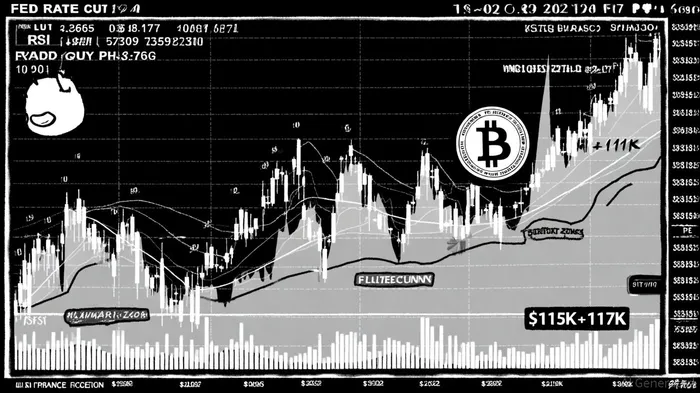
Bitcoin's recent pullback to $111,000 has triggered a mix of bearish and bullish technical signals. On the bearish side, the asset is trading below key short-term moving averages (10-, 20-, 50-day SMAs) and faces resistance at $115,000–$117,000[1]. The RSI is nearing oversold territory, suggesting potential short-term relief, but bearish momentum remains evident in the MACD and Commodity Channel Index (CCI)[1].
However, long-term support appears intact, with Bitcoin holding above the 100- and 200-day EMAs at approximately $111,000 and $103,000, respectively[1]. A Bollinger Band squeeze—a technical indicator of impending volatility—further suggests that a breakout is imminent[3]. If buyers step in around the $110,000–$111,000 range, RSI relief could push prices back toward key resistance levels. Conversely, a breakdown below $110,000 could test the $107,000–$108,000 zone, with the 200-day SMA at $103,000 serving as a critical floor[1].
Macroeconomic Indicators: Strategic Entry Points in a Post-Dip Environment
Bitcoin's price movements in 2025 have been closely tied to U.S. inflation data, particularly the Personal Consumption Expenditures (PCE) index. For example, the September 2025 PCE report—showing headline inflation at 2.9% and core PCE at 3.1%—signaled persistent inflationary pressures, which could delay further Fed rate cuts[4]. Similarly, the Consumer Price Index (CPI) rose to 2.9% year-over-year in September 2025, reinforcing the Fed's cautious approach[1].
These trends create a compelling case for strategic entry points. A dip to the $103,000–$105,000 range, for instance, could represent a high-probability opportunity if inflation data stabilizes and the Fed proceeds with its projected rate cuts. Historical precedent suggests that Bitcoin often rallies in response to dovish policy shifts, as seen in 2020 when rate cuts coincided with a price surge[5]. Additionally, the Federal Reserve's projected gradual decline in unemployment and inflation over the next three years[5] supports a long-term bullish case, even if near-term volatility persists.
Risk Management: Navigating a Volatile Landscape
Bitcoin's volatility necessitates a disciplined risk management framework. Given the asset's sensitivity to macroeconomic data, investors should consider hedging strategies such as options or futures to mitigate downside risk. Position sizing is also critical: allocating a smaller percentage of a portfolio to Bitcoin during periods of high volatility can preserve capital while allowing exposure to potential upside.
Technical indicators like the RSI and MACD can further aid in timing exits and entries. For example, an overbought RSI (above 70) may signal a temporary pullback, while a bearish MACD crossover could justify reducing positions. Conversely, a bullish breakout above $115,000—confirmed by increased volume—could justify adding to positions.
Conclusion: A Macro-Driven Path to Long-Term Value
Bitcoin's near-term volatility, driven by Federal Reserve policy uncertainty, presents both challenges and opportunities for investors. While Powell's cautious stance may delay rate cuts and prolong short-term turbulence, the asset's long-term fundamentals—scarcity, institutional adoption, and its role as an inflation hedge—remain robust. By combining technical analysis with macroeconomic insights, investors can identify strategic entry points and manage risk in a post-$111k dip environment.
As the Fed continues its delicate balancing act, Bitcoin's price trajectory will likely remain intertwined with broader economic trends. For those willing to navigate the volatility, the path to long-term value may yet be illuminated by the interplay of policy, data, and market sentiment.





Comentarios
Aún no hay comentarios