
Bitcoin's Volatility and the Fed's Shadow: Strategic Entry Points Amid Macroeconomic Uncertainty
The Federal Reserve's monetary policy has long cast a long shadow over global financial markets, but its influence on Bitcoin's volatility and institutional adoption has taken on new dimensions in 2023–2025. As central banks grapple with inflationary pressures, currency devaluation risks, and shifting regulatory landscapes, BitcoinBTC-- has emerged as both a speculative asset and a strategic hedge. For institutional investors, navigating this interplay between macroeconomic uncertainty and crypto allocation requires a nuanced understanding of how Fed signals shape Bitcoin's price dynamics-and where opportunities for strategic entry lie.
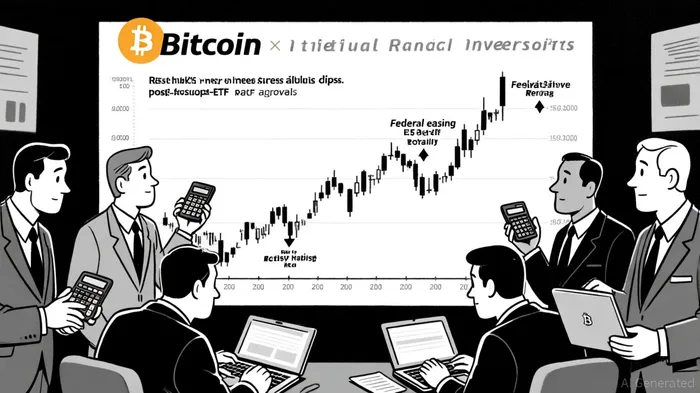
The Fed's Dual Role: Catalyst and Wildcard
Bitcoin's volatility remains a defining feature, but its correlation with Fed policy has evolved. While rate hikes and inflation spikes historically triggered short-term sell-offs, 2025 data reveals a paradox: institutional demand persists even amid volatility. For instance, delayed Fed rate cuts in early 2025 initially depressed Bitcoin's price, yet institutions continued buying dips, with one wallet acquiring $680 million worth of Bitcoin on September 16, 2025, following a 25-basis-point rate cut, according to Bitscreener. This resilience stems from Bitcoin's dual role as a hedge against inflation and a non-correlated asset in diversified portfolios.
The Fed's monetary base expansion and interest rate adjustments also indirectly influence Bitcoin through liquidity regimes. A dovish pivot, such as the September 2025 rate cut, reduced real yields and spurred risk-on flows, with Bitcoin surging to $109,000 amid ETF inflows exceeding $58 billion by Q2 2025, according to a Kenson Investments update. Conversely, hawkish signals-like the Fed's 2024 quantitative tightening-tightened liquidity, amplifying short-term volatility. However, institutional participation has dampened Bitcoin's price swings by 75% compared to pre-ETF approval levels, according to a CoinPulse analysis, suggesting a maturing market structure.
Institutional Strategies: From Speculation to Treasury Allocation
Institutional adoption has been a linchpin of Bitcoin's institutionalization. By 2025, 59% of Bitcoin portfolios are held by institutions, driven by regulatory clarity (e.g., spot ETF approvals) and macroeconomic tailwinds, according to CoinPulse. The approval of Bitcoin ETFs in 2024 marked a watershed, enabling firms to allocate 1%–3% of portfolios to Bitcoin as part of inflation-hedging strategies, according to a Kenson Investments update. For example, MicroStrategy's 2025 purchase of 11,000 BTC underscored corporate treasuries' growing appetite for Bitcoin, with small businesses allocating 10% of net income to the asset, according to a Business Initiative report.
Custody solutions have further lowered barriers. Hybrid models combining third-party custodians (e.g., Fidelity, Coinbase) with self-custody ensure institutional-grade security while complying with evolving regulations like the CLARITY Act, CoinPulse notes. Meanwhile, the U.S. Strategic Bitcoin Reserve, established in March 2025, and bipartisan support for digital assets have legitimized Bitcoin as a systemic asset, CoinPulse adds.
Strategic Entry Points: Timing the Fed's Moves
Institutional buyers have refined their timing strategies around Fed signals. Key entry points emerge during:
1. Rate Cut Announcements: The September 2025 rate cut triggered a 12% Bitcoin rally as institutions capitalized on discounted borrowing costs, Bitscreener reported.
2. Inflation Dips: Softening inflation data in Q1 2025 reduced real rates, prompting $4.41 billion in ETF inflows and a 15% price surge, according to a OneSafe analysis.
3. Regulatory Milestones: The CLARITY Act's passage in July 2025 reduced compliance risks, spurring $65 billion in ETF AUM by Q1 2025, CoinPulse notes.
However, macroeconomic uncertainty remains a wildcard. Political tensions, such as potential clashes between President Trump and Fed Chair Powell, could disrupt market sentiment, as highlighted in an OKX analysis. Institutions mitigate this by adopting "buy-the-dip" strategies, as seen in August 2025 when on-chain data revealed passive buyers absorbing volatility despite a temporary cooling in CoinbaseCOIN-- Premium Index activity, Bitscreener observed.
Analytical Frameworks: Balancing Supply and Demand
Institutions employ supply-demand models to time Bitcoin purchases. Bitcoin's fixed supply (only 700,000 new coins to be mined over six years) contrasts sharply with projected $3 trillion in institutional demand, creating a 40:1 imbalance, according to Datos Insights. This dynamic is amplified by Fed-driven liquidity shifts: lower real rates incentivize capital allocation to Bitcoin, whose inelastic supply confers scarcity value, according to an MDPI study.
A critical framework involves monitoring the Fed's dot plot and forward guidance. Dovish pivots, like Powell's Jackson Hole speech advocating aggressive easing, historically correlate with Bitcoin's 20%+ rallies, a JU blog suggests. Conversely, hawkish surprises-such as delayed rate cuts in early 2025-trigger short-term volatility but often result in institutional accumulation, as seen in the September 2025 $680 million purchase, reported by Bitscreener.
Conclusion: Navigating the Fed's Shadow
Bitcoin's journey from speculative asset to institutional staple reflects a broader shift in how macroeconomic uncertainty is managed. While the Fed's policies remain a double-edged sword-driving volatility yet enabling strategic entry points-the interplay between regulatory clarity, supply constraints, and institutional demand defines Bitcoin's trajectory. For investors, the key lies in aligning crypto allocations with Fed signals, leveraging ETFs and custody innovations to mitigate risks while capitalizing on Bitcoin's role as a hedge against a fracturing global monetary system.
As the Fed's shadow looms, the question is no longer whether Bitcoin belongs in institutional portfolios-but how deeply it will embed itself in the fabric of macroeconomic strategy.





Comentarios
Aún no hay comentarios