
Bitcoin's Volatility Before the Fed: A Macro-Driven Speculative Playbook
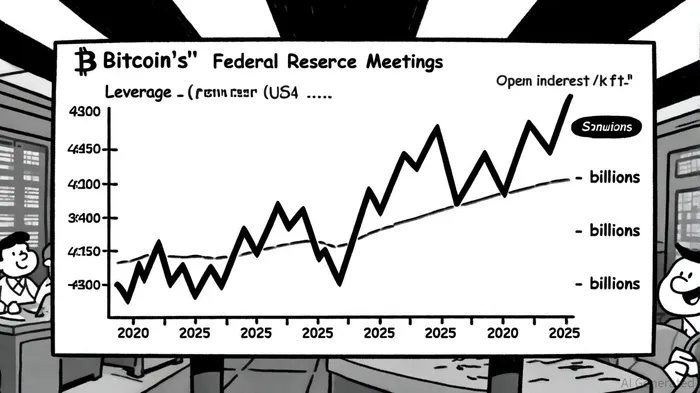
Bitcoin's price action ahead of the Federal Reserve's September 2025 policy decision is a masterclass in macro-driven speculation. The cryptocurrency is perched near $115,000, a level that has become a fulcrum for both institutional and retail positioning. With the Fed's rate cut widely anticipated, the market is caught in a tug-of-war between optimism and caution—a dynamic amplified by speculative positioning, leverage ratios, and historical volatility patterns.
The Current Macro Setup: Cautious Bullishness
Bitcoin's price has consolidated within a narrow range of $114.6K–$117.1K, reflecting a market in wait-and-see mode. Social sentiment remains bullish, with 64% of comments leaning positive—the highest greed levels in ten weeks[3]. Technical indicators, such as the 50-day simple moving average (SMA) turning upward and the 100 SMA flattening, suggest renewed momentum[1]. However, the Crypto Fear and Greed Index remains neutral, signaling underlying caution[5].
This duality is mirrored in trader positioning. Open interest in BitcoinBTC-- futures stands at $96 billion, with leverage ratios hitting a peak since late 2021[1]. The liquidation heatmap reveals tightly packed positions around $115K, indicating that even a minor price deviation could trigger sharp volatility[5]. Meanwhile, the Altcoin Season Index has climbed to 71, nearing the 75 threshold historically associated with altcoin rallies[5]. This suggests broader crypto markets are primed for a breakout—if the Fed delivers a dovish surprise.
Historical Patterns: Fed Events and Bitcoin's Volatility
Bitcoin's volatility has long been a function of macroeconomic catalysts, particularly Federal Reserve policy. Over the past decade, the 30-day BTC/USD volatility averaged 4.56% in 2021 and typically ranged between 4% and 5%[1]. However, during FOMC meetings, this volatility intensifies. Traders often reduce leverage and risk exposure pre-meeting, leading to declines in open interest[2]. Yet recent deviations from this norm—such as the March 2025 meeting, where open interest held steady despite a price drop—suggest shifting expectations about Fed outcomes[2].
Historical data underscores the asymmetry of Bitcoin's response to Fed decisions. Dovish outcomes, such as the emergency rate cuts in March 2020, catalyzed surges of over 100% in Bitcoin's price by August 2020[3]. Conversely, the 2019 mid-cycle cuts initially triggered a 30% decline before Bitcoin resumed its uptrend[3]. These divergent outcomes highlight the importance of broader economic context. In 2020, liquidity-driven demand for risk assets dominated; in 2019, inflation concerns and a weaker dollar were less favorable.
Trader Positioning: Leverage, COT Reports, and Institutional Bets
Granular trader positioning data reveals a market teetering on the edge of a speculative frenzy. As of August 2025, Bitcoin's long/short ratio showed a slight bearish bias, with 51.84% of traders holding short positions[4]. This contrasts with the bullish social sentiment, suggesting a divergence between retail optimism and institutional caution. The Commitments of Traders (COT) report for September 9, 2025, further highlights this tension, with non-commercial (speculative) traders increasing short positions ahead of the Fed's decision[5].
Leverage ratios add another layer of complexity. The Realized Cap Leverage Ratio hit 10.2% in May 2025, placing it among the top 10.8% of trading days since 2018[1]. This level of leverage amplifies the risk of cascading liquidations should Bitcoin break below $115K. Conversely, if the Fed signals sustained easing, the leverage-driven environment could fuel a rapid rally toward $120K–$122K[5].
Institutional positioning also plays a critical role. South Korea's granting of venture status to crypto firms and the FDIC's easing of crypto service restrictions have bolstered confidence[6]. Meanwhile, proposals for a U.S. government strategic Bitcoin reserve underscore growing institutional adoption[2]. These developments suggest that even a modest rate cut could trigger a re-rating of Bitcoin as a macro asset.
The Fed's Dovish Signal: A Catalyst or a Mirage?
The Fed's September 2025 decision to cut rates by 0.25%, bringing the federal funds rate to 4%–4.25%, marks the first easing of the year[6]. Officials project two more cuts by year-end, targeting a 3.5%–3.75% range[6]. This dovish trajectory is expected to weaken the U.S. dollar and reduce bond yields, both of which lower the opportunity cost of holding Bitcoin[4].
However, the market is bracing for a hawkish twist. Seven of 19 policymakers dissented from the rate cut, with some advocating for a half-point reduction[6]. Internal divisions and the Fed's acknowledgment of “downside risks to employment” suggest that forward guidance could be more cautious than anticipated[6]. A weaker-than-expected labor market or a surprise pivot to hawkish rhetoric could trigger a sharp correction, exposing Bitcoin to dips below $112K[1].
Conclusion: A High-Stakes Macro Bet
Bitcoin's volatility ahead of the Fed's decision is a function of speculative positioning, leverage, and macroeconomic uncertainty. The market is priced for a dovish outcome, but the risk of a hawkish surprise remains. For investors, the key lies in hedging against both scenarios: long positions for a Fed-driven rally and short exposure to capitalize on potential corrections.
As the Fed's September 17 meeting approaches, the crypto market is a microcosm of broader financial dynamics. Bitcoin's price action will not only reflect the Fed's policy but also test the resilience of a speculative environment built on leverage and liquidity. In this high-stakes game, the winners will be those who understand the interplay between macro forces and trader psychology.






Comentarios
Aún no hay comentarios