
Bitcoin Volatility and the Erosion of Risk Premiums in Crypto-Collateralized Equity Strategies
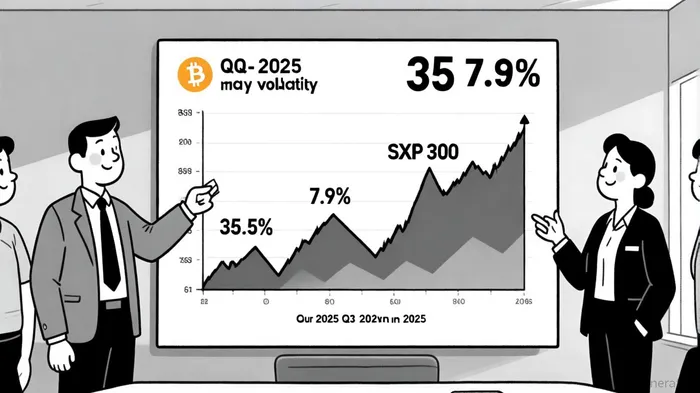
The crypto-collateralized equity strategy has become a hotbed of innovation—and controversy—as institutional investors increasingly allocate BitcoinBTC-- to collateralize equity positions. But here's the rub: Bitcoin's volatility is a double-edged sword. While it amplifies returns in bullish cycles, it also erodes risk premiums when the market turns bearish. Let's break down the numbers and the real-world implications.
The Volatility Conundrum
Bitcoin's annualized volatility in Q3 2025 averaged 35.5%, dwarfing the S&P 500's 7.9% [3]. This isn't just noise—it's a structural issue. When companies like Semler ScientificSMLR-- load up on Bitcoin as a corporate treasury asset, they expose their equity to wild swings. Case in point: Semler's stock plummeted 45% in mid-2025 despite Bitcoin's price rising, as dilution from equity issuance near net asset value (NAV) crushed shareholder value [1]. This isn't a fluke; it's a warning shot.
Risk Premiums Under Fire
The risk premium erosion is quantifiable. Bitcoin's contribution to active risks in equity portfolios now exceeds 10% in defensive strategies [2]. Why? Because Bitcoin's volatility isn't just higher—it's asymmetric. Negative returns drive volatility spikes more than positive ones, a phenomenon known as the leverage effect [4]. For example, during April 2025's market stress, Bitcoin's seven-day realized volatility hit 83%, while the S&P 500 surged to 169% [3]. The result? Investors demand higher compensation for holding Bitcoin, but when volatility erupts, those premiums vanish faster than a candle in a hurricane.
The Math of Erosion
Let's get granular. Bitcoin's variance risk premium (VRP)—the compensation investors demand for bearing uncertainty—is 3.6x that of the S&P 500 [2]. But here's the twist: in low-volatility regimes, Bitcoin's pricing kernel (PK) is steeper in the negative return region, meaning investors prioritize downside protection. In high-volatility states, the PK flattens, and the VRP drops. This dynamic creates a seesaw effect: when Bitcoin's volatility spikes, the risk premium erodes, and strategies collateralized with it face margin calls or forced liquidations.
The Bottom Line
Crypto-collateralized equity strategies aren't dead—but they're far from bulletproof. The key takeaway? Diversification and hedging are non-negotiable. Direct hedging via options or stock selection constraints can mitigate Bitcoin's tail risks [2]. For now, the market is in a “healthy correction” phase, per on-chain metrics like the MVRV Z-Score (1.43) and Value Days Destroyed (VDD) in the “green zone” [5]. But as Q3 2025 progresses, investors must brace for volatility to intensify—especially with the Fed's rate cuts and potential trade wars on the horizon.







Comentarios
Aún no hay comentarios