
Bitcoin's Volatility Amid Central Bank Divergence: Is This a Buying Opportunity?
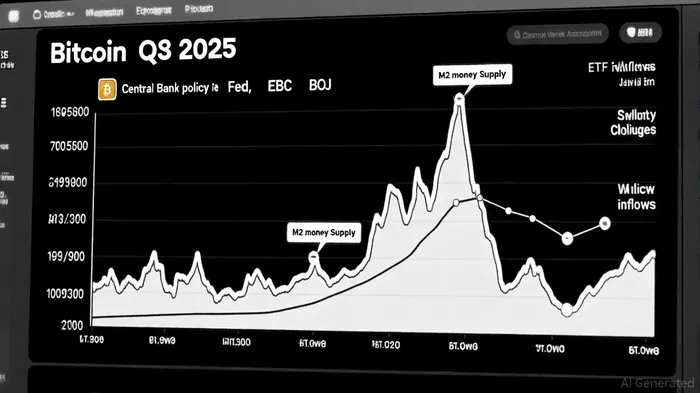
In 2025, Bitcoin's price action has become a barometer for global macroeconomic shifts. Central bank policies—particularly divergent approaches to inflation, growth, and liquidity—are amplifying Bitcoin's volatility while reshaping how investors allocate capital to crypto assets. As the Federal Reserve tightens to combat stubborn inflation and the European Central Bank and Bank of Japan ease to stimulate growth, the resulting interest rate differentials are creating a tug-of-war between risk-on and risk-off dynamics. This divergence isn't just a technicality; it's a catalyst for rethinking Bitcoin's role in a portfolio.
Central Bank Divergence: A New Era of Macro Uncertainty
Central banks are no longer marching in lockstep. The U.S. Federal Reserve has maintained a restrictive monetary stance, keeping rates elevated to curb inflation, while the ECB and BOJ have pivoted toward easing amid weaker growth and deflationary pressures [1]. This divergence has created pronounced interest rate differentials, fueling forex volatility and spilling over into alternative assets like BitcoinBTC--. For example, the yen's depreciation following BOJ's easing has driven capital flows into higher-yielding assets, including Bitcoin, while the Fed's hawkish pivot has periodically triggered risk-off sentiment [4].
The result? A fragmented macroeconomic landscape where Bitcoin's price is increasingly sensitive to policy surprises. According to a report by Exness, Bitcoin's volatility in Q3 2025 spiked to multi-year highs as traders navigated conflicting signals from central banks [1]. This volatility isn't a bug—it's a feature of a world where monetary policy is no longer a monolith.
Macro-Driven Crypto Allocation: Rates, ETFs, and Institutional Appetite
Bitcoin's appeal as a macro asset is rooted in its inverse relationship with interest rates. Lower rates reduce the opportunity cost of holding non-yielding assets like Bitcoin, making it more attractive to investors seeking yield in a low-interest-rate environment [2]. This dynamic has been amplified by the launch of Bitcoin ETFs, which have injected institutional-grade liquidity into the market. As of Q3 2025, ETFs alone hold 1.3 million BTC, with corporations and sovereign entities adding to their treasuries, effectively reducing circulating supply and supporting price [3].
The “buy the rumor, sell the news” cycle has also become a defining feature of Bitcoin's macro-driven behavior. For instance, Bitcoin surged to $117,000 in anticipation of a Fed rate cut in 2025 but dipped afterward as traders took profits or expectations were unmet [2]. Altcoins, with higher betas to Bitcoin, have experienced even more pronounced swings, underscoring the asset class's growing integration with traditional markets.
Is This a Buying Opportunity? Balancing Bulls and Bears
The case for Bitcoin as a buying opportunity hinges on two pillars: monetary tailwinds and structural adoption. On the monetary side, cumulative central bank easing—particularly if the Fed follows through on its September 2025 rate cut—could boost global liquidity and drive capital into risk assets. A report by Tiger Research estimates that a record M2 money supply of over $90 trillion and the inclusion of Bitcoin in 401(k) retirement accounts could inject $89 billion into the market, providing long-term stability [1].
Structurally, Bitcoin's role as a “zero-duration” asset is gaining traction. As central banks strategically allocate to gold and other non-fiat assets, Bitcoin's appeal as a hedge against currency debasement is growing [3]. However, risks remain. The potential return of trade tensions—such as the expiration of Trump's 90-day tariff freeze—could disrupt Bitcoin's upward momentum [3].
Conclusion: Navigating the New Normal
Bitcoin's volatility in 2025 is less a sign of instability and more a reflection of its evolving role in a macro-driven world. For investors, the key is to view Bitcoin notNOT-- as a speculative bet but as a strategic allocation to a liquidity-sensitive asset class. While central bank divergence introduces noise, it also creates opportunities for those who can parse the signal from the noise.
As the year progresses, the interplay between policy divergence, institutional adoption, and regulatory clarity will determine whether Bitcoin's volatility becomes a feature of its value proposition—or a barrier to mainstream acceptance. For now, the data suggests that Bitcoin's price trajectory is less about the coin itself and more about the world it's trying to hedge against.






Comentarios
Aún no hay comentarios