
Bitcoin's Volatility Amid $22B Options Expiry: A Strategic Buying Opportunity?
Bitcoin's $22 billion options expiry on September 26, 2025, has become a focal point for traders and investors, with the cryptocurrency trading near critical support levels and open interest skewed toward bullish call options. This event, one of the largest quarter-end expiries of the year, could trigger significant price swings as market participants reposition portfolios. But for those willing to navigate the volatility, this expiry may present a strategic entry point—if approached with a disciplined understanding of options-driven psychology and risk management.
Options-Driven Market Psychology: Max Pain and Sentiment Shifts
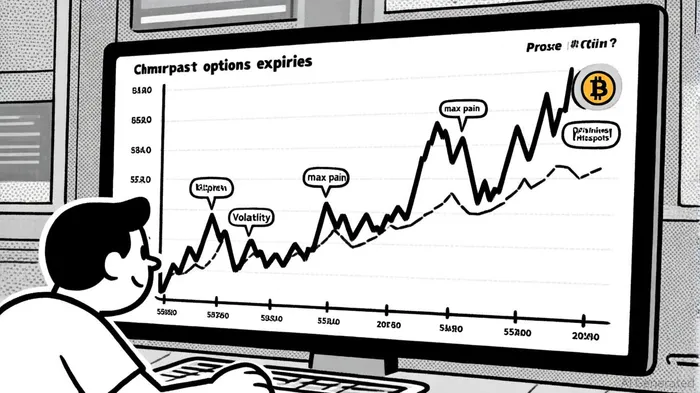
The expiry's psychological impact is rooted in the “max pain” theory, which posits that Bitcoin's price often gravitates toward the strike price where the most options expire worthless. Historical data shows this theory has held true in 73% of cases since 2023[1]. For this expiry, the max pain level is estimated at $111,000, just above Bitcoin's current price of $111,578.31[3]. If the price converges toward this level, it could create a temporary equilibrium between bullish and bearish positions, offering traders a window to assess directional bias.
Sentiment indicators further complicate the picture. The put/call ratio for BitcoinBTC-- options stands at 0.71, signaling a net bullish bias[1]. However, this optimism is tempered by a 30-day delta skew favoring puts by 13% on Deribit, suggesting lingering caution[3]. This duality reflects a market torn between short-term bearish positioning and long-term bullish conviction—a tension that often amplifies volatility during expiry.
Institutional behavior also plays a role. Deribit, which holds $17.07 billion in open interest, has $12.6 billion concentrated in call options above $120,000[3]. If Bitcoin fails to hold above $112,000, these positions could trigger a cascade of liquidations, pushing the price toward lower support levels. Conversely, a successful defense of $112,000 might see gamma scalping activity from market makers, further reinforcing the bullish case[2].
Risk-Managed Entry Strategies: Navigating the Volatility
For investors considering entry, the key lies in leveraging options-driven volatility while mitigating downside risk. One approach is the short strangle strategy near max pain levels. By selling out-of-the-money call and put options, traders can collect premiums if Bitcoin consolidates around $111,000. This strategy benefits from the high open interest at $120,000 (calls) and $110,000 (puts), where liquidity is deepest[3].
Another tactic is gamma scalping in put-heavy zones. With Ethereum ETF outflows and macroeconomic uncertainty creating bearish headwinds[3], traders can profit from short-term dips by buying puts near $108,000—a level where forced selling from short gamma positions could amplify downward moves[2]. However, this requires strict stop-loss discipline, as a break above $112,000 could invalidate the bearish thesis.
Monitoring open interest and liquidity is equally critical. Large open interest at specific strike prices can create “pinning effects,” where prices cluster around those levels due to hedging activity[1]. For example, the $120,000 call options have $3.3 billion in open interest, meaning even a modest price surge toward this level could trigger aggressive delta hedging, further fueling upward momentum[3].
Macro Factors: Beyond the Options Expiry
While options expiry is a catalyst, broader macroeconomic forces cannot be ignored. The U.S. Federal Reserve's rate-cut expectations and potential government shutdowns have already pressured Bitcoin, with Ether ETF outflows compounding the bearish sentiment[3]. Additionally, on-chain data from Glassnode suggests long-term holders are showing signs of exhaustion—a pattern historically associated with market tops[3].
Yet, long-term fundamentals remain intact. Bitcoin's adoption in corporate treasuries and infrastructure projects continues to grow[3], and new products like BlackRock's Premium Income ETF—using covered calls on Bitcoin futures—signal institutional confidence[1]. These developments suggest that while the expiry may cause short-term turbulence, the underlying narrative for Bitcoin remains intact.
Is This a Buying Opportunity?
The $22B options expiry is a double-edged sword. For risk-tolerant investors, the convergence of max pain dynamics, skewed open interest, and macroeconomic catalysts creates a high-probability scenario for price discovery. A strategic entry could involve:
1. Dollar-cost averaging into Bitcoin as it consolidates near $111,000, using options premiums to offset costs.
2. Hedging with puts to protect against a breakdown below $110,000.
3. Monitoring liquidity shifts post-expiry, as normalized open interest could create mean-reversion opportunities[3].
However, this approach requires patience and discipline. As one analyst noted, “The expiry is a test of conviction. Those who panic-sell at the first sign of volatility may miss the rebound”[4].






Comentarios
Aún no hay comentarios