
Bitcoin's Volatility in 2025: Leveraged Trading and Macroeconomic Forces at Play
The Perfect Storm: Leverage and Macroeconomic Divergence
Bitcoin's volatility in 2025 has been shaped by a dual force: the explosive growth of leveraged derivatives trading and the shifting tides of global macroeconomic policy. These factors have created a feedback loop where speculative activity amplifies price swings, while central bank decisions and fiscal policies further destabilize market sentiment.
Leveraged Trading: A Double-Edged Sword
According to derivatives market statistics, the crypto derivatives market has matured into a $28 trillion annual behemoth, with perpetual swaps accounting for 78% of trading volume (derivatives market statistics). Platforms now offer up to 125x leverage on BitcoinBTC-- futures, enabling retail and institutional traders to amplify gains-or losses-exponentially. This environment reached a boiling point on "Red Monday" (September 22, 2025), when $1.5 billion in leveraged long positions were liquidated within hours, according to the same derivatives market statistics. The event triggered a defensive repositioning: U.S. traders increased margin-call checks by 40%, while Asian markets rebounded with a 32% surge in futures setups, the report notes.
The systemic risk here is stark. Open interest in Bitcoin futures hit $45.3 billion by October 2025, according to a KuCoin analysis (KuCoin analysis), meaning even a 10% price drop could trigger a $4.5 billion loss in leveraged positions. This concentration of risk is exacerbated by the dominance of platforms like Binance (36% market share) and the rise of decentralized derivatives exchanges (DEXs), which saw 80% QoQ growth in perpetual trading volumes, per the derivatives market statistics.
Macroeconomic Triggers: Dovish Policies and Inflationary Pressures
Bitcoin's price action in 2025 has been inextricably linked to central bank policies. The U.S. Federal Reserve's 25-basis-point rate cut in September 2025 weakened the dollar and fueled risk-on sentiment, pushing Bitcoin above $125,700 in early October, the derivatives market statistics show. However, divergent global policies have introduced volatility. The European Central Bank's cautious stance and the Bank of England's pause on rate cuts have created uncertainty in capital flows, as noted in the KuCoin analysis.
Meanwhile, Bitcoin's role as an inflation hedge has intensified. The upcoming U.S. CPI report on October 15, 2025, looms large: a surprise spike in inflation could trigger a flight to Bitcoin, while a cooling reading might extend a correction, according to a CoinRepublic analysis (CoinRepublic analysis). This dynamic is compounded by fiscal stimulus measures, such as the U.S. 2025 reconciliation bill and China's GDP expansion, which have injected liquidity into global markets, the KuCoin analysis adds.
Institutional Adoption: A Stabilizing Force or a New Risk?
Institutional participation has grown to 42% of total derivatives trading volume, per the derivatives market statistics, with spot Bitcoin ETFs driving $88.7 billion in open interest by late September, according to a BreakingCrypto article (BreakingCrypto article). While this has reduced Bitcoin's average daily volatility post-ETF launch, it has also created new risks. For instance, CME Group's Bitcoin futures open interest reached $39 billion by September 2025, yet its daily volume ($311 million) pales compared to centralized exchanges - a disparity that highlights the fragility of liquidity in a market still dominated by unregulated platforms, the derivatives market statistics indicate.
The Path Forward: Balancing Opportunity and Peril
Bitcoin's current trajectory reflects a precarious equilibrium. On one hand, record leverage and open interest signal bullish conviction. On the other, the potential for cascading liquidations during a downturn remains a critical risk. For example, a drop to $104,500 could erase $10 billion in leveraged positions, the KuCoin analysis warns, triggering a self-fulfilling downward spiral.
Investors must also weigh macroeconomic uncertainties. The U.S. dollar's strength, geopolitical tensions, and the looming U.S. government shutdown all influence Bitcoin's safe-haven appeal, the BreakingCrypto article notes. Meanwhile, regulatory clarity in the EU and U.S. may provide a counterweight to volatility, though the sector's rapid innovation often outpaces oversight.
Conclusion
Bitcoin's 2025 volatility is a product of both speculative fervor and macroeconomic turbulence. Leveraged trading has turned the crypto market into a high-stakes arena where retail and institutional players alike face existential risks. At the same time, central bank policies and fiscal stimulus have created a backdrop where Bitcoin's role as a hedge-or speculative asset-remains contested. For investors, the key lies in hedging against leverage-driven crashes while navigating the macroeconomic unknowns that will define the remainder of 2025.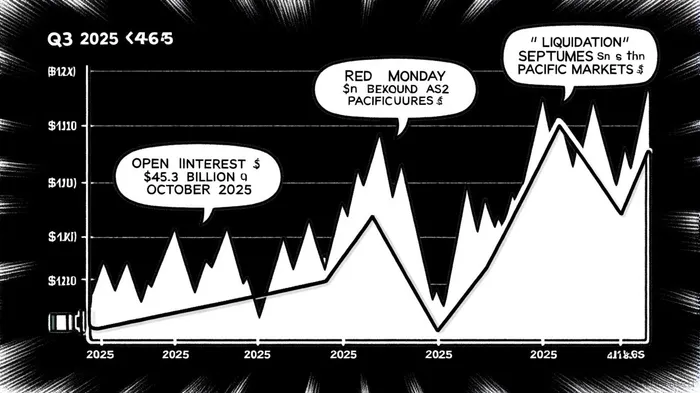





Comentarios
Aún no hay comentarios