
Bitcoin's Vanishing Arbitrage: A Signal of Institutional Dominance and Market Maturity
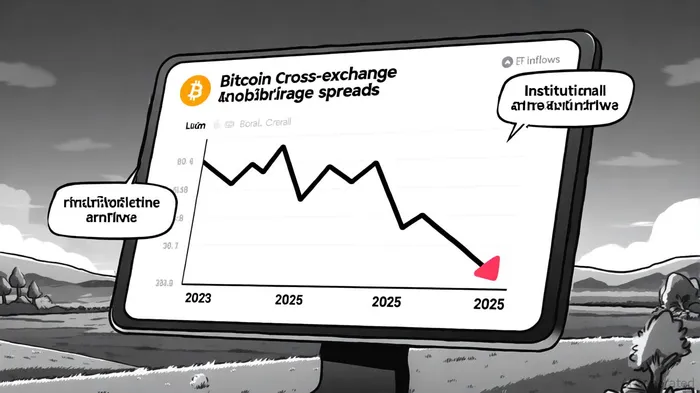
The disappearance of BitcoinBTC-- arbitrage opportunities is not a bug-it's a feature. As cross-exchange price disparities shrink, the market is signaling a maturation of Bitcoin's structure, driven by institutional adoption and technological innovation. This shift marks a pivotal moment: Bitcoin is transitioning from a fragmented, speculative asset to a globally liquid, institutional-grade asset class.
The State of Arbitrage in 2025: Efficiency Through Automation and Risk Mitigation
Bitcoin arbitrage, once a low-hanging fruit for retail traders, has become increasingly elusive. In Q3 2025, spatial arbitrage opportunities-buying low on one exchange and selling high on another-persisted at 0.5–3% spreads[1], but execution has grown far more complex. High-frequency trading (HFT) algorithms, AI-driven price prediction models (e.g., LSTM networks), and quantum-resistant execution protocols now dominate the space[3]. These tools have compressed arbitrage windows to milliseconds, leaving little room for manual traders.
The rise of cross-exchange funding arbitrage-exploiting funding rate divergences between perpetual futures markets-has also gained traction[2]. By holding opposite positions on exchanges with mismatched rates, traders can capture steady yields, albeit with nuanced risk management. However, even these strategies face headwinds. Transaction costs, blockchain congestion, and regulatory scrutiny have eroded margins[2], while MEV (mining extractive value) attacks and execution lag remain persistent threats[3].
Institutional Adoption: Liquidity's New Engine
The decline in arbitrage opportunities is not accidental-it's a byproduct of institutional capital reshaping Bitcoin's market structure. U.S. spot Bitcoin ETFs have drawn over $118 billion in institutional capital in 2025, with BlackRock's iShares Bitcoin Trust (IBIT) capturing 89% of the market share[2]. This influx has removed 18% of Bitcoin's circulating supply from active trading, creating a "liquidity vacuum" that stabilizes prices and reduces cross-exchange inefficiencies[2].
Public companies have also doubled down on Bitcoin, with 172 firms now holding over $117 billion in BTC[1]. These entities act as "price anchors," absorbing volatility and reducing the incentive for arbitrageurs to exploit minor price gaps. Meanwhile, institutional demand has outpaced mining supply by 7.4x in 2025[3], further tightening the market's liquidity.
Market Efficiency and Price Resilience: A New Era
Bitcoin's market efficiency is now comparable to traditional assets. Cross-exchange price convergence has accelerated, with arbitrage opportunities lasting mere seconds rather than hours[4]. This efficiency is not just a function of technology-it's a reflection of Bitcoin's growing legitimacy. As institutions treat Bitcoin as a core portfolio asset, its price is increasingly decoupled from retail-driven volatility and instead tethered to macroeconomic fundamentals[2].
The role of stablecoins like USDTUSDT-- in facilitating rapid liquidity transfers has also reduced the cost of arbitrage execution[4]. However, the very tools that once enabled arbitrage-low-latency networks and automated bots-are now the same tools that eliminate it. This self-correcting dynamic is a hallmark of a mature market.
Positioning for the Breakout
The vanishing arbitrage is a signal, not a warning. As Bitcoin's market structure evolves, investors should focus on three key trends:
1. ETF-Driven Liquidity: The $118 billion in ETF inflows has created a new baseline of demand, insulating Bitcoin from short-term shocks[2].
2. Institutional Price Anchoring: Corporate holdings and ETFs act as stabilizers, reducing the likelihood of extreme price swings[1].
3. Technological Convergence: AI and automation are not just tools-they're market participants, ensuring price discovery is near-instantaneous[3].
For investors, this means Bitcoin is no longer a speculative bet but a strategic asset. The disappearance of arbitrage is a sign that the market is no longer a "Wild West" but a well-regulated, high-liquidity environment. Positioning in Bitcoin now is akin to investing in a stock with a growing institutional base and a shrinking discount to intrinsic value.
Conclusion
Bitcoin's shrinking arbitrage window is a milestone. It reflects a market where institutional capital, technological innovation, and regulatory clarity are aligning to create a new era of efficiency. For investors, this is not a reason to exit-it's a signal to reposition. As Bitcoin transitions from a speculative asset to a foundational one, its price resilience and liquidity will only strengthen, setting the stage for a breakout phase in 2026 and beyond.






Comentarios
Aún no hay comentarios