
Bitcoin's Uptober Prediction: From $112K to Institutional Adoption
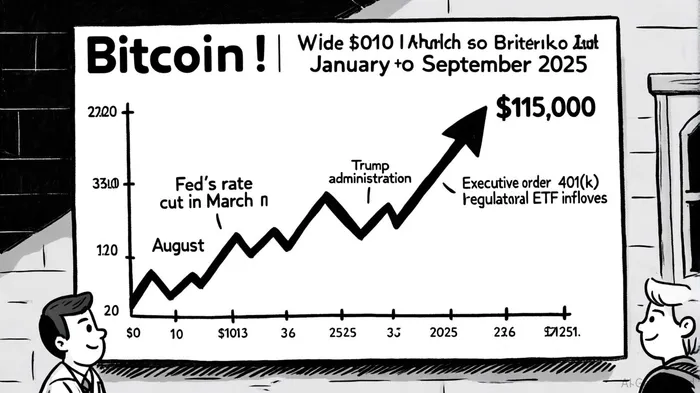
Bitcoin's price action in late 2025 has been a masterclass in macroeconomic tailwinds and institutional momentum. As of September 2025, BitcoinBTC-- (BTC) trades near $115,000–$120,000, with critical resistance forming at $118,000 [1]. This surge is not a speculative bubble but a structural shift driven by three pillars: Fed dovishness, institutional onboarding, and regulatory clarity.
Macroeconomic Tailwinds: The Fed's Dovish Pivot
The U.S. Federal Reserve's 25-basis-point rate cut in March 2025 marked a pivotal shift toward accommodative monetary policy [1]. Historically, Bitcoin has thrived in low-rate environments, as seen in 2020 when BTCBTC-- surged from $10,000 to $60,000 amid similar Fed easing [2]. Lower rates diminish the opportunity cost of holding non-yielding assets like Bitcoin, while also weakening the U.S. dollar—a key driver of BTC's appeal as a hedge against currency devaluation [2].
Moreover, the Fed's pivot aligns with a broader global trend of monetary stimulus. Central banks in Japan and the Eurozone have also signaled rate cuts, creating a “race to the bottom” in yields that favors risk assets [1]. This environment has pushed institutional investors to allocate capital to Bitcoin, which now competes with gold as a store of value.
Institutional Adoption: From ETFs to 401(k)s
Institutional adoption in Q3 2025 has been nothing short of seismic. Bitcoin ETFs have attracted $55 billion in year-to-date inflows, with even conservative portfolio managers allocating 1–2% of assets to BTC [2]. The Trump administration's August 7 executive order unlocking $8.9 trillion in 401(k) capital for crypto investments has further accelerated this trend. A mere 1% allocation to Bitcoin from these accounts would inject $89 billion into the market—equivalent to 4% of BTC's current market cap [1].
Corporate treasuries have also joined the fray. MicroStrategy's Q3 purchases added 120,000 BTC to its reserves, while Tesla's $1.5 billion BTC allocation now constitutes 15% of its liquid assets [1]. These moves have shifted Bitcoin's network dynamics: high-value, low-frequency transactions now dominate, with average transaction sizes rising 30% year-over-year [1].
Regulatory Clarity: The GENIUS Act and Beyond
Regulatory progress has been a silent catalyst. The GENIUS Act, passed in early 2025, standardized crypto custody and reporting requirements, reducing institutional friction [2]. Simultaneously, the U.S. government's designation of Bitcoin as a national reserve asset has legitimized its role in sovereign wealth strategies [1]. These developments have quelled earlier fears of a “regulatory crackdown,” allowing institutional capital to flow unimpeded.
However, challenges remain. Ethereum's growing traction among portfolio managers—its ETFs now hold 2.5 million ETH—signals a diversification trend that could cap Bitcoin's dominance [2]. Additionally, the Fed's sensitivity to inflation could trigger a policy reversal, testing Bitcoin's resilience in a tightening cycle.
The Uptober Thesis: $112K to $128K and Beyond
The convergence of these factors sets the stage for a $128,000 rally by year-end. With the Fed's next rate cut expected in November and 401(k) adoption gaining momentum, Bitcoin's demand curve is shifting upward. Coinbase's Q3 analysis notes that even a 0.5% allocation from global pension funds could push BTC beyond $140,000 by early 2026 [2].
Yet, this optimism hinges on two conditions: continued Fed easing and no major regulatory setbacks. A return to hawkish policy or a crackdown on crypto custodians could trigger a 20–30% correction. For now, though, Bitcoin's institutional narrative is unshakable.





Comentarios
Aún no hay comentarios