
Bitcoin's Unstoppable Future and MicroStrategy's Strategic Repositioning
Bitcoin's rise as a financial asset class is no longer a speculative narrative but a structural inevitability. By 2025, institutional adoption has surged, with over $54.75 billion in net inflows into Bitcoin ETFs since their launch in January 2024. Regulatory clarity-bolstered by the U.S. SEC's approval of spot BitcoinBTC-- ETFs, the repeal of SAB 121, and the passage of the GENIUS Act-has normalized Bitcoin as a strategic reserve asset for corporations and institutions alike according to market analysis. In this evolving landscape, MicroStrategy (MSTR) has emerged as both a bellwether and a cautionary tale. The company's aggressive Bitcoin accumulation strategy, now holding 671,000 BTC (3% of global supply), has redefined corporate treasury management. Yet its pivot to a "capital markets platform" in 2025 raises critical questions: Can this repositioning reignite investor confidence? And can it outperform the rise of Bitcoin ETFs, which now dominate institutional access to the asset?
MicroStrategy's Capital Markets Gambit
MicroStrategy's 2025 strategy has been a masterclass in leveraging capital markets to fund Bitcoin accumulation. By year-end, the company had raised $11.9 billion in common equity, $6.9 billion in preferred equity, and $2.0 billion in convertible debt, enabling it to maintain its BTC Yield target of 30% and project a $20 billion Bitcoin gain for 2025. This approach, however, has introduced structural risks. The company's stock has declined 54% year to date, despite Bitcoin's 15.7% gain, due to dilution from continuous equity issuance and volatility tied to Bitcoin's price swings according to financial analysis.
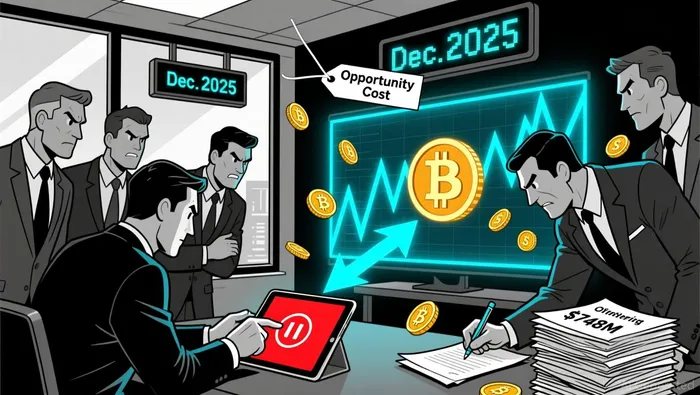
The recent pause in Bitcoin purchases-replacing them with a $748 million stock offering-highlights a tension between capital preservation and long-term accumulation. While this move bolstered cash reserves to $2.2 billion, it also drew criticism for missing a window to buy Bitcoin at lower prices according to market commentary. Institutional investors have responded by reducing their MSTRMSTR-- positions by $5.38 billion over two quarters, reflecting concerns about the company's ability to meet S&P 500 inclusion criteria (which require four consecutive quarters of positive earnings) according to financial reports.
Bitcoin ETFs: The New Institutional Standard
Bitcoin ETFs have emerged as a superior vehicle for institutional investors seeking exposure to the asset. BlackRock's IBIT, for instance, has amassed $50 billion in AUM, capturing 48.5% of the ETF market. These funds offer lower expense ratios (0.25% for IBIT) and a Sharpe ratio of 1.12, compared to MSTR's 1.85 but with significantly higher volatility (50.6% vs. 96.7%) according to financial analysis. A $10,000 investment in MSTR grew to $324,290 over five years, outpacing Bitcoin's $102,229, but this performance came with a 32.4% premium to net asset value and a beta of 1.40 to Bitcoin-indicating amplified downside risk according to performance data.
The structural advantages of ETFs are clear. They avoid the dilution and leverage risks inherent in MSTR's capital structure while providing transparent, regulated exposure. For fiduciary investors, this efficiency is critical. As one institutional analysis notes, "ETFs are a superior vehicle for Bitcoin exposure due to their lower structural complexity and reduced downside exposure" according to market research.
Can MicroStrategy Outperform?
MicroStrategy's long-term thesis remains compelling. Its Bitcoin treasury strategy has generated a 26% BTC Yield year to date and a 116,555 BTC gain, demonstrating disciplined execution. The company's S&P B- credit rating and IRS fair-value taxation guidance have further solidified its access to capital markets. However, the path to outperforming ETFs is fraught.
The key challenge lies in balancing capital preservation with accumulation. MSTR's recent stock sales, while prudent in volatile markets, have introduced opportunity costs. For example, its December 2025 purchase of 10,645 BTC at $92,098 per coin coincided with Bitcoin's drop below $80,000, triggering losses in both BTC and MSTR stock according to financial reporting. Meanwhile, ETFs like IBIT have benefited from a 400% acceleration in institutional flows post-SEC approval, driven by their streamlined infrastructure and regulatory clarity according to market analysis.
Investor Confidence: A Tenuous Balance
Investor sentiment toward MSTR is polarized. While 86% of institutional investors plan to allocate to digital assets in 2025, MSTR's stock has faced outflows from hedge funds like Clear Street LLC, even as Vanguard and Goldman Sachs added shares according to financial data. Analysts remain cautiously optimistic, with 8 firms issuing "Buy" ratings and a median price target of $485.0 according to market research. Yet the company's exclusion from the S&P 500 and its reliance on continuous equity issuance underscore structural fragility.
In contrast, Bitcoin ETFs have gained trust through simplicity and transparency. Their role as a fiduciary-compliant vehicle has normalized Bitcoin in institutional portfolios, with 94% of institutional investors believe in blockchain's long-term value. This trust is a hurdle for MSTR to overcome.
Conclusion: A Tale of Two Strategies
Bitcoin's future is unstoppable, but the vehicles through which it is accessed will determine its winners and losers. MicroStrategy's pivot to a capital markets platform has been bold, but its structural risks-dilution, volatility, and regulatory uncertainty-make it a less efficient bet for institutional investors compared to ETFs. While MSTR's Bitcoin treasury strategy has delivered exceptional returns, the rise of ETFs like IBIT offers a more scalable, risk-adjusted path to Bitcoin exposure. For MSTR to reignite investor confidence, it must address its capital structure and demonstrate that its leverage and dilution are justified by long-term BTC gains. Until then, the ETFs will likely remain the preferred conduit for Bitcoin's next phase of institutional adoption.







Comentarios
Aún no hay comentarios