
Bitcoin's Undervaluation Relative to Gold: A Structural Shift in Global Money Infrastructure
Market Cap Disparity and Growth Potential
Gold's dominance as a store of value is undeniable, but Bitcoin's trajectory suggests it is undervalued relative to its potential. According to Strategy Dominates Q3, a mere 0.2% reallocation of global assets into crypto could inject $94 billion into Bitcoin, pushing its price toward $160,000 by 2025. Binance founder Changpeng Zhao even predicts Bitcoin could surpass gold's $30 trillion market cap, citing its capped supply and digital transfer advantages, according to CZ Predicts Bitcoin.
The recent $2.5 trillion crash in gold's value in October 2025 further highlights vulnerabilities in traditional safe-haven assets, as detailed in Gold vs Bitcoin in 2025. While gold's 5,000-year history remains a testament to its stability, its ETF-driven liquidity and exposure to modern financial dynamics now appear fragile.
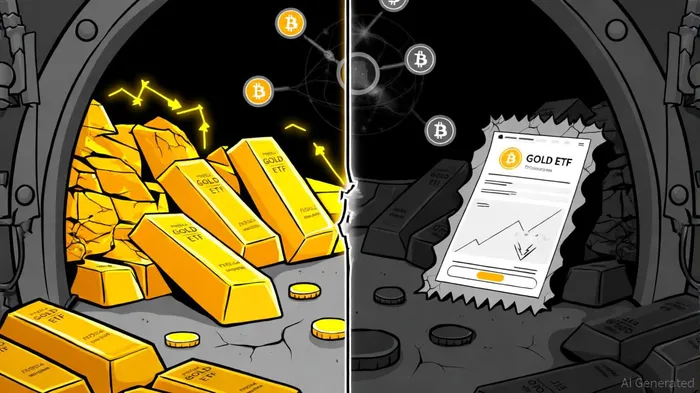
Institutional Adoption: From Speculation to Infrastructure
Bitcoin's transition from speculative asset to institutional infrastructure is accelerating. By 2025, institutional holdings of Bitcoin surpassed $100 billion, with spot Bitcoin ETFs managing over $170 billion in assets, a trend noted alongside Japan's mining project. BlackRock's IBIT alone amassed $100 billion in two years, stabilizing Bitcoin's price during corrections.
Corporate adoption is equally transformative. Steak 'n Shake, for instance, launched a Strategic Bitcoin Reserve, holding all Bitcoin payments and donating a portion to open-source initiatives, as reported by Steak 'n Shake reserve. Meanwhile, Strategy Inc.MSTR-- reported a 26% BTC yield in Q3 2025, leveraging a $70.9 billion Bitcoin treasury to issue digital credit instruments. These moves signal Bitcoin's integration into yield-generating business models, not just speculative portfolios.
Network Utility: Efficiency vs. Tradition
Bitcoin's network utility is outpacing gold's traditional strengths. The Lightning Network processed over 8 million monthly transactions in early 2025, while Layer-2 solutions and institutional tools enabled 78% of Fortune 500 companies to adopt Bitcoin or blockchain-based tools, according to Bitcoin statistics 2025. Settlement efficiency is a key differentiator: Bitcoin transactions settle in minutes, whereas gold's physical delivery and verification can take days, as explored in gold vs Bitcoin.
Japan's state-backed Bitcoin mining project exemplifies this shift. By using surplus renewable energy to power mining rigs, the country is turning Bitcoin into a tool for grid efficiency and sustainability. Similarly, Ripple's integration of XRPXRP-- on Amazon Web Services (AWS) has enabled real-time cross-border payments, challenging gold's role in traditional financial systems, as discussed in gold & silver markets.
The Structural Shift: From Physical to Digital
Gold's physical storage costs (0.12%–0.50% annually) and liquidity constraints contrast sharply with Bitcoin's zero-storage cost and 24/7 accessibility, according to Gold prices forecast. Tether's Q3 2025 report revealed $22.8 billion in Bitcoin and gold reserves, but Bitcoin's programmable nature allows for dynamic use cases like stablecoin collateral and DeFi integration.
Meanwhile, gold's EFP (Exchange for Physical) system has exposed liquidity risks, with U.S. dealers repairing imbalances through 50-ton gold deliveries. Basel III regulations now require institutions to fully back gold positions with physical metal, imposing stricter liquidity constraints.
Conclusion: A New Monetary Paradigm
Bitcoin's undervaluation relative to gold is not a flaw but a feature of its early-stage adoption. As institutional capital flows into crypto and network utility expands through Layer-2 solutions and corporate integration, Bitcoin is becoming the digital counterpart to gold's analog legacy. While gold retains its role as a store of value, Bitcoin's programmability, efficiency, and scalability position it as the infrastructure for the next era of global finance.
The structural shift is not about replacing gold but redefining what value storage means in a digital age. For investors, the question is no longer whether Bitcoin will surpass gold-it's how quickly this transformation will unfold.





Comentarios
Aún no hay comentarios