
Bitcoin's Transition to Accumulation: A Structural Shift in Investor Behavior and Market Dynamics
The BitcoinBTC-- market in late 2025 and early 2026 is undergoing a profound transformation, marked by the exhaustion of speculative demand and the tentative emergence of a buyer-driven equilibrium. This shift, rooted in on-chain data and evolving investor behavior, signals a departure from the bullish momentum of prior cycles and hints at a reconfiguration of market dynamics that could redefine Bitcoin's role in global finance.
On-Chain Demand Exhaustion and Structural Bear Market Shifts
Bitcoin's transition into a bearish phase is underscored by a collapse in demand growth, as evidenced by on-chain metrics. According to a report by CryptoQuant, demand for Bitcoin has fallen below its long-term trend since early October 2025, with institutional and large-holder activity reversing course. U.S. spot Bitcoin ETFs, once a pillar of accumulation, have shifted to net distribution in Q4 2025, reflecting a stark contrast to the previous year's inflows. This weakening in demand coincides with the exhaustion of three major bullish drivers: U.S. spot Bitcoin ETF adoption, presidential election optimism, and Treasury Company interest according to analysis.
Derivatives markets further reinforce the bearish narrative. Funding rates and open interest have declined, signaling reduced speculative conviction. On-chain data also reveals Bitcoin breaking below its 365-day moving average-a historically significant threshold for market transitions-and remaining trapped under overhead supply between $93k and $120k. Meanwhile, the supply in loss has surged to 6.7 million BTC, a level consistent with early bearish phase transitions observed in prior cycles.
BlackRock's analysis attributes recent volatility to a confluence of factors, including unwinding leverage and shifting Federal Reserve policy expectations. The October sell-off, exacerbated by forced liquidations, exemplifies the fragility of speculative positions in a tightening macro environment. On-chain indicators also suggest that long-term holders-wallets holding Bitcoin for over 155 days-are beginning to distribute, compounding downward pressure.
The Emergence of a Buyer-Driven Equilibrium
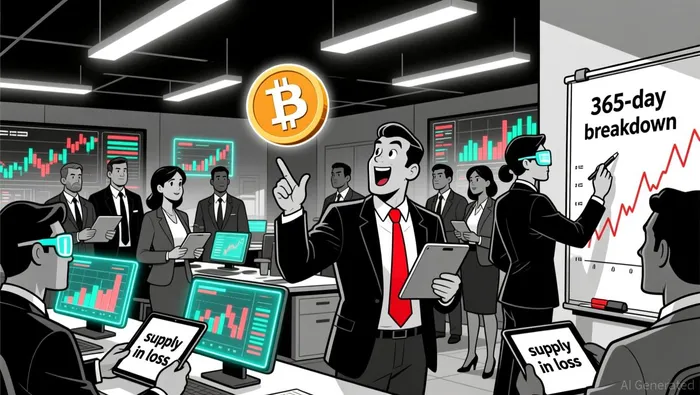
Despite these bearish signals, early 2026 has seen the emergence of a buyer-driven equilibrium, characterized by institutional accumulation and structural market adjustments. Price action remains constrained within a fragile range, with overhead supply between $90k–$92k and the short-term holder cost basis at $101.5k acting as key barriers according to Glassnode data. However, on-chain data reveals a critical shift: long-term holders flipped to net accumulation in late December 2025, adding 3,784 BTC after nearly three months of distribution. This suggests that patient capital is stepping in to absorb dips, stabilizing the market at lower levels.
Institutional participation is another key driver of this equilibrium. The average deposit size into Binance increased 34x from early 2024, signaling renewed activity from whales and institutional investors. Meanwhile, ETF flows-despite short-term outflows- continue to absorb newly issued supply, with cumulative inflows serving as a structural support. Regulatory developments, such as the CLARITY Act and the GENIUS stablecoin law, are further embedding Bitcoin into traditional financial systems, fostering deeper institutional adoption.
Corporate treasuries, including firms like StrategyMSTR--, have also reinforced confidence by accumulating Bitcoin at prices near $90k, treating it as a strategic asset. This shift reflects a broader recognition of Bitcoin's utility as a macro hedge, particularly given its 0.52 correlation with the Nasdaq 100 in 2025.
Investor Behavior and Market Sentiment
Investor behavior is increasingly shaped by the interplay of loss realization and cautious optimism. The rise in supply in loss-now at 6.7 million BTC indicates that weaker investors are capitulating, with their holdings maturing into long-term holder cohorts. This process, while painful, is a necessary step toward market equilibrium.
At the same time, sentiment remains polarized. On one hand, fear-driven corrections persist, amplified by geopolitical events such as the U.S. military operation in Venezuela, which introduced new layers of uncertainty. On the other, the institutionalization of Bitcoin is creating a foundation for resilience. As BlackRock notes, the unwinding of leverage and the maturation of investor psychology are critical to understanding the current phase.
Conclusion: A New Equilibrium in the Making
Bitcoin's transition to a buyer-driven equilibrium represents a structural shift in market dynamics, driven by on-chain demand exhaustion and the recalibration of investor behavior. While the bearish phase is far from over, the emergence of institutional accumulation, regulatory clarity, and strategic corporate holdings suggests that the market is adapting to a new reality.
The Bitcoin On-Chain Index (BCMI), currently declining but above historical lows, may provide further clues. If it reaches the 0.25–0.35 range-a level historically associated with bear market bottoms-this could signal stabilization. For now, investors must navigate a fragile balance between capitulation and accumulation, with the path forward dependent on macroeconomic clarity and the continued evolution of institutional participation.





Comentarios
Aún no hay comentarios