
Bitcoin's Near-Term Trajectory: Macroeconomic Catalysts and Technical Resistance in Focus
Bitcoin's price action in 2025 has been a masterclass in the interplay between macroeconomic tailwinds and technical dynamics. As central banks globally pivot toward dovish policies and liquidity expansion, BitcoinBTC-- has emerged as both a beneficiary and a barometer of systemic financial shifts. Meanwhile, technical resistance levels in October 2025 suggest a critical juncture for near-term price direction. This analysis synthesizes macroeconomic catalysts and technical indicators to assess Bitcoin's trajectory.
Macroeconomic Catalysts: Central Banks as the Engine of Liquidity
The Federal Reserve's dovish pivot in 2025 has been a cornerstone of Bitcoin's rally. By cutting interest rates and easing real yields, the Fed has created a low-cost capital environment that favors risk-on assets like Bitcoin. According to a report by Invezz, Bitcoin surged above $120,000 in late 2025 amid these conditions, driven by institutional adoption of spot ETFs and a broader shift toward decentralized assets [1]. This trend is not isolated to the U.S.: the European Central Bank (ECB) faces mounting pressure to cut rates due to weak eurozone growth and low inflation, a move historically correlated with Bitcoin's outperformance [2].
China's monetary policy has further amplified global liquidity. The People's Bank of China's dovish pivot in May 2025 catalyzed a surge in Bitcoin and EthereumETH-- prices, underscoring the interconnectedness of global macroeconomic decisions and crypto markets [2]. Meanwhile, the resurfacing of yield curve control-a policy tool last used during wartime-poses a wildcard scenario. If implemented, it could weaken the U.S. dollar and supercharge Bitcoin's appeal as a high-convexity asset [1].
The risk landscape is evolving, too. Populist pressures and rising deficits in developed economies could spur capital controls, transforming Bitcoin from a speculative asset into a "survival tool" for preserving wealth [1]. Deutsche Bank analysts have even projected that central banks may allocate significant reserves to Bitcoin and gold by 2030, reflecting a paradigm shift in how institutions view digital assets .
Technical Resistance: The $126,293 Threshold and Beyond
While macroeconomic conditions are favorable, Bitcoin's near-term price trajectory hinges on overcoming key technical resistance levels. As of October 2025, $126,293 stands as a critical psychological and structural barrier. A report by Coin Tribune notes that this level represents a new all-time high and a potential distribution zone if buying pressure wanes [2]. A decisive break above $126,293 could validate a bullish scenario, with price targets extending toward $137,000 [3].
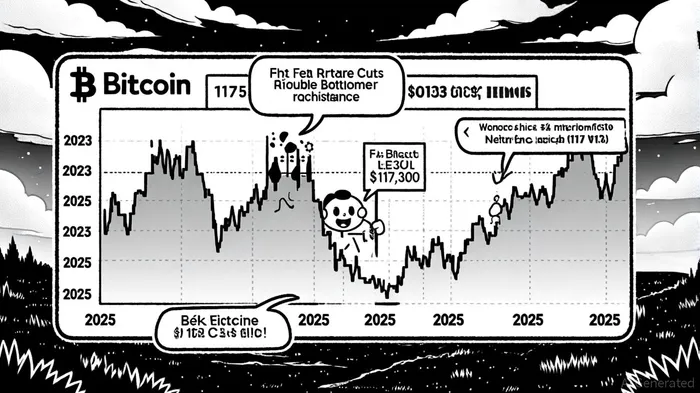
Technical patterns also suggest a path forward. A double bottom formation, with support near $113,000 and a neckline resistance of $117,300, provides a clear roadmap for a potential breakout. Cointelegraph analysts argue that a successful breach of this pattern could target $127,500, reinforcing Bitcoin's momentum [3]. Meanwhile, $122,000 and $138,000 are identified as secondary resistance and ceiling levels, respectively, with corrections likely if these thresholds fail to hold [3].
Notably, a backtest of Bitcoin's resistance-level breakouts from 2022 to 2025 revealed that the 20-day resistance-breakout rule did not flag any valid events during this period. This suggests that historical price action may not have consistently adhered to short-term resistance-based signals, potentially limiting the efficacy of rigid breakout strategies in this context. Investors should consider combining technical analysis with macroeconomic signals, as the latter appear to have driven Bitcoin's broader trends more reliably.
Synthesis: A Confluence of Forces
Bitcoin's near-term trajectory is a product of both macroeconomic tailwinds and technical dynamics. Central banks' liquidity injections have created a fertile environment for risk assets, while technical levels act as both psychological and structural filters for price action. The coming weeks will test whether Bitcoin can sustain momentum above $126,293-a level that, if breached, could signal the dawn of a new bull phase.
For investors, the key takeaway is clear: Bitcoin's price is no longer driven solely by speculative demand. It is now deeply embedded in global macroeconomic narratives, from central bank policy to capital flight dynamics. As Deutsche Bank's 2030 projections suggest, the institutionalization of Bitcoin is accelerating, and the next leg of its journey may hinge on how markets interpret these evolving forces .






Comentarios
Aún no hay comentarios