
Bitcoin's Near-Term Price Trajectory: RSI Dynamics, Profit-Taking, and the ETF-Driven Bull Case
Bitcoin's near-term price trajectory in October 2025 presents a nuanced interplay between technical indicators and macro-driven fundamentals. While the 14-day RSI hovers in neutral to bearish territory (43–44), signaling weakening momentum, according to Mudrex's technical outlook, institutional demand via ETFs and macroeconomic tailwinds suggest a deeper bullish narrative, as noted in Copygram's weekly analysis. This analysis dissects the tension between RSI dynamics, profit-taking behavior, and ETF-driven capital flows to assess whether Bitcoin's consolidation phase offers a strategic entry point or a cautionary pause.
RSI Dynamics: A Tale of Two Timeframes
Bitcoin's 14-day RSI of 43–44 indicates a market in neither overbought nor oversold conditions, reflecting a balance between buying and selling pressure, per Mudrex's technical outlook. However, shorter-term RSI readings (e.g., 70) during price surges near $120,000 highlight overbought conditions, triggering profit-taking and volatility, as reported by Analytics Insight. This duality suggests a market in transition: while long-term bullish momentum persists (e.g., 200-day moving average above price, according to Mudrex), near-term corrections are likely as traders lock in gains.
The MACD and moving averages further complicate the picture. Short-term indicators like the MACD remain bearish, with the price trading below its pivot point at $113,379.73, per Mudrex's observations. Yet, long-term bullish signals-such as Bitcoin's historical correlation with gold and the Federal Reserve's dovish pivot-are discussed in the 'Uptober' outlook, suggesting that the current consolidation could be a prelude to a breakout, provided institutional inflows continue to offset profit-taking.
Profit-Taking and ETF Inflows: Fueling the Bull Cycle
Bitcoin's price action in October 2025 has been characterized by a tug-of-war between institutional buying and profit-taking. On October 2, 2025, the market saw a historic $3.7 billion profit-taking event as the price approached $120,000, as reported by CryptoBasic, driven by both speculative and long-term investors. This activity coincided with record inflows into U.S. spot BitcoinBTC-- ETFs, which attracted $5.95 billion in a single week (October 4, 2025), with BlackRock's iShares Bitcoin Trust (IBIT) leading the charge with $1.8 billion, according to coverage from Mudrex and the 'Uptober' outlook.
These inflows underscore Bitcoin's growing institutional adoption, with ETFs acting as a bridge between traditional finance and crypto. The surge in capital has reinforced Bitcoin's role as a hedge against fiat depreciation and a store of value, as noted by Analytics Insight, while negative funding rates in derivatives markets suggest a more sustainable bull cycle compared to leveraged-driven rallies, per CryptoBasic.
Technical Levels and Market Sentiment: A High-Stakes Game
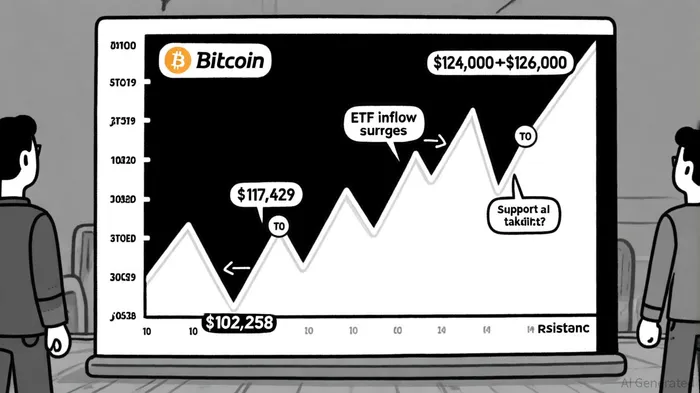
Bitcoin's price is currently consolidating below key resistance at $117,429 and $124,000–$126,000, according to BTCC. A decisive break above $124,000 with increased volume could signal a bullish breakout toward $130,000 or $140,000, as discussed by Analytics Insight, but failure to hold this level risks a pullback toward support at $102,258, per Mudrex's technical notes. The market's sensitivity to profit-taking is evident in its inability to sustain gains above $126,000, despite strong ETF inflows, as observed by Copygram.
Seasonal trends also play a role. Historically, Bitcoin has posted positive returns in 83% of Octobers over the past 12 years, a pattern dubbed "Uptober," noted in the 'Uptober' outlook. However, this year's rally faces headwinds, including potential dollar strength and regulatory uncertainty. The current RSI divergence-neutral in the 14-day timeframe but overbought in shorter-term intervals-suggests that while the bull case remains intact, volatility is inevitable.
Strategic Entry Point or Cautionary Pause?
The current consolidation phase offers a mixed outlook. On one hand, the 14-day RSI's neutral reading and institutional inflows indicate that Bitcoin's long-term bullish thesis is intact. On the other, the overbought short-term RSI and profit-taking risks highlight the need for caution. For investors, this duality creates an opportunity to enter at key support levels (e.g., $102,258) while hedging against near-term volatility.
However, the market's reliance on ETF inflows introduces a critical variable. If institutional demand continues to outpace profit-taking, Bitcoin could retest $126,000 and beyond. Conversely, a sharp pullback in ETF flows or a stronger-than-expected U.S. dollar could reignite bearish momentum, as discussed in Copygram's weekly analysis.
Conclusion
Bitcoin's near-term trajectory hinges on the resolution of conflicting signals: a neutral-to-bearish RSI, robust ETF inflows, and profit-taking behavior. While the current consolidation may appear as a cautionary pause, the underlying fundamentals-institutional adoption, macroeconomic tailwinds, and historical seasonal trends-suggest that this phase could be a strategic entry point for long-term investors. The key will be monitoring volume during breakouts and the sustainability of ETF inflows. As always, volatility is the price of participation in a market as dynamic as Bitcoin.





Comentarios
Aún no hay comentarios