
Bitcoin's Near-Term Price Retest: A Technical and Sentiment-Driven Bull Case
Bitcoin's price action in late 2025 has painted a compelling narrative of resilience and institutional conviction. With the cryptocurrency trading near $111,951 as of October 13, the market is poised for a critical retest of key technical and macroeconomic thresholds. This analysis synthesizes on-chain data, macro trends, and sentiment indicators to evaluate Bitcoin's near-term trajectory.
Technical Analysis: A Tightening Supply Narrative
Bitcoin's on-chain metrics tell a story of scarcity-driven demand. Over 74% of circulating BitcoinBTC-- has become illiquid, with 75% of the supply dormant for at least six months, signaling robust hoarding behavior by long-term holders [2]. The Network Value to Transactions (NVT) ratio, currently at a golden-cross level of ~1.51, suggests Bitcoin's valuation is anchored in real transactional activity rather than speculative fervor [2].
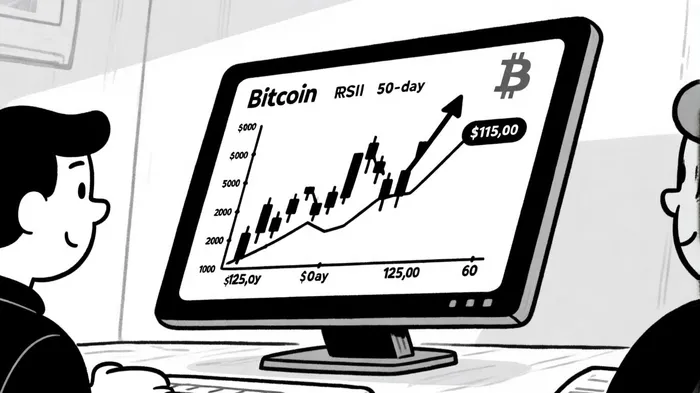
Technical indicators reinforce this bullish backdrop. The 50-day and 200-day moving averages are both trending upward, with Bitcoin trading above both at $111,951, a sign of sustained momentum [3]. The Relative Strength Index (RSI) sits near 60, indicating moderate bullish energy, while the Fear & Greed Index remains in "Greed" territory, reflecting strong retail and institutional appetite [3].
Historical data on resistance breakouts from 2022 to 2025 reveals a 55–60% win rate, though average returns over 30 days remain modest (0–4%), suggesting that while breakouts are somewhat reliable, they do not consistently offer exploitable short-term gains.
However, caution is warranted. A recent 10% crash following U.S.-China trade tensions exposed vulnerabilities, with Bitcoin retreating to $111,951 after testing $126,293 [5]. Analysts highlight the $116,483 level as a critical mean-reversion target within Bollinger Bands, with a break above this threshold potentially unlocking a $160,000–$200,000 range by year-end [4].
Macroeconomic Tailwinds: Fed Policy and Inflation
The Federal Reserve's dovish pivot in September 2025-marked by a 25-basis-point rate cut-has injected liquidity into global markets, fueling demand for risk-on assets like Bitcoin [5]. With the U.S. Personal Consumption Expenditures (PCE) inflation index at 2.7%, Bitcoin's role as an inflation hedge has gained traction, particularly as real yields decline and the dollar weakens [1].
Institutional adoption has further amplified this dynamic. U.S. spot Bitcoin ETFs, including BlackRock's IBIT and Fidelity's Wise Origin, have attracted $5.95 billion in net inflows in early October 2025, enabling pension funds and sovereign wealth entities to allocate to Bitcoin [6]. Public companies like MicroStrategy and Tesla have also deepened their BTC holdings, exacerbating a supply squeeze effect [6].
Price Retest Scenarios: Key Levels to Watch
Bitcoin's near-term path hinges on its ability to retest and hold above critical support/resistance levels. The $115,000–$125,000 range is pivotal, with $116,483 acting as a psychological and technical fulcrum [5]. A successful retest of this level could validate the bullish thesis, while a breakdown below $113,000 may trigger a deeper correction.
Derivatives markets add nuance. Open interest and positive funding rates indicate speculative repositioning upward, though oscillators show slight exhaustion after recent gains, hinting at a potential pullback [1]. The Fear & Greed Index, currently in the 70s, underscores widespread bullish sentiment but warns of rapid shifts in the face of macro shocks [6].
Conclusion: A Calculated Bull Case
Bitcoin's technical and macroeconomic fundamentals align with a bullish narrative, supported by tightening supply, institutional inflows, and a dovish Fed. However, geopolitical risks-such as U.S. government shutdown fears or trade-war escalations-remain wild cards. For now, the market appears to be in a consolidation phase, with $116,483 as the linchpin. Investors should monitor ETF flows, macroeconomic data, and key level reactions to gauge the next move.
As always, volatility is the price of participation in this nascent asset class. Position accordingly.






Comentarios
Aún no hay comentarios