
Bitcoin's Near-Term Bottoming Prospects and Q1 2026 Positioning: Capitalizing on Capitulation Signals and Regulatory Clarity
The BitcoinBTC-- market in late 2025 is at a pivotal inflection point, marked by a confluence of capitulation signals and regulatory tailwinds that could catalyze a sustained recovery. As on-chain metrics reveal structural recalibration and global regulators pivot toward clarity, the stage is set for a strategic repositioning ahead of Q1 2026. This analysis synthesizes critical data points to outline why now is the time to capitalize on Bitcoin's near-term bottoming process.
Capitulation Signals: A Market Reset in Motion
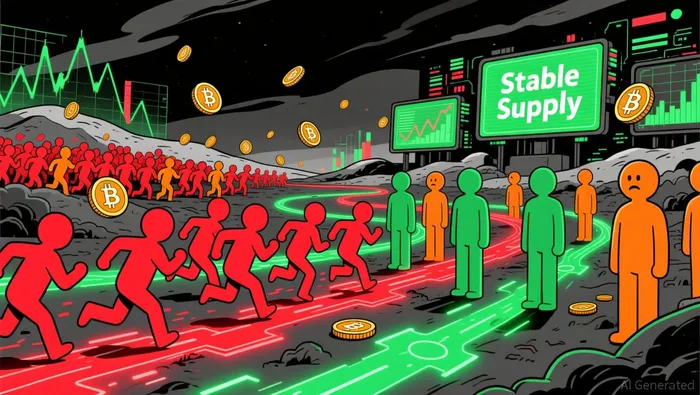
Bitcoin's December 2025 price action has been defined by classic capitulation dynamics, signaling a potential exhaustion of short-term selling pressure. Miner capitulation, a historically reliable contrarian indicator, has intensified as the network hash rate plummeted 4% year-to-date-the sharpest decline since April 2024. This compression reflects miners offloading BTCBTC-- to cover operational costs, a move that often precedes bullish reversals.
On-chain holder behavior further underscores the market's divergence. Short-term holders have aggressively rotated out of Bitcoin, with the STH cost basis stubbornly anchored at $101.5k-a critical threshold that, if breached, could trigger deeper corrections. Meanwhile, medium-term holders (1–5 years) have engaged in profit-taking, while long-term holders (>5 years) have remained resolute, maintaining 13.6 million BTC in supply-a 1.5 million BTC drop from its 2025 peak. This distribution pattern mirrors historical cycles (e.g., 2018, 2020), where heavy LTH selling signaled a reset rather than a terminal bear market.
Corporate accumulation via Digital Asset Treasuries has partially offset retail outflows, with institutions adding 42,000 BTC in December alone. However, this inflow remains insufficient to clear the overhead supply cluster between $93k and $120k, which continues to stifle upward momentum. The key takeaway: Bitcoin's on-chain data paints a picture of a market in consolidation, with capitulation concentrated among cyclical investors and long-term conviction intact.
Regulatory Clarity: The Catalyst for Institutional Influx
While on-chain signals suggest a near-term bottoming process, regulatory developments in late 2025 and early 2026 are the critical catalysts for a broader institutional reentry. The U.S. has emerged as a global leader in crypto policy, with the Trump administration dismantling post-FTX restrictions and encouraging banks to engage with digital assets. Agencies like the Federal Reserve and FDIC have withdrawn overly cautious guidance, creating a more hospitable environment for innovation.
This regulatory thaw has already spurred institutional adoption. The approval of spot Bitcoin ETPs in the U.S. and Europe has democratized access for large investors, with 68% of institutional players either invested in or planning to allocate to ETPs in 2025. The July 2025 passage of the GENIUS Act, which clarified stablecoin regulations, further reduced compliance risks, accelerating capital inflows.
Looking ahead, 2026 will see the U.S. pass bipartisan crypto market structure legislation, integrating public blockchains into traditional finance and enabling regulated trading of digital asset securities. Globally, the UK, EU, and Australia are set to finalize stablecoin frameworks and DeFi oversight, creating a domino effect of institutional participation. These developments are not just incremental-they represent a systemic shift toward treating Bitcoin as a legitimate asset class.
Q1 2026 Positioning: A Strategic Inflection Point
The convergence of capitulation signals and regulatory clarity creates a compelling case for Q1 2026 positioning. Historically, Bitcoin's long-term holder supply stabilization has preceded major rallies. With LTH selling now abating and the long-term/short-term holder supply ratio hitting a historically significant level, the market is primed for a consolidation phase that could serve as a base for a new bull cycle.
However, technical hurdles remain. The Short-Term Holder Cost Basis at $101.5k is a critical psychological level; breaking below this could test support at $85k–$90k, where DAT accumulation and retail buying may provide a floor. Conversely, a successful retest of $101.5k-coupled with further institutional inflows-could trigger a parabolic move as overhead supply is absorbed.
Regulatory tailwinds will amplify this dynamic. As 2026's crypto market structure legislation nears passage and global tokenization frameworks take shape, Bitcoin's utility as a store of value and settlement asset will become undeniable. This is not just a technical or regulatory event-it's a paradigm shift.
Conclusion: The Time to Act Is Now
Bitcoin's December 2025 price action and the regulatory momentum of late 2025/early 2026 present a rare alignment of conditions for capitalizing on capitulation. The market is in the early stages of a reset, with institutional infrastructure and policy frameworks now in place to support a multi-year bull run. For investors, the priority is clear: position aggressively ahead of Q1 2026, with a focus on accumulating at levels where capitulation meets regulatory clarity.
The next chapter of Bitcoin's story is being written-not in the headlines, but in the on-chain data and regulatory filings. Those who recognize this inflection point will be the ones to reap the rewards.






Comentarios
Aún no hay comentarios