
Bitcoin's Tentative Bounce: Navigating Technical and Macroeconomic Catalysts for a Potential Breakout
Bitcoin's price action in late 2025 has painted a complex picture of market dynamics, with technical indicators and macroeconomic forces creating a tug-of-war between bearish consolidation and tentative bullish momentum. As the cryptocurrency tests critical support and resistance levels, investors are scrutinizing both on-chain data and broader economic signals to gauge whether the current correction marks a temporary pause or the start of a deeper bearish phase.
Technical Analysis: A Bearish Cross with Oversold Resilience
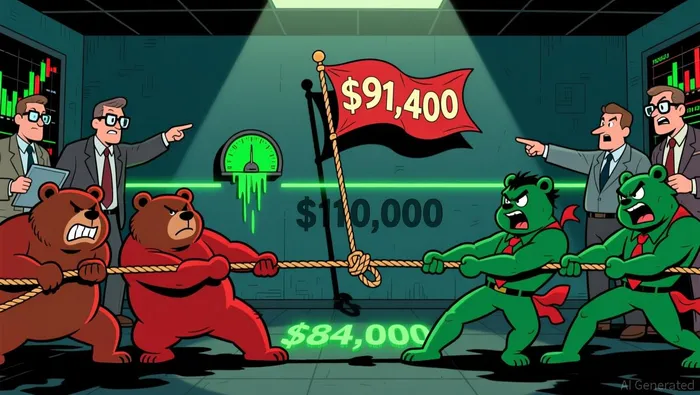
On the weekly chart, BitcoinBTC-- closed as a red bearish candle, confirming a bearish crossover on the MACD oscillator-a signal often interpreted as a warning of prolonged downward pressure. This bearish momentum is compounded by the price's inability to reclaim key resistance levels such as $91,400 and $94,000, despite the $84,000 support level holding firm. The 14-day RSI indicator, currently at 35.92, has dipped below the 30 threshold, signaling an oversold condition. However, as noted by technical analysts, an oversold RSI alone is insufficient to predict a reversal without accompanying price action, such as a breakout above critical resistance or a shift in candlestick patterns indicating easing selling pressure. The 200-day Exponential Moving Average (EMA), positioned near $110,000, acts as a pivotal resistance level. This level coincides with the average purchase price of short-term holders, making it a psychological battleground for bulls. A sustained move above $110,000 could trigger a wave of profit-taking among retail investors, easing selling pressure. Conversely, a drop below $100,000 would likely deepen bearish sentiment, with further downside risks to $94,000 or even $75,000 if the correction intensifies.
Macroeconomic Catalysts: Policy, Inflation, and Geopolitical Tensions
Bitcoin's price movements in late 2025 have been heavily influenced by macroeconomic headwinds. A 24% decline in the month leading up to November 2025 was driven by a combination of geopolitical tensions, central bank policy tightening, and leveraged position liquidations. A notable trigger was U.S. President Donald Trump's announcement of 100% tariffs on Chinese imports, which sparked a $19 billion liquidation event in 24 hours, breaking the $100,000 psychological barrier.
Monetary policy remains a critical factor. The U.S. Federal Reserve's October 2025 rate cut of 25 basis points led to a 38.61% surge in Bitcoin's price within 24 hours, underscoring the asset's sensitivity to interest rate adjustments. Meanwhile, inflation data has shown mixed signals. A September 2025 U.S. CPI report of 3.0% year-over-year-slightly below expectations-briefly pushed Bitcoin to $114,000, reinforcing historical correlations between lower inflation and risk-on sentiment in crypto markets.
Investor Behavior and On-Chain Metrics: Stability Amid Volatility
Despite the recent selloff, on-chain metrics suggest a degree of stability among long-term holders. The Network Value to Transactions (NVT) ratio at ~1.51 indicates that Bitcoin's valuation is supported by real transactional activity rather than speculative fervor. Active address data, with ~735,000 unique addresses transacting daily, further reflects healthy on-chain usage. Holder profitability metrics, such as the SOPR (Spent Output Profit Ratio) at ~1.03 and MVRV (Market Value to Realized Value) at ~2.3×, suggest selective profit-taking without panic selling. These signals imply that the market is not in a state of capitulation, which could provide a floor for further declines.
Institutional adoption also remains a stabilizing force. ETF inflows, while showing moderate selling, have not retreated significantly, indicating that long-term investors continue to accumulate Bitcoin despite short-term volatility. This behavior contrasts with leveraged traders, whose liquidations have amplified short-term price swings.
The Path Forward: A Delicate Balance
For Bitcoin to break out of its current range, both technical and macroeconomic catalysts must align. On the technical front, a sustained move above $110,000 would be critical to rekindle bullish momentum. On the macroeconomic side, a shift in Federal Reserve policy-such as a pause in rate hikes or a dovish pivot-could provide the necessary tailwind. Additionally, a resolution to geopolitical tensions, particularly U.S.-China trade disputes, would reduce risk-off sentiment and ease pressure on crypto markets. However, the absence of immediate bullish catalysts for a Thanksgiving rally suggests that seasonal factors alone may not drive a breakout. Instead, structural factors such as regulatory clarity, institutional adoption, and macroeconomic stability will play a more decisive role in shaping Bitcoin's trajectory.
Conclusion
Bitcoin's tentative bounce in late 2025 reflects a fragile equilibrium between bearish technical signals and stabilizing macroeconomic and on-chain factors. While the path to a breakout remains uncertain, the interplay of key resistance levels, Fed policy, and investor behavior patterns offers a framework for assessing the asset's potential. Investors must remain vigilant, as the market's next move could hinge on a single catalyst-be it a policy shift, a geopolitical development, or a surge in on-chain activity.






Comentarios
Aún no hay comentarios