
Bitcoin's Synchronous Fluctuations with Yen Amid Rate Hike: A Leading Indicator of Risk Sentiment
In the evolving landscape of global macroeconomic dynamics, BitcoinBTC-- has emerged as a barometer for risk-on/risk-off sentiment, particularly during periods of monetary tightening. The Bank of Japan's (BoJ) recent pivot toward normalization of interest rates has created a unique lens through which to analyze Bitcoin's behavior. As central banks recalibrate policy to combat inflation, the interplay between Bitcoin and the Japanese Yen (JPY) reveals critical insights into market psychology and liquidity shifts. This article examines Bitcoin's role as a leading indicator of risk sentiment during BoJ rate hikes, drawing on empirical evidence from 2023–2025.
The BoJ's Tightening Cycle and Yen Dynamics
The BoJ's prolonged ultra-loose monetary policy historically underpinned the yen's role as a funding currency for global carry trades. By maintaining near-zero interest rates, Japan became a source of cheap liquidity, enabling investors to borrow yen to fund higher-yielding assets, including cryptocurrencies. However, this dynamic has frayed as the BoJ signals a shift toward tighter policy. In late 2024 and early 2025, Governor Kazuo Ueda's hawkish rhetoric-coupled with rising Japanese government bond yields-triggered a reevaluation of risk appetite. For instance, when the BoJ hinted at a December 2025 rate hike, Bitcoin plummeted below $87,500 amid a broader selloff in risk assets, while the yen strengthened against the U.S. dollar according to market analysis.
This correlation is not coincidental. The yen's strength during tightening cycles reflects a repricing of capital away from speculative positions and toward safer assets. Bitcoin, as a high-beta asset, often reacts first to these shifts. According to a report by Coindesk, Bitcoin's 5% drop in early December 2024 preceded the yen's appreciation, underscoring its role as a leading indicator.
Lead-Lag Relationship: Bitcoin as a Canary in the Coal Mine
Historical data reveals a consistent lead-lag relationship between Bitcoin and the yen during BoJ policy shifts. For example, in August 2024, Bitcoin fell from $66,000 to $55,000 within a week as traders unwound yen carry trades in anticipation of tighter monetary conditions according to The Block. Similarly, in December 2025, Bitcoin's decline to $84,000 occurred ahead of the yen's strengthening, driven by expectations of a rate hike according to Coindesk.
This pattern suggests that Bitcoin's price action often precedes yen movements by days or weeks, acting as a forward-looking signal of risk sentiment. A study by the Bank of Japan notes that Bitcoin's sensitivity to liquidity conditions and interest rate differentials makes it a useful proxy for gauging global risk appetite. When Bitcoin drops sharply, it signals a flight to safety, which later manifests in the yen's appreciation as carry trades unwind.
Case Study: The December 2025 Rate Hike and Market Reactions
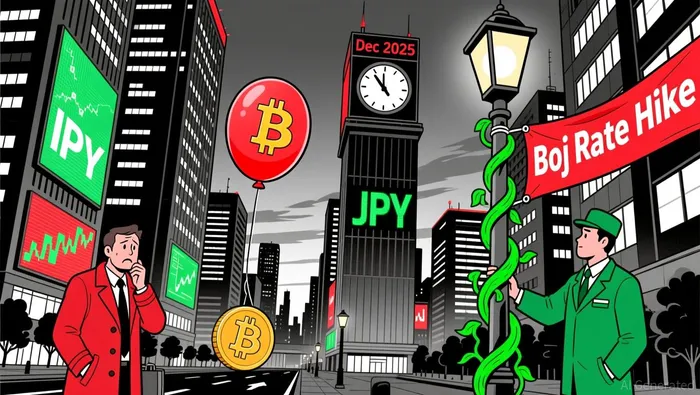
The December 2025 BoJ meeting serves as a pivotal case study. As Governor Ueda signaled a potential rate hike, Japanese 10-year bond yields surged to 1.84%, the highest since 2008 according to Yahoo Finance. This triggered a wave of leveraged position liquidations in crypto markets, wiping $150 million in long positions and pushing Bitcoin below $87,500 according to Coindesk. The yen's subsequent strength further accelerated the risk-off environment, as capital flowed back into Japan's domestic assets.
This episode highlights Bitcoin's dual role as both a victim and a harbinger of tightening liquidity. Unlike traditional assets, Bitcoin's price is not directly tied to the yen's exchange rate but is instead influenced by broader macroeconomic expectations. According to Reuters, the unwinding of yen carry trades during BoJ tightening cycles often creates a "domino effect," with Bitcoin's volatility amplifying shifts in risk sentiment.
Implications for Investors and the Future Outlook
For investors, Bitcoin's lead-lag relationship with the yen offers a strategic tool for navigating tightening cycles. When Bitcoin exhibits sharp declines ahead of BoJ rate hikes, it may signal an impending risk-off phase, prompting hedging strategies or a shift toward defensive assets. Conversely, a stabilization or rebound in Bitcoin could indicate easing liquidity pressures and a return to risk-on sentiment.
However, Japan's fiscal challenges-exemplified by its 240% debt-to-GDP ratio-introduce complexity. According to Investing.com, rising bond yields and fiscal instability have weakened the yen's traditional role as a carry-trade currency, complicating the risk-on/risk-off dynamic. Analysts now argue that the Swiss franc (CHF), with its stronger fiscal position, may emerge as a more reliable barometer of global risk appetite according to Yahoo Finance.
Looking ahead, the BoJ's December 2025 meeting remains a critical event. If a rate hike is enacted, it could further tighten global liquidity and pressure Bitcoin. Conversely, a dovish stance might provide temporary relief for risk assets. Investors must closely monitor BoJ communication, bond yields, and Bitcoin's price action to anticipate market shifts.
Conclusion
Bitcoin's synchronous fluctuations with the yen during BoJ rate hikes underscore its role as a leading indicator of risk-on/risk-off sentiment. By analyzing Bitcoin's price movements ahead of yen appreciation, investors can gain early insights into liquidity shifts and macroeconomic trends. As central banks continue to navigate inflationary pressures, Bitcoin's behavior will remain a critical signal for gauging the health of global risk markets.






Comentarios
Aún no hay comentarios