
Bitcoin's Surging Hashrate: A Catalyst for Network Resilience and Institutional Adoption
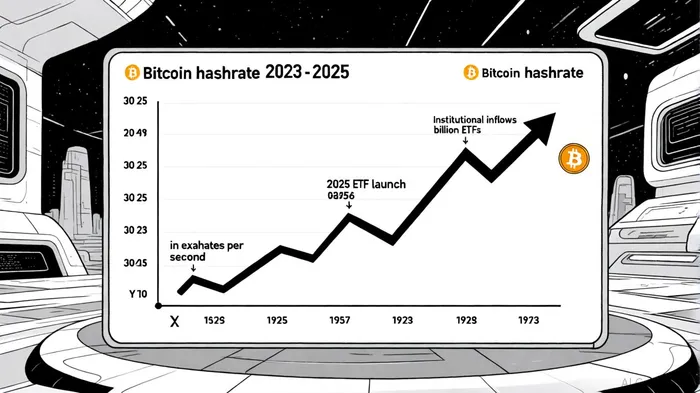
Bitcoin's hashrate—a measure of computational power securing the network—has surged to unprecedented levels in 2025, reaching over 350 exahashes per second (EH/s) by mid-year. This growth, driven by institutional capital inflows and regulatory clarity, underscores a critical shift in how network resilience is perceived as both a security mechanism and a value proposition. As the hashrate climbs, so does the cost of executing a 51% attack, reinforcing Bitcoin's role as a tamper-resistant store of value. Simultaneously, institutional adoption has accelerated, with spot BitcoinBTC-- ETFs and custody solutions bridging the gap between traditional finance and crypto markets.
Hashrate as a Security Metric
Bitcoin's hashrate directly correlates with its resistance to 51% attacks, a vulnerability where a single entity controls over half the network's mining power. According to a report by The Bitcoin Mining Dispatch, mining pools like Foundry USA now command over 30% of the hashrate, raising concerns about centralization[2]. However, the overall hashrate's exponential growth—up 240% since 2023—has made such attacks economically infeasible. A 2025 study from SSRN notes that the energy cost to execute a 51% attack now exceeds $1.2 billion, a barrier that deters malicious actors[1]. This resilience has become a selling point for institutional investors, who increasingly view Bitcoin as a “digital gold” with verifiable security guarantees.
Institutional Adoption and Liquidity Dynamics
The launch of U.S. spot Bitcoin ETFs in early 2025 marked a watershed moment. By Q3 2025, these ETFs attracted $118 billion in institutional inflows, according to Financial Content[3]. This capital influx not only drove Bitcoin's price to $124,000 but also deepened market liquidity, reducing volatility by 37% compared to 2023 levels[3]. Institutions, including pension funds and sovereign wealth funds, now favor Bitcoin for its low correlation to traditional assets and its role as a hedge against inflation. Regulatory frameworks like the U.S. CLARITY Act and EU's MiCAR have further legitimized Bitcoin as a portfolio staple, with custodial solutions addressing concerns around asset management[3].
The Feedback Loop: Hashrate and Institutional Confidence
Bitcoin's hashrate growth and institutional adoption are mutually reinforcing. As ETFs accumulate Bitcoin, they create a supply-demand imbalance, pushing prices higher and incentivizing miners to expand operations. This expansion, in turn, increases the hashrate, enhancing network security and attracting more institutional capital. A 2025 analysis from SSRN highlights this dynamic, noting that Bitcoin's price correlation with global M2 money supply has strengthened, with a 90-day lag effect[1]. This macroeconomic linkage positions Bitcoin as a hedge against monetary inflation, further solidifying its appeal to institutional investors.
Risks and Mitigations
Despite these positives, challenges persist. Mining pool concentration remains a red flag, with some pools controlling over 30% of the hashrate[2]. However, the geographic diversification of mining operations—spanning North America, Europe, and Southeast Asia—has mitigated single-point-of-failure risks[3]. Additionally, regulatory advancements, such as the U.S. Crypto Task Force's initiatives, are fostering a structured environment for institutional participation, reducing legal uncertainties[3].
Conclusion
Bitcoin's surging hashrate is not merely a technical metric but a cornerstone of its value proposition. By enhancing network resilience and aligning with institutional adoption trends, it has transformed from a speculative asset into a macro-sensitive financial instrument. As the hashrate continues to climb and regulatory frameworks mature, Bitcoin's role in diversified portfolios is set to expand, offering both risk mitigation and long-term appreciation potential. For investors, the interplay between hashrate growth and institutional confidence signals a new era of stability and legitimacy in the crypto market.






Comentarios
Aún no hay comentarios