
Bitcoin's Surge Against the Japanese Yen: A Macro-Driven Inflation Hedge in 2025
Bitcoin's Surge Against the Japanese Yen: A Macro-Driven Inflation Hedge in 2025
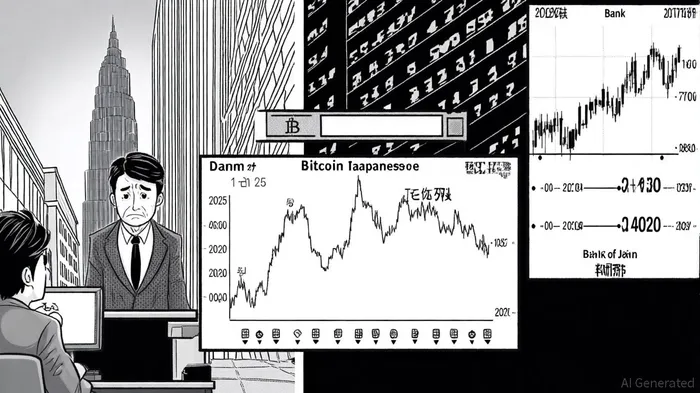
The Japanese Yen and BitcoinBTC-- have become unlikely bedfellows in 2025, as divergent global monetary policies and inflationary pressures have reshaped the landscape for both traditional and digital assets. Bitcoin's surge against the JPY-peaking at ¥18.1 million in August 2025-reflects a broader macroeconomic narrative driven by the Bank of Japan's (BOJ) tightening cycle and the U.S. Federal Reserve's easing trajectory. This divergence has not only redefined currency valuations but also elevated Bitcoin's role as an inflation hedge in a world increasingly skeptical of fiat guarantees.
Monetary Policy Divergence: BoJ's Hawkish Turn vs. Fed's Easing Cycle
The BOJ's shift from ultra-accommodative policies to a gradual normalization has been one of the most significant developments in 2025. After years of quantitative easing and yield curve control (YCC), the central bank raised its key interest rate to 0.5% in January 2025-the first increase in 17 years-marking a decisive break from deflationary stagnation, according to a CNBC report. This move, coupled with a planned reduction in Japanese Government Bond (JGB) purchases, has strengthened the yen against the U.S. dollar, which has appreciated by approximately 6% year-to-date, per a Deriv analysis.
Meanwhile, the Federal Reserve has adopted a contrasting approach. Amid slowing economic growth and a declining Dollar Index (DXY), the Fed cut its federal funds rate by 25 basis points in September 2025, signaling a broader easing cycle. This divergence has created a yield differential that favors the yen, while also amplifying Bitcoin's appeal as a non-sovereign asset. As U.S. bond yields fall and fiscal deficits widen, investors are increasingly seeking alternatives to traditional inflation hedges, with Bitcoin emerging as a compelling option, according to a TradersUnion forecast.
Japan's Inflationary Pressures and the Case for Bitcoin
Japan's core inflation rate has remained stubbornly above the BOJ's 2% target throughout 2025, driven by wage growth of approximately 5% during spring labor negotiations and a gradual recovery in domestic demand, as noted by TradersUnion. While the BOJ projects a "virtuous cycle" of income and spending, the central bank's cautious approach to rate hikes-holding rates steady at 0.25% in September 2025-has left room for further tightening if inflationary pressures persist, as highlighted by TradersUnion.
Bitcoin's performance against the JPY has mirrored these dynamics. As inflation expectations in Japan and the U.S. converge-U.S. PCE inflation reached 2.7% year-on-year in August 2025-Bitcoin's fixed supply model has positioned it as a strategic asset for hedging against currency devaluation, a theme discussed in the Deriv analysis. Analysts note that Bitcoin's surge to ¥18.1 million in August was partly fueled by institutional adoption, including U.S.-listed spot ETPs, which have enhanced its legitimacy as a mainstream inflation hedge, according to a Cointelegraph analysis.
Risks and Volatility: The Double-Edged Sword
Despite its potential, Bitcoin's role as an inflation hedge remains complicated by its volatility. The BTC/JPY exchange rate swung from a low of ¥11.1 million in April 2025 to a high of ¥18.1 million by August, reflecting sharp swings in risk appetite and macroeconomic sentiment, as noted by Deriv. Additionally, concerns about the centralization of mining power and wallet ownership persist, raising questions about Bitcoin's long-term reliability as a decentralized store of value, an issue highlighted by Cointelegraph.
For investors, the key lies in balancing Bitcoin's theoretical advantages-such as its fixed supply and decentralization-with its practical limitations. As the BOJ continues to reduce JGB purchases and the Fed navigates fiscal imbalances, Bitcoin's price trajectory against the JPY will likely remain tethered to broader macroeconomic trends.
Conclusion: A New Era for Digital and Traditional Assets
The interplay of Japan's tightening cycle and the Fed's easing stance has created a unique environment for Bitcoin to thrive as an inflation hedge. While the yen's strength against the dollar underscores the impact of monetary policy divergence, Bitcoin's surge against the JPY highlights a growing appetite for non-sovereign assets in an era of fiscal uncertainty. For investors, the challenge will be to navigate Bitcoin's volatility while leveraging its potential to diversify portfolios in a world where traditional inflation hedges are increasingly called into question.






Comentarios
Aún no hay comentarios