
Bitcoin's Sudden Price Drop Below $112,000: A Short-Term Buying Opportunity Amid Market Volatility?
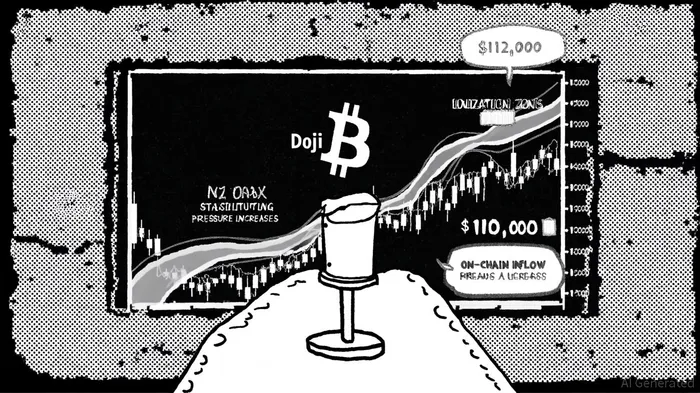
Bitcoin's recent plunge below $112,000 has ignited a frenzy of debate among traders and analysts. While the selloff—triggered by a combination of institutional profit-taking, a strengthening U.S. dollar, and bearish technical signals—has rattled short-term optimism, the broader narrative suggests a potential buying opportunity for those with a medium-term horizon. Let's dissect the market sentiment and technical indicators to assess whether this dip is a warning sign or a catalyst for a rebound.
Market Sentiment: Fear, Leverage, and Institutional Resilience
The immediate reaction to Bitcoin's drop was panic. A viral X post falsely claiming the price had breached $112,000 forced traders to verify data across multiple platforms, amplifying short-term volatility [4]. Over $1.7 billion in liquidations occurred as the price fell to $111,760, with leveraged long positions accounting for nearly $280 million of that total [5]. However, the Fear & Greed Index remains neutral at 45, and social media sentiment is still 45% bullish, indicating that retail and institutional buyers haven't entirely abandoned the asset [1].
Institutional activity tells a different story. On-chain data reveals that BitcoinBTC-- ETFs and corporate accumulators—such as Japan's Metaplanet—are continuing to absorb supply, creating a structural squeeze that could limit downside potential [1]. The Coinbase Premium Index, which measures U.S. retail demand, also shows robust buying pressure, suggesting that retail investors are stepping in as prices dip [1].
Technical Indicators: A Mixed Bag of Signals
From a technical perspective, the breakdown below $112,000 is concerning. A Doji candle formed at the $124,500 resistance zone, signaling indecision among buyers [1]. While the Doji candle at the $124,500 resistance zone signals indecision, historical backtests show that Doji Star patterns since 2022 have occurred only six times, with no significant returns over 30-day periods. This suggests the pattern, by itself, has offered little edge in the recent market regime[6]. The taker buy/sell ratio of -0.79 and a declining SOPR (Spent Output Profit Ratio) further reinforce bearish momentum, as they indicate fading profitability and increased selling pressure from long-term holders [3].
Yet, key support levels provide a floor for potential rebounds. The $111,400 and $110,000 levels are critical psychological and technical barriers. Historically, Bitcoin has closed the year higher than September levels in 70% of cases since 2015, a statistic that fuels cautious optimism among long-term holders [1]. If the price stabilizes above $111,400, a rebound toward $115,500 could reignite bullish sentiment, while a breakdown below $110,000 would likely test the $104,000 (200-day moving average) level [2].
Macro Risks and Institutional Tailwinds
The broader macroeconomic environment remains a wildcard. Mixed messaging from the Federal Reserve—coupled with upcoming PCE inflation data—has created uncertainty around rate cuts, which could either bolster risk assets or trigger renewed selloffs [1]. However, institutional adoption continues to offset these risks. Corporate Bitcoin accumulations and ETF inflows are creating a structural floor, while the seasonal weakness of September (historically a challenging month for Bitcoin) may already be priced in [2].
Conclusion: A Calculated Entry Point?
Bitcoin's drop below $112,000 is undeniably bearish in the short term, but it also presents a compelling case for a medium-term buying opportunity. For investors with a 3–6 month horizon, the combination of institutional demand, historical resilience, and oversold conditions (as reflected in the Fear & Greed Index) suggests that this dip could be a temporary setback rather than a bear market confirmation.
That said, prudence is key. Traders should monitor the $111,400 support level closely and avoid overexposure to leveraged positions. For those with capital to deploy, dollar-cost averaging into Bitcoin at these levels—while keeping a watchful eye on macroeconomic developments—could position them to capitalize on a potential rebound.






Comentarios
Aún no hay comentarios