
Bitcoin's Sudden Drop Below $90,000: A Buying Opportunity or a Warning Signal?
Bitcoin's plunge below $90,000 in December 2025 has ignited fierce debate among investors, analysts, and institutional players. The move, driven by a confluence of macroeconomic uncertainty and shifting risk appetite, has exposed the fragility of a market still grappling with structural liquidity challenges. To assess whether this represents a buying opportunity or a deeper correction, we must dissect the interplay of macroeconomic catalysts, institutional sentiment, and technical dynamics shaping Bitcoin's trajectory.
Macroeconomic Catalysts: Policy Divergence and Liquidity Pressures
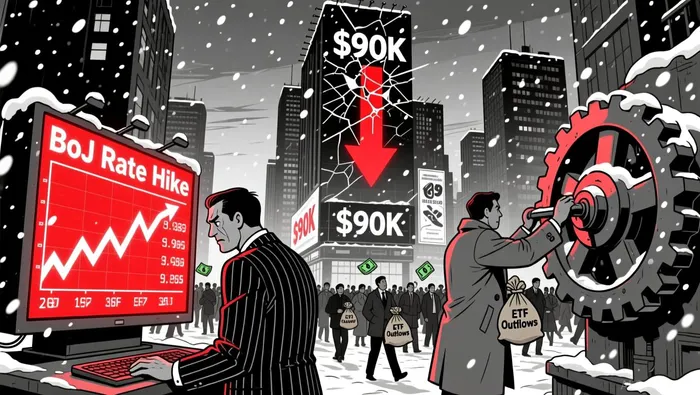
The immediate trigger for Bitcoin's selloff was the Bank of Japan's potential 0.25% interest rate hike, which threatened to unwind the yen carry trade-a historically significant source of liquidity for crypto markets. This policy divergence from the U.S. Federal Reserve's dovish stance-marked by its 25-basis-point rate cut in October 2025-created a volatile environment where capital flowed toward safer assets. The BoJ's hawkish pivot, combined with U.S. trade war rhetoric and stagflationary pressures, amplified risk-off sentiment, pushing the Crypto Fear and Greed Index to an extreme fear reading of 16.
Compounding these pressures were outflows from Bitcoin ETFs, which saw over $3.48 billion in redemptions last month. This exodus, coupled with thin December liquidity, exacerbated downward momentum. Meanwhile, corporate holders like Strategy Inc. reignited fears of forced selling after hinting at using BitcoinBTC-- reserves to cover dividends, further eroding confidence.
Institutional Sentiment: Cautious Optimism Amid Uncertainty
Despite the bearish near-term action, institutional sentiment remains mixed. On one hand, US-listed spot Bitcoin ETFs recorded $151.74 million in net inflows on December 9, signaling accumulation by institutional investors viewing Bitcoin as a hedge against fiat devaluation. A 2025 institutional outlook survey revealed 64% of investors anticipate a soft landing in their home regions, up from 51% in 2024, reflecting growing confidence in macroeconomic resilience.
However, this optimism is tempered by caution. The Federal Reserve's muted response to its rate cut-Bitcoin's muted rebound post-December 10-suggests investors are recalibrating expectations. Central banks globally are adopting neutral stances, with nominal neutral rates estimated between 1.5% and 3.5%, prolonging policy uncertainty. Meanwhile, 63% of institutional investors expect interest rates to continue declining in 2025, but fixed-income strategies remain focused on active duration management.
Technical and On-Chain Indicators: Cyclical Bottom or Deeper Correction?
Technically, Bitcoin's support levels at $83,000–$84,000 and resistance near $90,000 define a critical battleground. A failure to reclaim $90,000 could trigger further downward pressure, while a rebound might signal a macro-driven reset rather than structural collapse. On-chain data offers conflicting signals: the Puell Multiple entered a "buy" zone, and whale wallets resumed accumulation, suggesting cyclical bottoms. Yet ChatGPT's bearish model projects a year-end price of $86,000 based on RSI and MACD indicators, while bulls cite institutional flows and potential Fed cuts as catalysts for a rebound toward $111,000.
Global Macroeconomic Context: Inflation, Growth, and Policy Pathways
Global GDP growth is projected to slow to 3.1% in 2025, with advanced economies facing headwinds from high tariffs and policy uncertainty. The U.S. inflation rate remains stubbornly above 2.7%, while the Eurozone approaches its 2% target. These divergences complicate Bitcoin's role as a hedge, as investors weigh regional risks. The BoJ's potential 2026 rate hike and the ECB's pause on cuts further cloud the macroeconomic outlook, creating a tug-of-war between risk-on and risk-off dynamics.
Conclusion: Navigating the Crossroads
Bitcoin's drop below $90,000 is neither a definitive collapse nor a guaranteed buying opportunity. It reflects a market at a crossroads, where macroeconomic headwinds and institutional caution clash with cyclical accumulation and long-term bullish fundamentals. For investors, the key lies in balancing short-term volatility with structural trends: Bitcoin's role as a portfolio diversifier is gaining traction, with 94% of institutions believing in blockchain's long-term value. However, the path forward remains contingent on central bank coordination, liquidity conditions, and the resolution of global trade tensions.
In this environment, patience and position sizing are paramount. Those with a multi-year horizon may find value in dips like this, but only if they're prepared to weather further volatility. As always, the market's next move will depend on whether fear proves to be a temporary blip or a harbinger of deeper structural shifts.






Comentarios
Aún no hay comentarios