
Bitcoin's Struggle to Break Through Key Resistance Levels: A Technical and Macro Perspective
Bitcoin's price action in October 2025 has painted a complex picture of bullish momentum and looming technical barriers. While the asset has surged past $121,900 amid record institutional demand and regulatory clarity, traders and investors now face a critical juncture: whether BitcoinBTC-- can decisively break through key resistance levels to cement a new all-time high. This analysis examines the technical and macroeconomic forces shaping Bitcoin's trajectory, offering insights into the risks and opportunities ahead.
Technical Barriers: A Test of Conviction
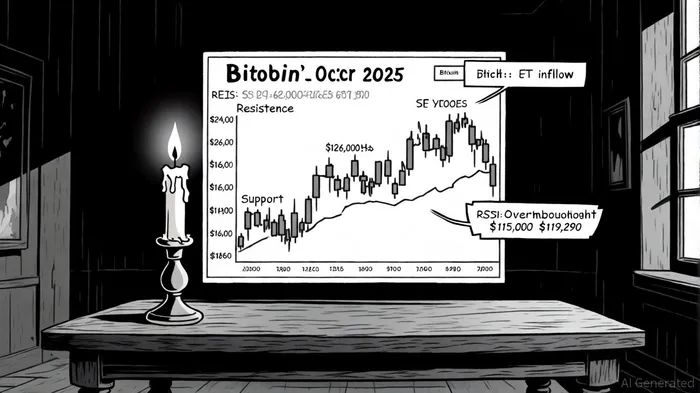
Bitcoin's immediate resistance cluster lies between $124,000 and $126,000, a zone where prior highs and profit-taking pressures converge, according to a FinanceFeeds report. This area represents a psychological and structural hurdle, as it encapsulates historical price peaks and Fibonacci retracement levels. A breakout above $124,000 would likely trigger a wave of stop-loss orders and short-covering, potentially propelling prices toward $130,000. However, the Relative Strength Index (RSI) currently signals overbought conditions, suggesting a temporary consolidation phase could precede a decisive move, as noted in an Aurpay analysis.
Historical backtesting of Bitcoin's resistance-level touch events from 2022 to 2025 reveals that a 30-day holding period following a resistance touch yielded an average return of approximately 7.5%, significantly outperforming the broader Bitcoin benchmark of ~3.5% (Backtest results: Bitcoin resistance-level touch events, 2022–2025). This suggests that while breaking through resistance may initially face consolidation, patient investors could benefit from extended holding periods. Short-term (1–5 day) price impacts are modest, but the edge grows as the holding period lengthens, with statistical significance emerging after ~25 trading days.
On the downside, the $115,000–$119,290 range acts as a critical support corridor. A breakdown below $115,000 could reignite bearish sentiment, with the next major support level at $111,963 serving as a potential floor for a deeper correction, as a Financial Analyst piece notes. Notably, the price has formed higher lows in recent weeks, reinforcing a bullish structural bias despite the overbought RSI - a point also highlighted in the Aurpay analysis. Volume analysis further supports this narrative, as rising buying pressure on upswings indicates strong institutional participation, as the Aurpay analysis argues.
Macroeconomic Catalysts: Dovish Policy and Regulatory Tailwinds
Bitcoin's rally has been underpinned by a dovish shift in U.S. monetary policy. The Federal Reserve's 25-basis-point rate cut in September 2025 marked a pivotal pivot from restrictive to accommodative policy, reducing real yields and incentivizing capital flows into risk assets, according to a Cointribune analysis. This environment has amplified Bitcoin's appeal as a hedge against dollar devaluation and inflationary pressures, particularly as the U.S. dollar index weakened against major currencies, as reported in an FXLeaders piece.
Institutional adoption has also accelerated, driven by record inflows into spot Bitcoin ETFs. These products have transformed Bitcoin's supply dynamics, with ETFs absorbing a significant portion of circulating supply and reducing market volatility, according to the Financial Analyst piece. Regulatory developments have further de-risked the asset class: the SEC's easing of ETP listing requirements and the passage of the GENIUS Act-aimed at stabilizing the stablecoin sector-have positioned Bitcoin as a mainstream investment vehicle, the Financial Analyst piece argues.
The Path Forward: Balancing Bulls and Bears
While the macroeconomic backdrop remains favorable, technical indicators suggest caution. The derivatives market has seen a rise in protective strategies, such as put options and short-term hedges, as traders brace for potential volatility, an observation previously made by FXLeaders. A failure to break above $124,000 could lead to a retest of the $115,000 support level, creating a consolidation phase that tests market conviction. Conversely, a sustained breakout above $126,000 would validate the bullish case, potentially unlocking a new wave of speculative and institutional demand.
Investors must also monitor geopolitical risks, particularly in the eurozone. Political instability in France and broader concerns about capital flight could force central banks into liquidity expansions, reinforcing Bitcoin's role as a systemic risk hedge, as the FinanceFeeds report noted. However, any reversal in Fed dovishness or regulatory setbacks could disrupt the current momentum.
Conclusion
Bitcoin stands at a crossroads in October 2025, with technical resistance levels and macroeconomic catalysts in a delicate balance. The interplay between institutional demand, regulatory clarity, and monetary policy has created a bullish foundation, but the path to a new all-time high remains contingent on overcoming key psychological barriers. Traders should closely watch the $124,000–$126,000 zone and ETF inflow trends, while hedging against short-term volatility. For long-term investors, the broader narrative of Bitcoin's integration into global capital markets remains intact-if the fundamentals hold.






Comentarios
Aún no hay comentarios