
Bitcoin's Structural Weakness Amid Record $28B Options Expiry: A Strategic Opportunity for Long-Term Accumulation?
The December 2025 BitcoinBTC-- options expiry, valued at $28 billion, has exposed structural vulnerabilities in the cryptocurrency's market dynamics while simultaneously creating a unique inflection point for strategic accumulation. As the largest single-day expiry in crypto history, this event has amplified short-term volatility, tested key price levels, and revealed shifts in capital reallocation across the Bitcoin ecosystem. However, beneath the noise of expiring contracts and seasonal outflows lies a compelling case for long-term investors to consider entry near projected support zones around $75,000.
Structural Weaknesses: Options Expiry and Gamma Dynamics
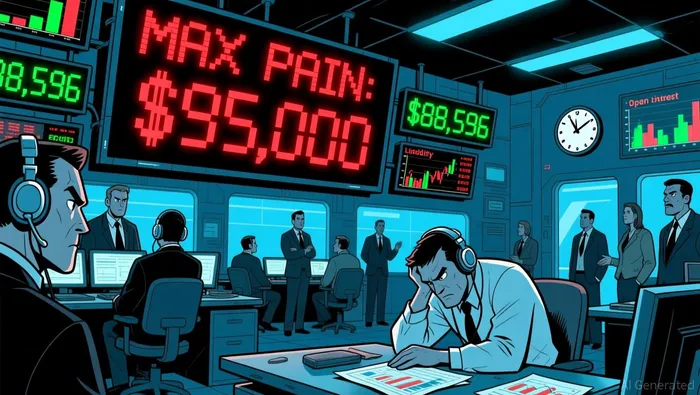
The December 2025 expiry's "max pain" level-calculated at approximately $95,000-represents a critical gravitational pull for Bitcoin's price action. This level, derived from open interest data, indicates where the greatest number of options contracts expire worthless, maximizing losses for buyers and profits for sellers. With Bitcoin currently trading near $88,596, the max pain level sits well above the current price, suggesting that market makers and institutional players are hedging to maintain delta neutrality, potentially driving price toward this threshold.
Post-expiry data reveals a sharp decline in open interest, dropping by nearly 50% as traders exited positions. This reduction has created thin liquidity conditions, particularly during the holiday season, where modest orders can trigger exaggerated intraday swings. The gamma-driven feedback loop-where dealers who were previously long gamma now hold short gamma positions-means rising prices force them to hedge by purchasing spot Bitcoin or short-dated call options, amplifying upward moves but lacking the volume to sustain a breakout above $90,000.
Capital Reallocation: ETF Outflows and Mining Sector Adaptation
Bitcoin ETFs experienced significant outflows in late December, with spot ETFs losing $175 million on Dec. 24 alone, led by BlackRock's IBIT and Grayscale's GBTCGBTC--. While these outflows reflect tactical adjustments tied to year-end portfolio rebalancing and tax considerations, the broader context shows robust institutional demand, with cumulative net inflows reaching $56.9 billion since January 2024. This suggests that the outflows are not indicative of a fundamental shift in sentiment but rather a temporary liquidity crunch.
Meanwhile, the Bitcoin mining sector has demonstrated resilience amid declining prices. Miners like HUT 8 CorpHUT-- have outperformed the broader market by leveraging operational efficiencies, and diversifying into AI data center hosting. The network hash rate dropped 4% in December-the sharpest decline since April 2024-partially attributed to Chinese miners reallocating capacity to AI infrastructure due to regulatory pressures. This shift underscores a broader trend of capital reallocation within the crypto ecosystem, where miners are adapting to macroeconomic challenges while maintaining long-term confidence in Bitcoin's value.
Weakening Short-Term Selling Pressure and Projected Support Zones
Despite the structural headwinds, signs of weakening short-term selling pressure are emerging. Open interest has stabilized at lower levels, and traders are increasingly engaged in short-covering rather than initiating fresh long positions. The Deribit perpetual funding rate, which spiked to over 30% post-expiry, reflects crowded bullish trades but also indicates that the cost of maintaining long positions is deterring speculative activity.
Technical analysts highlight that Bitcoin remains within an expanding wedge pattern, with a sustained close above $94,000 needed to reassert bullish momentum. On the downside, the $84,000 support level is critical, but historical data suggests that Bitcoin may need to consolidate in the $70,000–$80,000 range to establish stronger support. Santiment analysts project that the $74,000–$75,000 zone could serve as a pivotal support level, with accumulation by digital asset treasuries and mixed hodler behavior indicating potential for a rebound.
Strategic Opportunity for Long-Term Accumulation
The confluence of these factors presents a strategic entry point for long-term investors. The $28 billion options expiry has created a scenario where short-term volatility is likely to subside as liquidity returns in early 2026. Meanwhile, the mining sector's pivot to AI infrastructure and ETF outflows' normalization suggest that Bitcoin's structural weaknesses are being mitigated by adaptive capital flows.
For investors, the projected support near $75,000 offers a high-probability zone for accumulation, particularly if Bitcoin's price action mirrors historical patterns of consolidation in underdeveloped support zones. The key will be monitoring open interest trends and macroeconomic signals, such as U.S. equity performance and gold's safe-haven appeal, to gauge Bitcoin's cross-asset positioning.
In conclusion, while the December 2025 expiry has exposed Bitcoin's vulnerabilities, it has also created a rare alignment of market structure and capital reallocation dynamics that favor patient, long-term buyers. The path to $100,000 may require navigating near-term turbulence, but the fundamentals-both technical and structural-suggest that the storm is clearing for those willing to act decisively.





Comentarios
Aún no hay comentarios