
Bitcoin's Structural Shift: From Derivatives Trap to 2026 Re-rating
Bitcoin's price action since mid-December has been a study in mechanical suppression, not market indecision. The stock has been trapped in a tight range between $85,000 and $90,000, frustrating both bulls and bears. The culprit is not a lack of conviction but the overwhelming force of dealer gamma hedging in the options market. This creates an artificial price equilibrium where opposing hedging flows from concentrated options positions actively pin the spot price.
The scale of this suppression is stark. Dealer gamma exposure currently stands at $507 million, a figure that dwarfs the daily spot market activity. This is a 13-to-1 ratio against $38 million in daily ETF activity. In practice, this means the math of derivatives hedging overrides the narrative of institutional adoption. Every rally toward $90,000 triggers a mechanical response: dealers holding short call options at that strike must sell BitcoinBTC-- to hedge, creating forced supply that rejects the price. Conversely, as the price drifts toward $85,000, dealers holding short put options must buy spot Bitcoin to hedge, injecting forced demand that provides support. This dynamic creates a self-reinforcing range.
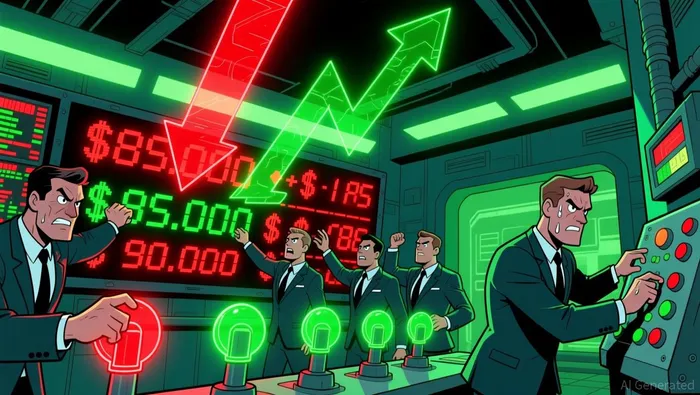
The structure is reinforced by leveraged futures positions, which have clustered around the same price levels, creating additional magnetic forces that double down on the range-bound pressure. The result is a market that appears stable but is actually held in place by opposing hedging flows from derivatives mechanics, not underlying market conviction.
This artificial equilibrium is set to expire. The December 26 options expiry is shaping up to be the largest in Bitcoin's history, with approximately $23.8 billion in notional value set to roll off. Analysts estimate this will remove roughly 75% of the current gamma profile, or about 46% of the dealer gamma that is currently suppressing volatility. When that overhang clears, the mechanical forces that have pinned the price will essentially disappear.
The bottom line is that Bitcoin is trapped, not poised. The market is waiting for a catalyst to break the range, and the December 26 expiry is that catalyst. Once the suppression mechanism is over, the stock will be free to move. The range-bound price action of the past weeks is a temporary phenomenon driven by derivatives mechanics, not a reflection of underlying market conviction. What comes next is a high-volatility transition as new positioning establishes itself, with the $85,000 support level becoming the critical battleground for the first major breakout.
Institutional Demand vs. Retail Selling: The Easing of Key Pressure Metrics
The recent pullback in Bitcoin's price is being met with a notable shift in the quality of selling pressure. While the broader market remains range-bound and liquidity is thin, two key metrics point to a cooling of the most destabilizing form of selling: the distribution by long-term holders. The Coin Days Destroyed (CDD) metric has experienced a significant decline, signaling that older, more influential wallets are moving their coins less frequently. This is a critical development because long-term holders represent the largest potential source of selling pressure. Their cooling activity alleviates a major structural stress on the market and creates a more stable base for price action.
This easing is mirrored in the institutional ETF space. While net outflows have persisted since early November, the magnitude of these negative readings has been gradually decreasing. The 30-day moving average is narrowing toward zero, indicating a decline in institutional selling pressure. The most telling data point is that despite a more than 30% drawdown from October highs, U.S. spot Bitcoin ETF holdings have declined by less than 5%. This shows that the core institutional allocators who drove the massive inflows since January 2024 are largely holding through the downturn. Their steady hands provide a crucial floor for the market.
In practice, this creates a clearer picture of who is driving the selling. The evidence points to selling pressure being primarily retail-driven from leveraged and short-term participants. These are the traders most sensitive to price moves and volatility, often exiting positions quickly. The institutional base, by contrast, is demonstrating resilience. This shift in the supply curve-from a broad, potentially destabilizing wave of selling to a narrower, retail-driven one-is a positive signal for market stability.
That said, this easing does not equate to strong demand. The broader context remains one of weak buying power and thin liquidity. The market is vulnerable to sharp moves, and a sustained rally will require more than just reduced selling pressure. It will need a genuine return of conviction and capital. The bottom line is that the key pressure metrics are improving, which could help form a durable bottom. But the path forward is likely to be a slow grind, not a swift recovery. The market's ability to hold support levels like $86,000 will be tested, but the structural risk of a flood of long-term holder supply has diminished.
The 2026 Re-rating Thesis: Catalysts, Scenarios, and Macro Tailwinds
The immediate catalyst for Bitcoin's next leg is structural: the record-breaking Boxing Day options expiry with roughly 300,000 Bitcoin contracts worth $23.7 billion set to expire. This event, representing over half of Deribit's open interest, is a classic volatility trigger. The market's current range-bound state between $85,000 support and $93,000 resistance is a direct function of this impending pressure. The central question for 2026 is whether the market can successfully defend the lower boundary. A clean break above $93,000 would signal a technical re-rating, but the more critical test is whether $85,000 support holds. A failure there would accelerate downside in a low-gamma environment, potentially setting up a deeper correction.
The macro tailwind is shifting. Markets are now pricing in an approximately 87% chance of a 25 basis point Fed rate cut, a dramatic shift from just a week prior. Historically, easing cycles support Bitcoin's risk-on re-rating, as lower discount rates make future cash flows more valuable and weaken the dollar. This creates a potential dual catalyst: the structural expiry pressure clears the deck, while easing expectations provide the fuel for a move higher. Analysts like Farzam Ehsani see scope for Bitcoin to revisit the $100,000–$120,000 range in the second quarter of 2026, with a renewed historical high possible as early as the first half of 2026.
However, this thesis faces persistent structural constraints. The market is currently in a period of thinning liquidity and year-end de-risking, with perpetual open interest dropping $3 billion for BTCBTC-- overnight. This creates a fragile setup where any move is amplified. Furthermore, on-chain data reveals weakening buying pressure across multiple metrics, with buy-volume divergence in futures markets resembling a 2021 cycle structure that has yet to recover. The recent $461.8 million in outflows over three days from Bitcoin ETFs, led by major players, underscores that selling pressure is primarily retail-driven, while institutional holdings remain largely intact.
The bottom line is a high-volatility transition period. The successful defense of the $85K-$90K range through expiry could set the stage for a structural breakout toward $100K-$120K in H1 2026, contingent on renewed buying power. But this requires the easing macro catalyst to overcome the structural constraints of thin liquidity and fading on-chain participation. If $85K support breaks, the path to a sustained re-rating becomes much longer and more uncertain. For now, the market is waiting for a clear signal on whether the post-expiry direction will be up or down.







Comentarios
Aún no hay comentarios