
Bitcoin's Structural Resilience: Why It Survives Downturns While Unstable Cryptos Collapse
In the ever-shifting landscape of cryptocurrency, Bitcoin's resilience during market downturns stands in stark contrast to the catastrophic collapses of unstable assets like LUNALUNA-- and FTX. This divergence is not a coincidence but a reflection of fundamental structural differences in market design, liquidity, and institutional adoption. As on-chain analytics firm Glassnode has repeatedly demonstrated, Bitcoin's evolution into a macro asset-anchored by deep liquidity, institutional participation, and alignment with global financial cycles-sets it apart from speculative projects that lack these foundational characteristics[1].
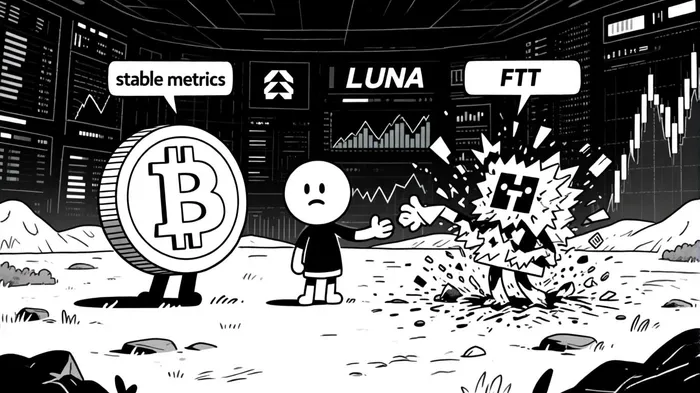
Structural Foundations: BitcoinBTC-- vs. Unstable Cryptos
Bitcoin's structural strength begins with its liquidity profile. According to a 2025 report by Avenir and Glassnode, Bitcoin's Realized Cap-a measure of the total value of coins not moved in the last year-has surged to an all-time high of $944 billion since November 2022[1]. This metric reflects the "realized value" of Bitcoin held by long-term investors, indicating a robust network liquidity layer. In contrast, unstable assets like LUNA and FTX lacked such depth. For example, during the FTX collapse, Bitcoin's reserves fell by less than 1% of its total supply, while FTX's Bitcoin holdings plummeted from 102,000 BTCBTC-- to near zero within days[2].
Institutional adoption further amplifies Bitcoin's resilience. Over 30% of Bitcoin's circulating supply is now held by just 216 centralized entities, including ETFs, exchanges, and corporate treasuries[5]. This concentration of ownership-driven by institutions like BlackRock and Fidelity-has created a "flight-to-quality" dynamic, where Bitcoin's dominance in the crypto market has grown from 38% in 2022 to 59% in 2025[3]. Meanwhile, projects like LUNA and FTX relied on speculative retail demand and opaque balance sheets, making them vulnerable to bank runs and liquidity spirals[2].
Performance During Downturns: Profit-Taking vs. Systemic Collapse
The 2022 market crash exemplifies Bitcoin's structural resilience. Glassnode data revealed that over 90% of Bitcoin investors were in profit before the selloff, turning the downturn into a "profit-taking event" rather than a panic-driven capitulation[1]. This contrasts sharply with the LUNA and FTX collapses, where less than 65% of investors were in profit, and Net Realized Profit/Loss metrics showed massive losses[1].
The FTX collapse, in particular, exposed the fragility of centralized crypto entities. On-chain analysis revealed a 99.5% drop in FTX's EthereumETH-- reserves and a near-total depletion of its Bitcoin holdings during the bank run[2]. These failures were not just technical but systemic, as FTX's balance sheet relied on interconnected entities like Alameda Research, which held synthetic assets with no real-world collateral[2].
2023–2025: Bitcoin's Maturing Market Structure
Recent data underscores Bitcoin's continued evolution into a mature asset class. Despite a 6% pullback from its 2025 all-time high of $111,700, Bitcoin's on-chain settlements reached $2.9 trillion in 2024, with a realized cap of $872 billion[4]. This growth is fueled by $40 billion in inflows to U.S. spot Bitcoin ETFs and a shift toward stablecoin-collateralized positions, signaling a more cautious, institutional-grade market[3].
Meanwhile, Bitcoin's alignment with global liquidity cycles has become increasingly evident. As Glassnode notes, its price action mirrors the four-year halving cycle, with recent movements echoing "euphoric phases" seen in 2017 and 2021[5]. Large investors now account for 89% of network volume through transactions over $100,000, further reinforcing its role as a settlement layer for institutional capital[1].
The Path Forward: Risks and Opportunities
While Bitcoin's structural advantages are clear, risks remain. Short-term holders currently sit on $4.3 billion in unrealized profits, which could trigger profit-taking and short-term volatility[2]. However, the STH (Spent Coin Age) cost basis model suggests a key resistance level at $136,000, assuming sustained demand[5]. For investors, this underscores the importance of distinguishing between Bitcoin's macro resilience and the inherent volatility of speculative assets.
Conclusion
Bitcoin's resilience during downturns is not a product of luck but of structural design. Its deep liquidity, institutional adoption, and alignment with global financial cycles create a flywheel effect that unstable cryptos like LUNA and FTX could never replicate. As Glassnode's analysis shows, Bitcoin is no longer just a digital asset-it is a macroeconomic force reshaping the financial landscape. For investors, the lesson is clear: structural strength, not hype, defines long-term value in crypto.






Comentarios
Aún no hay comentarios