
Bitcoin's Structural Dominance vs. Stagnant Altcoin Performance in Q4 2025
The cryptocurrency market in Q4 2025 is defined by a stark dichotomy: Bitcoin's structural dominance in derivatives markets and the fragile, overleveraged positioning of altcoins. While Bitcoin's derivatives metrics signal a resilient, capital-efficient bull case, altcoins remain trapped in a cycle of speculative excess and systemic risk. This divergence reflects deeper imbalances in market structure, driven by macroeconomic realities, regulatory clarity, and the maturation of BitcoinBTC-- as a financial asset.
Bitcoin's Derivatives Resilience: A Capital-Flow Engine
Bitcoin's derivatives market has become a cornerstone of its dominance. By September 2025, Bitcoin perpetual open interest (OI) had surged to $43.6 billion, a record high fueled by renewed capital inflows and institutional adoption, according to a BlockBeats report. Annualized funding rates on platforms like Deribit hit 13%, underscoring the willingness of longs to pay premiums for exposure amid anticipation of a historically bullish Q4, the same report noted. This optimism is notNOT-- unfounded: on-chain metrics show Bitcoin's demand growth since July 2025 mirrors patterns from prior bull cycles (2020, 2021, 2024), with derivatives positioning tightening around key price levels ($140,000–$200,000) as traders anchor to these targets, as CoinDesk reported.
Importantly, Bitcoin's leverage environment has stabilized post-volatility episodes in earlier 2025. Average leverage ratios remain moderate, and spot longs are less extended than earlier in the year, with daily buy orders averaging $56 million versus $42 million for sells, according to Coinbase Research. This balance suggests a healthier, more sustainable bullish case, where capital flows are not being artificially propped up by excessive leverage.
Altcoin Derivatives: A House of Cards
In contrast, altcoin derivatives markets are a cautionary tale. While open interest in altcoins reached $61.7 billion in Q4 2025-driven by speculative bets on assets like EthereumETH-- (ETH), SolanaSOL-- (SOL), and XRP-their structural health is dire, according to the CoinGlass outlook. The altcoin open interest dominance ratio remains above 1.4, a threshold historically correlated with cascading liquidations, Coinbase Research found. This fragility is compounded by extreme leverage: ETH's price, for instance, fell to $1,400 in April 2025 and only partially recovered to $2,500 by June, while altcoins like XRPXRP-- and SOLSOL-- saw over 90% declines from peaks, the BlockBeats report observed.
Leverage ratios and funding rates further expose the risk. Glassnode's LPOC metrics reveal synchronized price and OI trends in altcoins, indicating aggressive position openings during rallies but sharp divergences during downturns, as Coinbase Research shows. For example, XRP's OI spiked to $3.4 billion, yet its funding rates and leverage ratios suggest a precarious equilibrium, per a CoinPedia analysis. Retail and institutional traders are pouring capital into high-risk, high-reward altcoins, but macroeconomic and regulatory uncertainties-such as delayed ETHETH-- ETF staking approvals-have left the broader market in a risk-averse lull, the BlockBeats report concluded.
Structural Imbalances: Why Bitcoin Wins, Altcoins Lose
The divergence between Bitcoin and altcoins is not accidental but structural. Bitcoin's derivatives market is now a capital-efficient engine, attracting inflows from ETFs, large holders, and macro traders who view it as a hedge against fiat devaluation, as CoinDesk reported. Meanwhile, altcoins remain speculative playthings, with derivatives positioning driven by retail FOMO and short-term narratives.
This imbalance is exacerbated by Bitcoin's role as a systemic asset. Its derivatives metrics-stable leverage ratios, high funding rates, and institutional-grade liquidity-reflect a market that is self-sustaining. Altcoins, by contrast, rely on volatile capital flows and are vulnerable to sudden deleveraging. For instance, Ethereum's spot ETF staking mechanism approval in late 2025 was expected to boost risk appetite, but broader altcoin markets remain cautious, highlighting the lack of a unified narrative, the BlockBeats report noted.
Implications for Investors
For investors, the message is clear: Bitcoin's derivatives dominance signals a robust, capital-backed bull case, while altcoins face a high-risk, high-uncertainty environment. Positioning in Bitcoin derivatives-particularly longs with moderate leverage-offers a path to capitalize on Q4's historically bullish momentum. Altcoins, however, require extreme caution. Their elevated OI dominance ratios and leverage levels suggest a market primed for liquidations if volatility spikes or macroeconomic conditions deteriorate, Coinbase Research warned.
In this context, Bitcoin is not just a digital asset but a financial infrastructure asset. Its derivatives markets are a testament to its maturation, while altcoins remain in a speculative purgatory. As Q4 2025 unfolds, the structural divide between these two worlds will only widen. 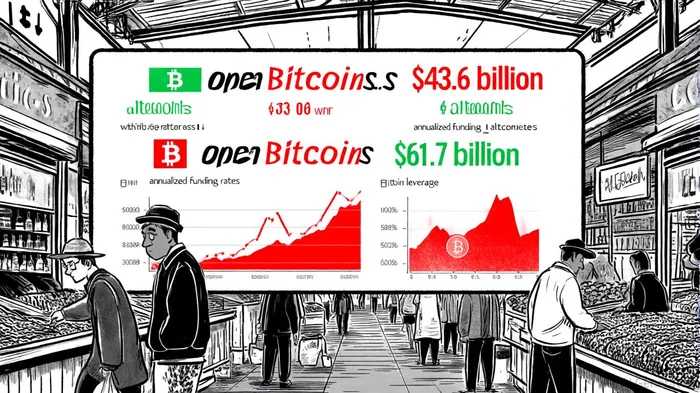






Comentarios
Aún no hay comentarios