
Bitcoin Strategy ETFs: A New Frontier for Income and Risk-Adjusted Returns in a Low-Yield World
In an era where traditional fixed-income assets offer paltry returns, investors are increasingly turning to alternative strategies to bolster income generation and enhance risk-adjusted returns. BitcoinBTC-- Strategy ETFs have emerged as a compelling option, blending the volatility of digital assets with innovative financial engineering to address the challenges of a low-yield environment. These funds, which leverage Bitcoin's price movements through spot exposure, futures contracts, and options strategies, are reshaping portfolio construction for both institutional and retail investors.
Performance and Cost Efficiency: Spot vs. Futures-Based ETFs
The performance divergence between spot and futures-based Bitcoin ETFs underscores the importance of structural design in asset allocation. From 2023 to 2025, spot ETFs like the iShares Bitcoin Trust (IBIT) and BitwiseBITB-- Bitcoin ETF (BITB) delivered year-to-date returns of 54–55%, outpacing the 45% return of the ProShares Bitcoin Strategy ETF (BITO), which tracks futures contracts, according to a MutualFundNation ranking. This gap is largely attributable to the costs associated with rolling futures, which erode returns over time. BITO's expense ratio of 0.95% further compounds this drag, compared to the 0.20–0.21% fees of lower-cost spot ETFs.
Risk metrics also highlight the tradeoffs. BITO's maximum drawdown of -77.86% reflects its exposure to contango and backwardation dynamics in futures markets, whereas spot-focused alternatives like the NEOS Bitcoin High Income ETF (BTCI) exhibit significantly lower volatility, with a drawdown of -24.36%, according to a Cointelegraph explainer. For long-term, diversified portfolios, these metrics suggest that spot ETFs offer a more favorable risk-return profile, despite Bitcoin's inherent price swings.
Income Generation: Covered Calls and Options Strategies
Bitcoin's volatility, often viewed as a drawback, has become a catalyst for income generation through structured strategies. ETFs like the Simplify Bitcoin Strategy PLUS Income ETF (MAXI) and BTCI employ covered call options and data-driven overlays to generate yields exceeding 40% in 2025, according to a Quantpedia paper. These strategies capitalize on Bitcoin's price swings by selling options to capture premiums, creating regular cash flows without direct ownership of the underlying asset.
BlackRock's recent foray into this space with its Bitcoin Premium Income ETF filing illustrates the growing institutional interest, as reported in a CoinCentral report. By pairing Bitcoin holdings with covered-call options, the fund aims to deliver yield while mitigating downside risk. Similarly, Amplify ETFs' BITY and BAGY funds use weekly options-writing strategies to balance income generation with upside potential. While these approaches cap gains from Bitcoin's price appreciation, they provide a critical edge in a world where traditional dividend-paying equities and bonds offer meager returns.
Risk-Adjusted Returns: A Comparative Edge
Bitcoin Strategy ETFs are increasingly evaluated through the lens of risk-adjusted returns, particularly in multi-asset portfolios. The Quantpedia paper "Bitcoin ETFs in Conventional Multi-Asset Portfolios" (Vojtko & Belobrad, 2025) demonstrates that tactical exposure to Bitcoin-linked ETFs can reduce drawdowns and enhance Sharpe ratios in portfolios dominated by equities, bonds, and real estate. For instance, a 5% allocation to Bitcoin in a traditional 60/40 portfolio could boost annualized returns by over 3%, albeit with a modest increase in volatility.
Institutional adoption further validates this potential. By Q4 2024, US Bitcoin ETF holdings surged to $27.4 billion, a 114% increase from the prior quarter, and BlackRock's recommendation of a 1–2% Bitcoin allocation underscores its role as a diversifier and return enhancer. Meanwhile, gold, another alternative asset, offers lower volatility (15.5%) but significantly lower returns compared to Bitcoin's 230% annualized return over the past decade, as shown in an RR2 Capital comparison. This juxtaposition highlights Bitcoin's unique position as both a hedge and a growth driver in low-yield environments.
Challenges and Considerations
Despite their promise, Bitcoin Strategy ETFs are not without risks. Regulatory uncertainty, liquidity constraints, and the absence of regular income streams (compared to bonds) pose challenges. Additionally, income-generating strategies like covered calls inherently limit upside potential, requiring investors to balance yield capture with growth expectations. For example, the Roundhill Bitcoin Covered Call Strategy ETF (YBTC) offers a 25.2% yield, per a U.S. News article, but this comes at the cost of capping gains during Bitcoin's upward cycles.
Conclusion: A Strategic Asset in Evolving Portfolios
Bitcoin Strategy ETFs represent a paradigm shift in portfolio management, offering a blend of income generation, diversification, and risk-adjusted returns that traditional assets struggle to match. As institutional adoption accelerates and regulatory frameworks evolve, these funds are likely to play an increasingly pivotal role in addressing the limitations of a low-yield world. However, their integration must be tempered with a nuanced understanding of their structural risks and tradeoffs. For investors seeking to navigate the next chapter of financial markets, Bitcoin Strategy ETFs present both an opportunity and a challenge-one that demands careful consideration in the pursuit of resilient, income-focused portfolios. 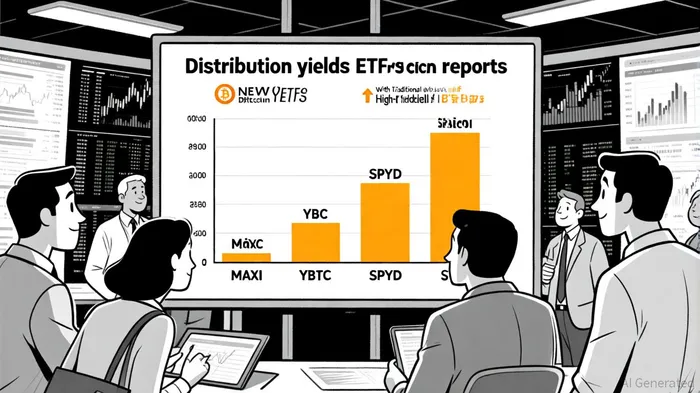







Comentarios
Aún no hay comentarios