
Bitcoin's Strategic Role in Retirement Portfolios: A 5% Allocation in Early Market Recovery
In the evolving landscape of retirement planning, BitcoinBTC-- has emerged as a contentious yet increasingly strategic asset. Veteran trader Peter Brandt, known for his macroeconomic insights, has recently signaled a 5% allocation to Bitcoin within a diversified retirement portfolio, emphasizing its role as a long-term hedge and growth catalyst during early market recovery phases. This approach aligns with broader institutional and academic research suggesting that Bitcoin's unique risk-return profile can enhance portfolio resilience while mitigating exposure to traditional market cycles, as shown in a Forbes analysis.
The Rationale for a 5% Allocation
Brandt's 5% allocation is rooted in a balanced strategy that combines growth, income, and capital preservation. By allocating a modest portion of his portfolio to Bitcoin, he leverages its potential for outsized returns while offsetting volatility with income-generating assets like dividend-paying stocks and precious metals, a point Brandt outlined in his Coinotag piece. This approach mirrors findings from the Forbes analysis, which demonstrated that a 5% Bitcoin allocation in a 60/40 equities-bonds portfolio could boost annualized returns by 4–5 percentage points with only a 1 percentage point increase in volatility. The Sharpe ratio-a measure of risk-adjusted returns-improved significantly over 5- and 10-year horizons, underscoring Bitcoin's efficiency in enhancing portfolio utility.
Brandt's methodology also reflects a shift toward behavioral risk management. By reducing trading frequency from daily to weekly positions, he minimizes emotional decision-making and execution errors, a critical consideration for retirees prioritizing capital preservation. This disciplined approach aligns with Bitcoin's historical performance during early recovery phases, where its volatility often subsides as institutional adoption and regulatory clarity take hold, according to a Bitcoinist study.
Bitcoin's Historical Performance in Early Recovery
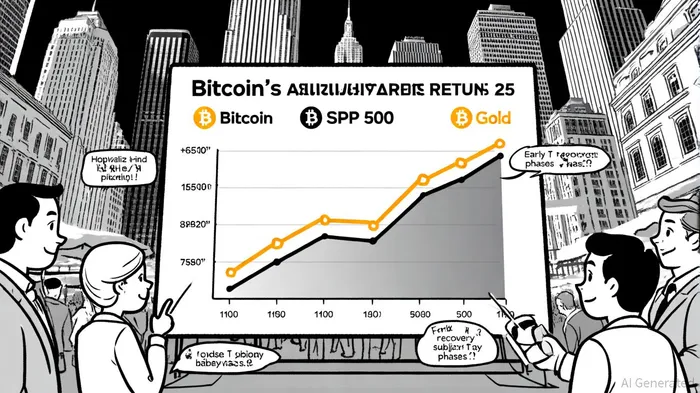
Bitcoin's track record during early market recoveries reveals a pattern of sharp corrections followed by robust rebounds. For instance, the 2015–2017 recovery saw a 12,804% rally from a post-bubble low, while the 2020–2021 phase delivered a 704% surge from pandemic-driven troughs. These rebounds were amplified by macroeconomic tailwinds, including zero-interest-rate policies and unprecedented fiscal stimulus.
Recent data from 2023–2025 further validates Bitcoin's role as a recovery asset. The launch of spot Bitcoin ETFs in early 2024 and regulatory milestones like the U.S. CLARITY Act in 2025 catalyzed a 30% year-to-date gain, pushing prices toward $95,000, according to InvestingHaven. During this period, Bitcoin's correlation with the S&P 500 fluctuated between 0.2 and 0.5, indicating a moderate but not perfect alignment with traditional risk assets, as highlighted by an Editverse analysis. This dynamic allows Bitcoin to act as both a diversifier and a complementary growth engine in multi-asset portfolios.
Diversification and Risk Mitigation
Bitcoin's low correlation with traditional assets is a cornerstone of its strategic value. Studies show a 3-year correlation of 0.32 with the S&P 500, 0.15 with gold, and -0.08 with bonds, according to the Forbes analysis. This decoupling is particularly valuable during periods of market stress, as seen during the 2020 pandemic, when Bitcoin's correlation with equities spiked to 0.5 but remained uncorrelated with safe-haven assets like the U.S. dollar, as noted in the Editverse analysis.
However, Bitcoin's volatility necessitates careful allocation. Fidelity and BlackRock both caution that its speculative nature requires a structured approach, with allocations calibrated to an investor's risk tolerance, a point reiterated in the Forbes analysis. A 5% allocation strikes a balance between capturing upside potential and avoiding overexposure to short-term swings. For retirees, this aligns with Brandt's emphasis on pairing Bitcoin with stable income streams and inflation hedges like gold and dividend stocks, as described in the Coinotag piece.
Scenarios and Strategic Flexibility
Brandt's bullish price forecasts for 2025-ranging from $76,000 to $200,000-highlight the importance of scenario planning. A head-and-shoulders pattern could trigger a bearish outcome, while a breakout from a 15-month trading channel might propel prices toward $200,000, scenarios Brandt discussed in his commentary. These scenarios underscore the need for a diversified strategy that remains resilient across market conditions.
For retirees, this means avoiding dogmatism and maintaining flexibility. A 5% Bitcoin allocation allows for participation in potential rallies without compromising the stability of income-generating assets. As BlackRock's research suggests, even a modest allocation can significantly enhance portfolio utility, particularly for long-term investors seeking to hedge against fiat devaluation and macroeconomic shocks, as summarized in the Bitcoinist study.
Conclusion
Bitcoin's role in a retirement portfolio is not a binary decision but a nuanced strategy requiring careful calibration. Peter Brandt's 5% allocation model, supported by historical performance data and institutional insights, offers a compelling framework for balancing growth, income, and capital preservation. As regulatory clarity and institutional adoption continue to evolve, Bitcoin's strategic value is likely to strengthen, making it an increasingly viable component of forward-thinking retirement planning.






Comentarios
Aún no hay comentarios