
Bitcoin's Strategic Reassessment Amid Macro Volatility and Altcoin Weakness
In Q4 2025, BitcoinBTC-- (BTC) faces a pivotal juncture as macroeconomic volatility and altcoin underperformance reshape investor positioning. With central banks globally recalibrating monetary policy, the cryptocurrency's downside risks have intensified, prompting a strategic reassessment of its role in diversified portfolios. This analysis examines the interplay of U.S. Federal Reserve (Fed) easing, divergent global central bank actions, and altcoin dynamics to evaluate Bitcoin's positioning ahead of critical policy events.
Fed Easing and Mixed Market Signals
The Fed's three consecutive rate cuts in 2025, reducing the benchmark rate to 3.50–3.75%, have injected liquidity into financial markets. However, Bitcoin's response has been muted, trading near $92,000 despite the dovish shift. This divergence highlights Bitcoin's evolving sensitivity to macroeconomic signals beyond interest rates. For instance, conflicting data-such as stronger-than-expected jobless claims and job openings-has created uncertainty, with markets pricing in a 90% probability of further Fed cuts. Yet, Bitcoin's resilience above key support levels suggests institutional accumulation, though broader risk aversion persists, as evidenced by the CMC's Crypto Fear & Greed Index remaining in "fear" territory.
Global Central Bank Divergence and Liquidity Constraints
Beyond the Fed, divergent monetary policies are amplifying Bitcoin's downside risks. The Bank of Japan (BoJ) is poised to raise rates by 25 basis points in December 2025, marking its first hike since 1995. This tightening, coupled with the Fed's easing, creates a complex liquidity environment. A BoJ rate hike could reduce yen carry-trade flows into dollar-denominated assets like Bitcoin, indirectly pressuring its price. Meanwhile, the European Central Bank (ECB) maintains a neutral stance, holding rates at 2.00% as inflation stabilizes near its 2% target as inflation stabilizes near its 2% target. This global policy divergence-tightening in Japan, easing in the U.S., and cautious neutrality in Europe-heightens volatility for risk assets, including Bitcoin.
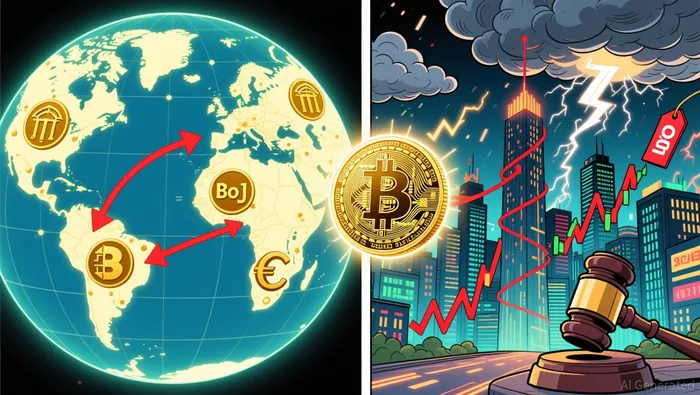
The People's Bank of China (PBOC) further complicates the landscape. While its moderately expansionary policy aims to stimulate domestic demand, its strict crypto ban and crackdown on stablecoins limit direct market influence as its strict crypto ban. However, the PBOC's emphasis on the digital yuan (e-CNY) underscores regulatory risks for Bitcoin, particularly if cross-border capital controls tighten.
Altcoin Weakness and Investor Behavior
Bitcoin's underperformance in Q3 2025, relative to altcoins, signals a shift in investor sentiment. Altcoin segments like smart contract platforms and financials outperformed BTCBTC--, driven by rising stablecoin adoption. However, this "alt season" reversed in Q4 as macroeconomic headwinds-such as the Fed's delayed data releases and hawkish rhetoric-triggered a 30% drawdown in Bitcoin's price. Memecoins, while surging in 2024, failed to displace Bitcoin's dominance, which remained near 58% by late 2024. This volatility underscores the market's sensitivity to macroeconomic narratives over speculative retail-driven trends.
Hedging Strategies and Institutional Adoption
Institutional investors continue to view Bitcoin as a strategic allocation, akin to gold, with JPMorgan projecting a $170,000 price target based on risk-adjusted comparisons. The approval of spot Bitcoin ETFs in the U.S. and other jurisdictions has further normalized its role in portfolios as the approval of spot Bitcoin ETFs. However, downside risks persist from long-term holder selling and miner margin pressures, which added supply pressure in November 2025. Hedging strategies, such as options and futures, are increasingly critical for managing exposure to central bank-driven volatility.
Strategic Positioning for Downside Risk
Investors must navigate a landscape where Bitcoin's performance is increasingly tied to global liquidity conditions and regulatory clarity. Key considerations include:
1. Monitoring Fed Guidance: The Fed's December 10 meeting and forward guidance will determine whether liquidity support extends into 2026.
2. BoJ Policy Shifts: A rate hike by the BoJ could tighten global liquidity by reducing dollar availability.
3. Regulatory Developments: The U.S. SEC's Bitcoin Market Structure Bill, which clarifies oversight for spot ETFs, may stabilize institutional demand.
4. Macro Data Sensitivity: Divergent economic signals-such as jobless claims and inflation data-will continue to influence central bank decisions and, by extension, Bitcoin's trajectory.
Conclusion
Bitcoin's strategic reassessment in Q4 2025 reflects a market grappling with macroeconomic uncertainty and policy divergences. While institutional adoption and gold-like positioning offer long-term optimism, short-term downside risks remain elevated due to central bank actions and altcoin volatility. Investors must balance exposure to Bitcoin's potential as a liquidity hedge with hedging strategies to mitigate risks from tightening cycles and regulatory shifts. As the Fed, BoJ, and ECB navigate their respective policy paths, Bitcoin's price will likely remain a barometer of global macroeconomic sentiment.






Comentarios
Aún no hay comentarios